Oxford's Word of the Year 'RIZZ'
'Charm that attracts the opposite sex' used as noun and verb
Greatly popular online among Gen Z this year
The slang term 'rizz,' which gained sensational popularity among Generation Z in the United States this year, has been selected as the Word of the Year by the Oxford Dictionary.
According to the official Oxford website on the 4th, 'rizz' was chosen as the Word of the Year for 2023.
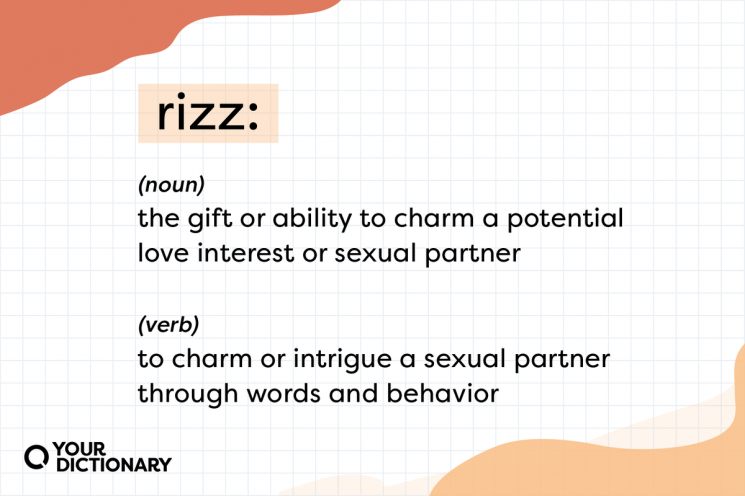 Among young people, the term '리즈,' which gained particular popularity this year, means 'the charm that attracts the opposite sex.' It is closer in meaning to hidden charm rather than simply being handsome or pretty.
 [Photo by yourdictionary]
Among young people, 'rizz' was especially popular this year and means 'the charm that attracts the opposite sex.' It is closer in meaning to a 'hidden charm' rather than simply being handsome or pretty.
For example, if someone says, "That person has rizz," it means they have the power to attract the opposite sex even if they are not necessarily good-looking. It is used as a noun or verb in forms such as "have rizz" (meaning "have a mysterious charm") or "rizz up" (meaning "to seduce"). The origin of rizz is interpreted as taking the middle part of the word charisma.
It mainly refers to the charm directed toward the opposite sex or sexual interest, and there is also an interpretation that it is an abbreviation of 'romantic charisma.' Recently, The Wall Street Journal (WSJ) reported that parents and teachers are having difficulties understanding its meaning.
New Coined Word 'Rizz' Created by Popular Streamer
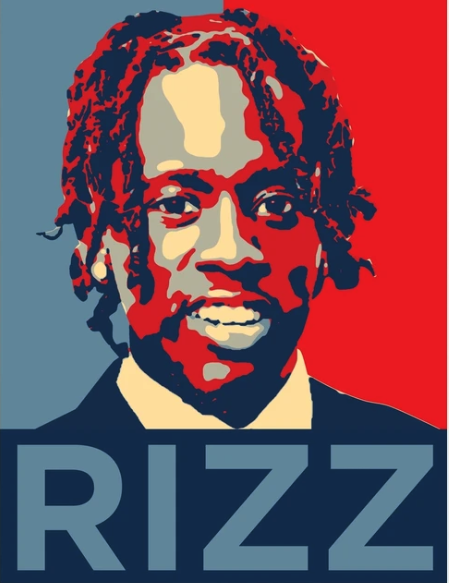 Reese is known to have first used the term in 2021 during a live internet broadcast by Kai Cenat, a popular streamer on the personal internet broadcasting platform 'Twitch'.
 [Photo by REDBUBBLE]
Rizz is known to have been first used in a live internet broadcast in 2021 by Kai Cenat, a popular streamer on the personal internet broadcasting platform Twitch. Cenat, who is 21 years old this year, has over 4 million YouTube subscribers, 5 million Instagram followers, and more than 6.5 million Twitch followers, giving him significant influence among young people.
Rizz specifically spread to the public in June this year when actor Tom Holland explained in an interview how he met his girlfriend, actress Zendaya, saying, "I have no rizz at all. It took a long process before I could meet Zendaya."
The words that competed with rizz in the final round were swiftie, situationship, and prompt.
Swiftie refers to the fan club of Taylor Swift, the world's top pop star. Taylor Swift, considered one of the most influential singers globally, has especially boasted overwhelming popularity this year, even coining the new term 'Taylornomics' to describe her massive influence.
Situationship is a term describing a relationship with the opposite sex that is neither friendship nor romantic partnership, involving emotional and physical exchanges but rejecting the exclusivity and commitment of traditional romantic relationships. Prompt refers to commands input into artificial intelligence (AI) programs or algorithms.
Last Year's Word Had an Opposite Meaning to 'Rizz'
 Various dictionary publishers, including the Oxford English Dictionary in the UK and Webster, select the word of the year.
 [Photo source=Pixabay]
Last year's Word of the Year announced by the Oxford Dictionary was 'goblin mode.'
This is a newly coined term describing an attitude of rejecting social norms or expectations, being shameless, lazy, and acting selfishly. Goblins are mythical creatures from European legends that mainly live in houses and cause harm to humans. Goblin mode was mainly used in a negative sense to describe people who did not want to return to normal life even after the pandemic ended.
However, some interpret it positively as expressing a free and new zeitgeist that rejects social expectations and structured lifestyles.
Casper Grathwohl, president of Oxford Languages, said, "While goblin mode resonated with many people after the pandemic, it is interesting to see a word with a completely opposite meaning like rizz come to the forefront," adding, "It represents the mood of 2023, where more people are opening up and gaining confidence in who they are after difficult years due to the pandemic."
He also added, "It is also proof that words and phrases derived from internet culture are increasingly becoming part of everyday language."
Earlier, the American dictionary publisher Merriam-Webster selected 'authentic,' meaning 'genuine' or 'accurate,' as the Word of the Year for 2023.
This reflects the growing 'crisis of authenticity' amid the proliferation of false information and fake news using deepfakes and other advanced artificial intelligence (AI) technologies.
© The Asia Business Daily(www.asiae.co.kr). All rights reserved.
![Clutching a Stolen Dior Bag, Saying "I Hate Being Poor but Real"... The Grotesque Con of a "Human Knockoff" [Slate]](https://cwcontent.asiae.co.kr/asiaresize/183/2026021902243444107_1771435474.jpg)


















