Prediction Results Revealed at COP28
Most Cities Virtually Submerged
What will happen to today's major cities if global warming continues at the current pace? The 28th United Nations Climate Change Conference of the Parties (COP28) held in Dubai, United Arab Emirates (UAE), has released simulation results that have attracted attention.
At COP28, which has been held in Dubai since the 30th of last month (local time), the nonprofit organization Climate Central announced predictions of sea level changes for 196 cities worldwide.
When carbon emissions are drastically limited from now on to keep the global temperature rise within 1.5 degrees Celsius compared to pre-industrial levels, the appearance of cities does not differ much from the present. However, when the temperature rises to 3 degrees, shocking results show that cities are virtually submerged.
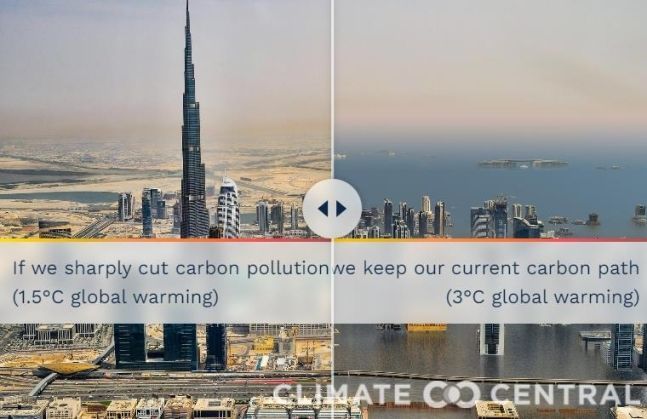 It has been found that the desert city Dubai will also be submerged in water. [Image source=Climate Central]
According to images created by the organization, even the desert city of Dubai was mostly flooded when the global temperature rose by 3 degrees. The lower floors of the world's tallest building, Burj Khalifa, were submerged underwater.
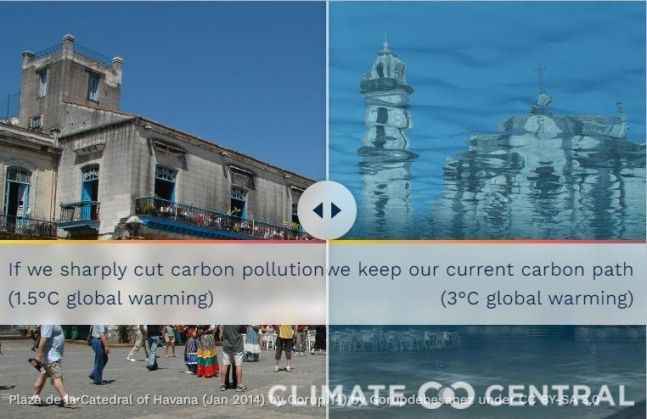
In Fukuoka, Japan, only the roofs of ordinary houses were visible, and the streets of Glasgow, United Kingdom, were filled with water to the extent that roads and sidewalks disappeared. The Cathedral Square in Havana, Cuba, was completely submerged.
Academia estimates that the current global temperature is about 1.2 degrees higher compared to pre-industrial levels. It is expected that the rise will exceed 1.5 degrees in the future. At the current pace, the global temperature could rise by up to 2.9 degrees compared to pre-industrial times.
If global warming accelerates, glaciers will melt and sea levels will rise, threatening the survival of coastal or low-lying cities and small island nations. Climate Central predicts that about 10% of the world's population (800 million people) will lose their homes due to sea level changes.
In particular, Asian countries such as China, India, Vietnam, and Indonesia were identified as the most at-risk nations due to rising sea levels.
Regarding this, Benjamin Strauss, Chief Scientist at Climate Central, emphasized in an interview with CNN, "The decisions made at COP28 will determine the long-term future of cities located along the Earth's coastlines," adding, "The survival of these places and their heritage depends on whether governments and industry leaders can reduce carbon pollution quickly and drastically enough to limit global warming to 1.5 degrees."
© The Asia Business Daily(www.asiae.co.kr). All rights reserved.
![Clutching a Stolen Dior Bag, Saying "I Hate Being Poor but Real"... The Grotesque Con of a "Human Knockoff" [Slate]](https://cwcontent.asiae.co.kr/asiaresize/183/2026021902243444107_1771435474.jpg)

















