"Facing US-Europe Pivot Pressure"
Since last year, central banks around the world have faced the dual challenge of maintaining price stability while preventing unnecessary economic recessions amid steep interest rate hikes to control inflation. Analysts suggest that, like the "fool in the shower (Milton Friedman)" who alternates between hot and cold water, policymakers are caught in a dilemma where they must worry not only about excessive tightening but also about insufficient tightening to avoid policy failure.
On the 3rd (local time), major foreign media reported that central banks in the US, Europe, and other countries are facing pressure to pivot as the pace of inflation slowdown accelerates. Less than two years after controversy over their delayed response to the worst inflation in 40 years, they are once again at the center of debates over monetary policy failure. Ines McPhee, chief economist at Oxford Economics, urged a change in direction, saying, "As inflation eases rapidly, the risk of central banks making (another) policy mistake is increasing."
Among advanced economies, the Eurozone (20 countries using the euro), which entered the tightening cycle relatively late, is at the forefront of this pivot debate. The Eurozone's inflation indicators have fallen below market expectations for three consecutive months. Last month, the Eurozone's Consumer Price Index (CPI) dropped to 2.4%, the lowest since July 2021, approaching the European Central Bank's (ECB) inflation target of 2%. Markets have recently speculated that the ECB might cut interest rates before the US. Economists predict the ECB's first rate cut will occur in the first half of next year. However, the ECB has recently shown no signs of easing its tightening stance, advancing the end date of bond purchases ahead of schedule.
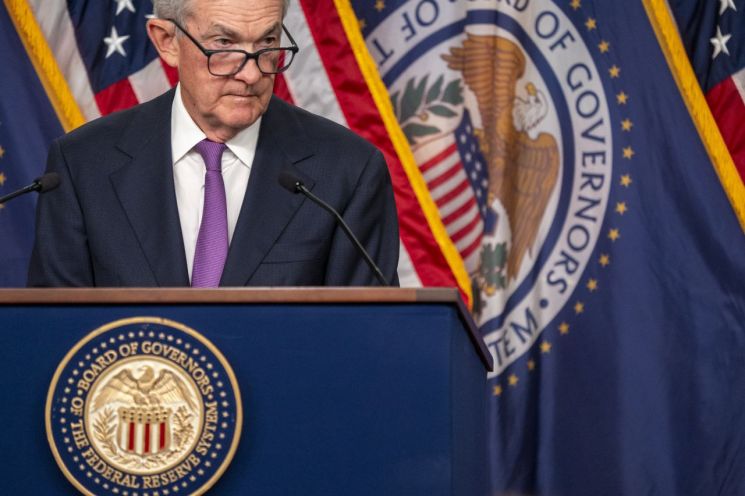
While the US Federal Reserve (Fed) maintains its stance that interest rates should remain steady for an extended period, the market is trying to gauge the timing of a pivot. On the 1st, Fed Chair Jerome Powell reiterated his hawkish stance during a conversation with President Helen Gail at Spelman College in Atlanta, Georgia, stating, "It is too early to predict when rate cuts will occur." Meanwhile, the market remains skeptical of the Fed's monetary policy direction and is betting on a rate hold at 5.50%. The next Federal Open Market Committee (FOMC) regular meeting is scheduled for the 12th-13th.
As central banks face the risk of becoming the "fool in the shower," the clock for a pivot may accelerate. Foreign media point out that prolonged high interest rates are slowing private consumption, and concerns about economic slowdowns in major economies such as China, the US, and Europe are growing, increasing the possibility of a recession next year.
In particular, some heavily indebted countries like Italy could become weak links, potentially deepening the current tightening environment into a global recession. Important elections around the world next year could also be a variable. A British foreign media outlet noted, "With major presidential and general elections scheduled in key countries next year, political pressure will increase to ease the interest burden on citizens suffering from demand slowdown, rising unemployment, and high mortgage payments."
© The Asia Business Daily(www.asiae.co.kr). All rights reserved.
![Clutching a Stolen Dior Bag, Saying "I Hate Being Poor but Real"... The Grotesque Con of a "Human Knockoff" [Slate]](https://cwcontent.asiae.co.kr/asiaresize/183/2026021902243444107_1771435474.jpg)















