This Year's Key Issue: Inflation... Growth Stagnation and Intensified Competition
"Retail Market Expected to Grow Only 1.6% Next Year"
Next Year's Outlook Through Top 10 News in the Distribution Industry This Year
Cost Reduction and Product Enhancement Accelerate... Securing New Revenue Sources Critical
This year, the hottest topic in the distribution industry was undoubtedly inflation. As high inflation continued, the industry faced adverse conditions of stagnant growth and intensified competition, while consumers confronted the burdensome situation of "everything rising except salaries." The Korea Chamber of Commerce and Industry predicted that this trend would continue next year, with the retail distribution market growth rate expected to be only 1.6%. The distribution industry is expected to accelerate cost reduction and product enhancement next year while fighting desperately to secure new revenue sources. On the 4th, Asia Economy summarized this year and selected the top 10 distribution news stories of the year to help anticipate and prepare for next year.
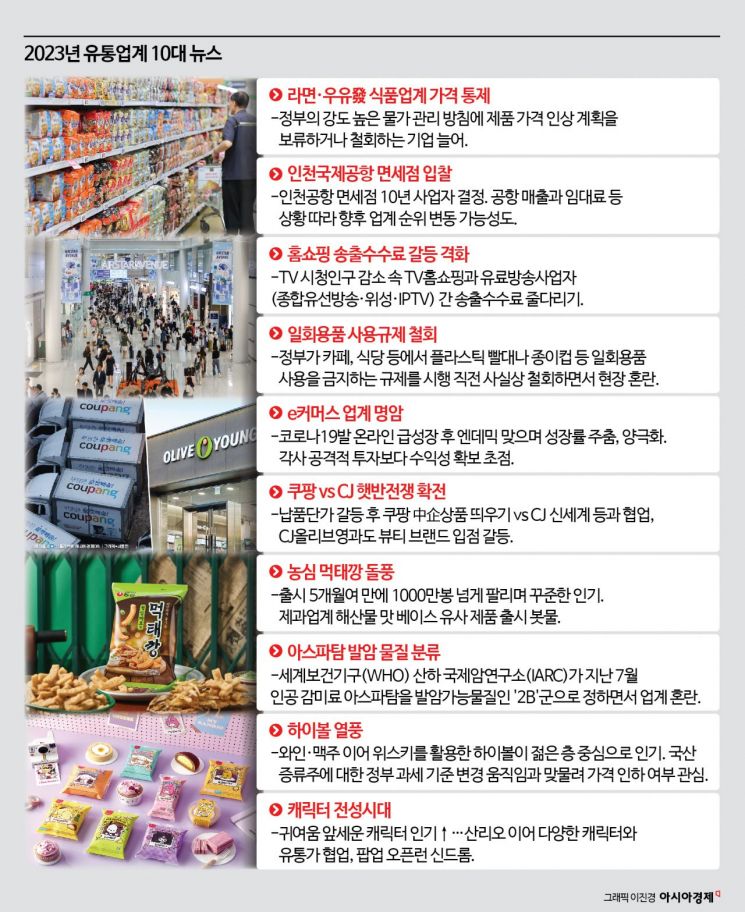
Due to High Inflation... Price Controls in the Food Industry Triggered by Ramen and Milk
The government, aiming to stabilize prices, urged the food industry to refrain from raising product prices, leading manufacturers to repeatedly withdraw or postpone price increase plans since early this year. In June, as the government and consumer groups increased pressure citing a drop in international wheat prices, manufacturers lowered prices or minimized increases for some products such as ramen, milk, bread, and snacks. Since then, until last month, companies like Ottogi considered price hikes but canceled them. Meanwhile, concerns have been raised that controlling only product prices amid significant increases in raw materials and production costs will inevitably increase burdens on both companies and consumers in the future.
Will the 10-Year Landscape Change? Incheon Airport Duty-Free Bidding
In April, the 10-year operator for Incheon International Airport duty-free shops was decided, changing each company's business strategy this year. In April, the domestic duty-free big four (Lotte, Shilla, Shinsegae, and Hyundai Department Store Duty-Free) and the China State-Owned Duty-Free Group competed for the Incheon Airport duty-free business rights. Shilla (DF1·3), Shinsegae (DF2·4), and Hyundai Department Store Duty-Free (DF5) won the final bid, securing a 10-year operating license. Their strategy is to use airport stores, where global luxury brands concentrate, as a base for sales expansion. Lotte, which lost the airport business rights, is intensifying its efforts in downtown duty-free shops and overseas markets. Depending on airport sales and rental fees, future changes in industry rankings are also being mentioned. The cumulative sales of the industry's first and second place, Lotte and Shilla, for the first to third quarters this year were 2.2446 trillion KRW and 2.1617 trillion KRW, respectively.
Declining TV Viewership... Intensified Conflict over Home Shopping Transmission Fees
Negotiations over transmission fees between the TV home shopping industry and pay-TV operators (cable, satellite, IPTV) failed to find a breakthrough, escalating conflicts with mentions of broadcast transmission suspension (blackout). Consequently, last month, the Ministry of Science and ICT's fee verification council was also activated. Transmission fees are costs paid by TV home shopping channels to pay-TV operators for channel allocation. According to the Korea TV Home Shopping Association, transmission fees increased by an average of 8.2% annually over 10 years from 2013 to last year. Despite operating profits of seven TV home shopping corporations decreasing by 19.1% and 10.1% in 2021 and 2022 respectively compared to the previous year, transmission fees rose by 7.9% and 5.5%. With the decline in TV viewership and the worsening outlook for the TV home shopping industry, a tug-of-war over transmission fees is expected to become structural.
Back and Forth... Withdrawal of Single-Use Product Usage Regulations
Since November last year, the government implemented the 'Recycling Act' regulation banning the use of single-use products in food service establishments such as cafes and restaurants. This law, which had been postponed due to COVID-19, was reactivated. However, considering confusion on the ground and difficulties faced by small business owners, a one-year grace period was granted. Later, the policy changed, and on the 7th of last month, paper cups were excluded from the restricted items, and the use period for plastic straws was extended indefinitely. The near-withdrawal of the single-use product usage regulation just before enforcement led to mixed reactions. Civic groups like the Korean Federation for Environmental Movements criticized the Ministry of Environment for abandoning obligations and responsibilities by withdrawing the regulation. On the other hand, the Korea Federation of Small and Medium Business and the Korea Franchise Industry Association welcomed the decision, saying it would alleviate the burdens of small business owners facing increased costs, labor shortages, and conflicts with consumers.
8 Trillion KRW in Sales and Voluntary Retirement... The Bright and Dark Sides of the E-Commerce Industry
Following rapid growth triggered by COVID-19 and the transition to an endemic phase, the e-commerce industry is experiencing mixed fortunes. Some companies like Coupang, which achieved quarterly sales of 8 trillion KRW and returned to profitability, are expanding their presence beyond online to the entire on- and offline distribution market. Meanwhile, the industry as a whole is focusing more on profitability than aggressive investment, with some companies accepting voluntary retirements, reflecting a gloomy atmosphere. According to the Ministry of Trade, Industry and Energy, online market sales surged 18.4% in 2020 compared to the previous year due to COVID-19, then increased by 15.7% in 2021 and 9.5% in 2022, and rose 7.2% in the first half of this year compared to the same period last year. However, growth is recovering in the second half, supported by travel, culture, and leisure sectors. With high inflation and high interest rates expected to continue next year, rational consumption is becoming normalized, and online shopping is expected to gain more weight, but the industry's fortunes are predicted to diverge.
From Hetbahn to Beauty... Coupang vs CJ Escalation
The 'product order suspension incident' between Coupang and CJ CheilJedang, which began at the end of last year due to disagreements over supply prices, has not been resolved and has rather expanded the conflict. CJ CheilJedang strengthened its 'anti-Coupang alliance' after Coupang suspended orders, responding by aggressively marketing with platforms other than Coupang. In June, CJ CheilJedang announced a partnership with Shinsegae Group to jointly plan and pre-launch products with top competitiveness in food and distribution sectors. Coupang responded by targeting CJ CheilJedang, claiming that products from 'monopolistic food companies' disappeared from Coupang, causing a surge in sales of small and medium-sized enterprises' products. Coupang, which has actively entered the beauty market, claimed that CJ Olive Young, a traditional leader in this market, blocked supply and transactions to Coupang from small suppliers and reported CJ Olive Young to the Fair Trade Commission for violating the Large-scale Distribution Business Act. The industry expects the relentless power struggle between distributors and food companies over price-setting rights to continue.
Seafood Flavor + Cheongyang Mayo Trend... Nongshim's Meoktaekkang Sensation
The standout product in the confectionery industry this year was Nongshim's 'Meoktaekkang.' Launched in June by Nongshim, the initial 1 million packs sold out within a week, and as of the 30th of last month, cumulative sales exceeded 10 million packs in just over five months. The sales trend is similar to Nongshim's third most popular snack, 'Honey Twisted Snack.' As Meoktaekkang became scarce in the market due to its popularity, similar products combining seafood-flavored snacks like dried pollack, dried fish, and shrimp with Cheongyang mayo were consecutively released in the distribution sector.
Eat or Not... Aspartame Classified as a Carcinogen
In July, the International Agency for Research on Cancer (IARC), under the World Health Organization (WHO), classified the artificial sweetener aspartame as a 'possible carcinogen (Group 2B),' sparking controversy over its safety in the food industry. Aspartame is about 200 times sweeter than sugar. It is used in many products because a small amount provides sweetness with almost no calories. Amid the spread of the 'zero sugar, zero calorie' trend, this decision increased consumer anxiety, and some food and beverage companies announced plans to exclude aspartame from their manufacturing processes, causing confusion. However, many experts argue that Group 2B means there is insufficient scientific evidence from human or animal studies to confirm cancer causation but that regulation is necessary, so adhering to the acceptable daily intake poses little risk. According to the WHO Joint Expert Committee on Food Additives (JECFA), an adult weighing 60 kg would need to drink nearly 55 cans of 250 ml zero-calorie cola daily to reach the recommended intake limit for aspartame.
From Wine to Whiskey... Highball Craze
In the alcoholic beverage market, a 'highball' craze swept through, where whiskey is mixed with carbonated water or tonic water. During the COVID-19 period, beer and wine were popular for home drinking ('homsul'), but the trend shifted. According to customs export-import trade statistics, whiskey imports such as Scotch and bourbon reached 26,937 tons from January to October this year, a 26.8% increase compared to the same period last year. Last year, whiskey imports also surged 72.6% year-on-year to 27,038 tons, and this year is expected to exceed 30,000 tons for the first time. The government plans to introduce a 'standard sales ratio' system that deducts domestic distribution and sales management costs from manufacturers when calculating taxes to resolve the reverse discrimination where domestic distilled spirits like whiskey and soju bear higher tax burdens than imports. The government has announced draft amendments to the 'Liquor Tax Act Enforcement Decree' and 'Liquor Tax Act Enforcement Rules,' which will undergo interdepartmental consultations and Cabinet meetings for enactment within the year.
Cuteness Opens Wallets... The Era of Characters
Characters emphasizing cuteness gained popularity mainly among the well-spending generation (Gen Z plus Alpha generation), sparking a wave of character collaborations in the distribution sector. Following Pok?mon, Sanrio, featuring representative characters like Cinnamoroll, My Melody, and Kuromi, partnered with food, fashion companies, and convenience stores to launch products. Disney, celebrating its 100th anniversary this year, opened an official Disney Store at Hyundai Department Store and collaborated with various companies. Recently, it has become trendy among the well-spending generation to carry small doll keyrings on bags, leading to some characters experiencing sold-out situations even when money is available. Lotte Department Store's Levi's 501 150th anniversary pop-up store launched in October caused 'open runs' and 'sold-out chaos' through collaboration with the popular keyring brand 'Monamhee.'
© The Asia Business Daily(www.asiae.co.kr). All rights reserved.
![Clutching a Stolen Dior Bag, Saying "I Hate Being Poor but Real"... The Grotesque Con of a "Human Knockoff" [Slate]](https://cwcontent.asiae.co.kr/asiaresize/183/2026021902243444107_1771435474.jpg)
















