[K-Construction, New Challenge] Next-Generation Nuclear Power, SMR Design Initiated
From Solar Power Project Design to Construction and Operation
Accelerating Technology Acquisition for All Stages from Hydrogen Production to Utilization
Hyundai Engineering & Construction is actively moving forward by establishing a business portfolio centered on next-generation energy. The fields are diverse, including the advancement of nuclear power technology accumulated over 50 years, renewable energy using natural resources such as solar and wind, and new energy from waste. These energy projects developed and promoted by Hyundai Engineering & Construction embody two propositions: the future and eco-friendliness.
Next-Generation Nuclear Power ‘SMR’ Ensuring Both Safety and Economic Efficiency
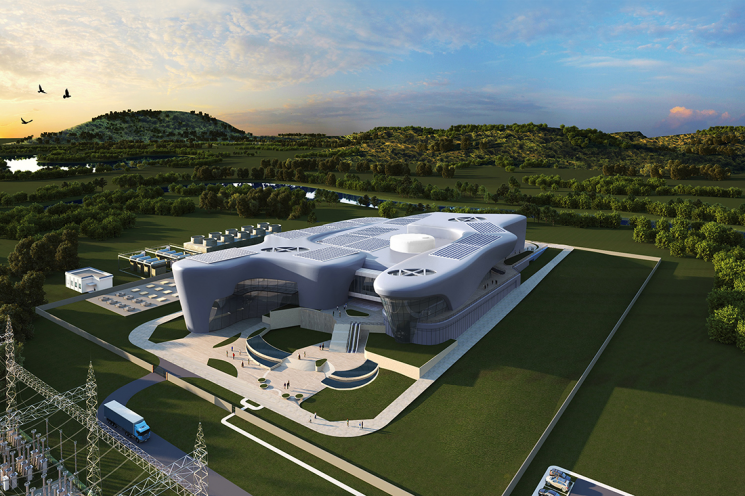 Hyundai Engineering & Construction has become the first domestic construction company to officially begin designing a commercial model of a Small Modular Reactor (SMR), accelerating its nuclear power plant business in the United States. The photo shows a bird's-eye view of the SMR model.
 [Photo by Hyundai Engineering & Construction]
Hyundai Engineering & Construction, which has built the most nuclear power plants (NPPs) in South Korea, is now transitioning to a next-generation nuclear power business roadmap. Having participated as the main contractor in the construction of 22 out of 34 Korean-style large nuclear reactors domestically and internationally over the past 50 years, Hyundai Engineering & Construction set milestones such as ‘the most nuclear power plant constructions in Korea’ and ‘the first overseas nuclear power export.’ Based on the technology and experience accumulated so far, the company is expanding its capabilities across the entire nuclear power value chain, including small modular reactors (SMR), nuclear power plant decommissioning, and spent nuclear fuel storage facilities.
In particular, SMRs are small reactors with an electric output of 300MW or less, characterized by manufacturing the pressurizer, steam generator, and reactor as a single module. The integrated design offers advantages over conventional nuclear power plants in terms of site acquisition, safety, and economic efficiency.
Since 2021, Hyundai Engineering & Construction has signed an exclusive contract with the U.S. nuclear company Holtec International for joint development and business entry into SMRs. It is leading next-generation nuclear power development by initiating the design of the first commercial SMR in the U.S., a first among domestic construction companies.
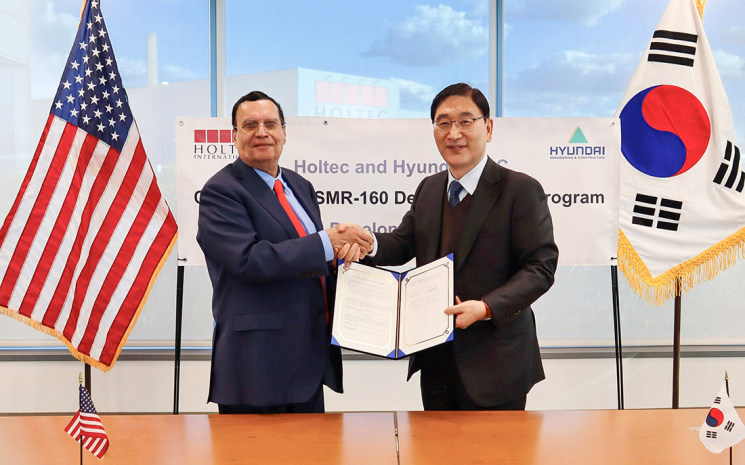 Yoon Young-jun, President of Hyundai Engineering & Construction (right), and Holtec's Dr. Kris Singh are holding a groundbreaking ceremony for the development and commercialization of the SMR-160 first commercial model.
 [Photo by Hyundai Engineering & Construction]
The SMR being developed by Hyundai Engineering & Construction and Holtec is targeting its first construction at the Palisades nuclear power plant site in the U.S. Furthermore, the project is evolving into a model for international nuclear power business by considering joint entry into more than 20 countries, including Europe, starting with the U.S.
Korea’s First and Largest Solar and Offshore Wind Projects
Hyundai Engineering & Construction is also leading the transition to low-carbon, clean energy with the future in mind. The company has led domestic solar power projects. From the 1980s Saesan reclamation project, it secured 1,590 hectares of land, of which 993,480㎡ (approximately 300,000 pyeong) of idle land was used to complete a solar power plant equipped with 65MW capacity power generation facilities and a 130MWh energy storage system.
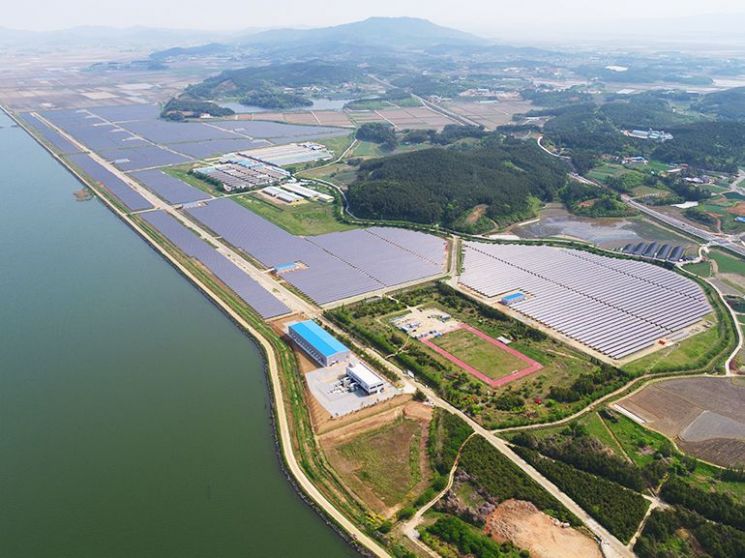
Currently, this power plant generates 65MW of solar power from 185,724 units of 350W solar modules, steps up the voltage to 154kV at the substation within the plant, and transmits it directly to the Korea Electric Power Corporation’s Anmyeon substation. Hyundai Engineering & Construction has demonstrated outstanding technical capabilities by independently managing all processes from design to construction and operation of the Saesan solar power plant project.
Building on this accumulated technology and experience, Hyundai Engineering & Construction is accelerating its global expansion. Recently, it established a public-private partnership with Korea Midland Power, Korea Infrastructure Safety & Technology Corporation (KIND), and jointly developed solar power projects in the U.S. The company plans to strengthen its competitiveness in securing orders for renewable energy projects in the U.S., where solar power accounts for a significant portion.
Hyundai Engineering & Construction has also established a leading position in domestic offshore wind power projects, which generate electricity by rotating large generators using the kinetic energy of sea winds. It was responsible for the construction of the Seonamhae offshore wind power (60MW) complex, the first offshore wind initial demonstration project in Korea, installing a total of 20 offshore wind turbines rated at 3MW each.
Based on this, the company is accelerating the successful completion of the largest domestic project, the Jeju Hallim offshore wind power complex. The power generation capacity per wind turbine (5.56MW) at Jeju Hallim offshore wind power complex is about 1.9 times that of the Seonamhae site (3MW). Hyundai Engineering & Construction is responsible for the entire project from discovery to financing and EPC (engineering, procurement, and construction), and is expected to play a significant role in expanding domestic offshore wind power supply through its exclusive offshore wind installation vessel, the ‘Hyundai Frontier.’
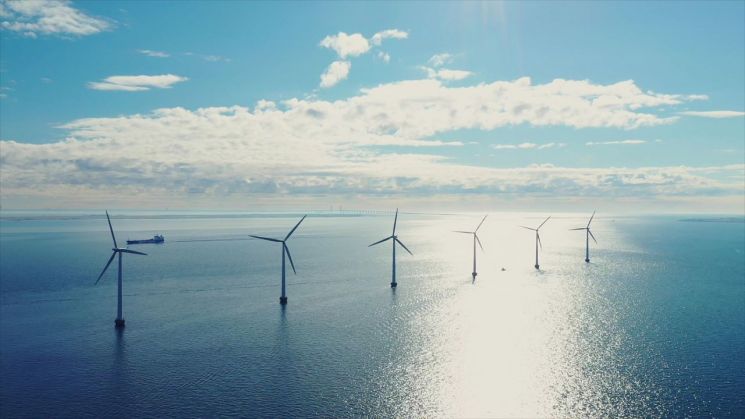 A panoramic view of the Seonamhae offshore wind power demonstration complex. [Photo by Hyundai Engineering & Construction]
New Energy Born from Waste: Biogas
Hyundai Engineering & Construction is also focusing on organic waste resources that are discarded to efficiently utilize limited resources. Biogas is energy generated by microorganisms during the treatment of organic waste such as food waste, livestock manure, and sewage sludge. After removing impurities and carbon dioxide, biogas can produce over 97% biomethane, making it a resource-circulating energy gaining attention.
Since 2008, Hyundai Engineering & Construction has been conducting research and development on biogas, securing core technology, and successfully commercialized it by completing the ‘Chungju Food Waste Bioenergy Center’ in 2016. The ‘Siheung Clean Energy Center,’ which produces biogas by integrating various organic wastes, is scheduled for completion in 2024. In May, the company signed a memorandum of understanding with the Ministry of Environment and Inje County to build an integrated biogas facility.
Targeting the Hydrogen Economy Captivating the World: Hydrogen and Carbon Capture Projects
Hyundai Engineering & Construction views hydrogen as a new opportunity in the future energy and plant market and is accelerating the acquisition of technologies across all stages from hydrogen production to utilization. In particular, it possesses core technologies in water electrolysis-based hydrogen production and hydrogen storage and transportation, and is focusing on securing basic design capabilities related to hydrogen plants.
As a result, last year, it was finally selected for the ‘Water Electrolysis-Based Hydrogen Production Base Construction Project’ in Buan, Jeonbuk, which is the first commercial-scale infrastructure in Korea capable of producing, storing, and transporting more than one ton of hydrogen per day, proving its basic design capabilities.
In this project, Hyundai Engineering & Construction is responsible for key processes from hydrogen production base design to major equipment procurement and construction, laying the foundation as a future global leader in hydrogen plants. Additionally, it actively participates in the entire hydrogen business value chain, from clean hydrogen production to ammonia conversion for transportation and hydrogen power generation, striving to realize its hydrogen vision.
There is also active movement to effectively capture, store, or utilize emitted carbon. Known as ‘CCUS (Carbon Capture Utilization and Storage),’ this technology refers to all technologies that capture emitted carbon dioxide for utilization or storage. Hyundai Engineering & Construction is laying the groundwork for research that stores carbon dioxide through CCUS and transforms it into eco-friendly raw materials.
Since May last year, Hyundai Engineering & Construction has been leading a national project titled ‘Optimization and Demonstration of Hybrid CO2 Capture Liquefaction Process for Blue Hydrogen Production’ with 12 companies and research institutes, including Hyundai Motor Company and Lotte Chemical.
In July, it signed a pre-FEED (preliminary front-end engineering design) contract for CCS (Carbon Capture and Storage) utilizing the Donghae gas field, which will become the largest permanent carbon dioxide storage site in Korea, together with the Korea National Oil Corporation. Starting with this project, which is the first commercial CCS project in Korea, Hyundai Engineering & Construction is fully committed to strengthening global technological competitiveness across the entire CCUS value chain.
© The Asia Business Daily(www.asiae.co.kr). All rights reserved.
![Clutching a Stolen Dior Bag, Saying "I Hate Being Poor but Real"... The Grotesque Con of a "Human Knockoff" [Slate]](https://cwcontent.asiae.co.kr/asiaresize/183/2026021902243444107_1771435474.jpg)

















