Directed 109 Works Including 'Jeo Haneul-edo Seulpeumi'
Kim Soo-yong, a master of Korean cinema in the 1960s, passed away on the 3rd at the age of 94. Director Kim died of old age at 1:50 a.m. that day at Seoul National University Hospital.
He was born in 1929 in Anseong, Gyeonggi Province, and during his school days in 1945, just after liberation, he directed a play about the March 1st Movement. During the Korean War, he served as an interpreter officer, and after the armistice, he was assigned to the Film Department of the Public Information Bureau of the Ministry of National Defense, beginning his connection with the film industry.
His debut work was Gongcheoga (1958). It tells the story of a beef soup restaurant owner who resolves family conflicts ahead of his daughter's marriage. At the time, he was still a soldier and directed this work during weekends.
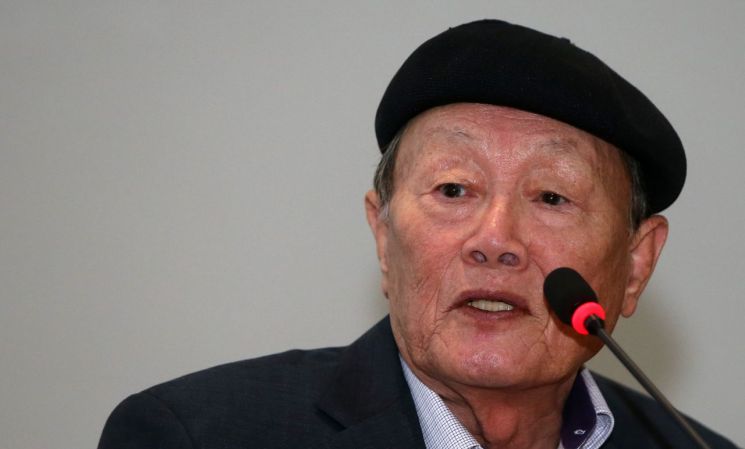 Director Kim Soo-yong attending the commemorative screening for the discovery of the 2014 film 'Sadness in That Sky'.
 [Image source=Yonhap News]
After discharge, he fully entered the film industry and mainly produced comedies such as Byorakbuja (1961), Cheongchun Gyosil (1963), and Nae Awaega Choegoya (1963). He gained attention with works like Gulbi (1963), Hyeolmaek (1963), Gaetmaeul (1965), Angae (1967), Mansun (1967), Toji (1974), Sanbul (1977), Hwaryeohan Oechul (1977), and Manchu (1981).
Jeo Haneul-edo Seulpeumi (1965), considered one of the biggest box office hits of the 1960s, was also exported to countries like Taiwan at the time. The film calmly portrayed the story of a young breadwinner suffering from poverty and featured famous actors of the era such as Shin Young-kyun, Jo Mi-ryeong, and Hwang Jeong-soon.
Director Kim was known for his prolific output. Over 40 years, until Chimhyang in 1999, he released 109 films. In 1967 alone, he presented 10 films. He is also regarded as one of the leaders of the Korean film renaissance in the 1960s alongside directors Shin Sang-ok and Yu Hyun-mok.
His works were noted for their realism, realistically depicting the realities of Korean society. Representative films include Gaetmaeul, Mansun, Sanbul, Sagyukjang-ui Aideul (1967), and Dosi-ro Gan Cheonyeo (1981).
In 2005, he published a memoir titled My Love Cinema, reflecting on his life in film.
The funeral will be held with honors for film professionals. Directors Jeong Ji-young and Lee Jang-ho, as well as actors Ahn Sung-ki and Jang Mi-hee, who can be considered his disciples, will serve as joint funeral committee chairs. The funeral hall is at Seoul National University Hospital, and the funeral procession will take place at 1 p.m. on the 5th.
© The Asia Business Daily(www.asiae.co.kr). All rights reserved.
![Clutching a Stolen Dior Bag, Saying "I Hate Being Poor but Real"... The Grotesque Con of a "Human Knockoff" [Slate]](https://cwcontent.asiae.co.kr/asiaresize/183/2026021902243444107_1771435474.jpg)















