Sharp Decline in Births Starting with 2017-Born Generation Accelerates Low Fertility
NYT: "South Korea's Population Decline Surpasses 14th Century Black Death"
The number of first-grade students entering elementary school next year is expected to fall below 400,000 for the first time in history. This is a direct hit from the accelerating low birthrate each year.
According to the education sector on the 3rd, the distribution of elementary school enrollment notifications and preliminary gatherings for next year will begin this month. The Ministry of the Interior and Safety compiles a list of children of school age based on the resident registration population, and then each local administrative welfare center sends enrollment notifications to the guardians of children expected to enter elementary school by registered mail and in person.
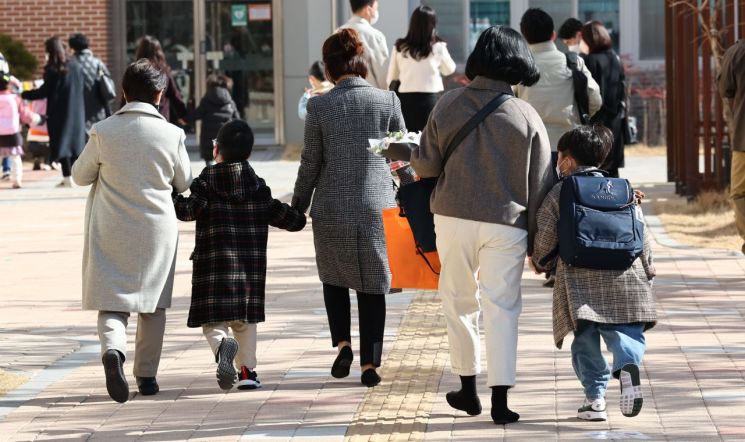
Inside and outside the education sector, the prevailing view is that the number of elementary school entrants next year will not reach the 400,000 mark.
This year, the number of first-grade elementary school students born in 2016 barely exceeded 400,000 at 401,752, but from the 2017-born students entering next year, the birthrate sharply declined, causing a significant drop in the number of births. According to Statistics Korea, the number of births was 406,243 in 2016 but decreased by nearly 50,000 to 357,771 in 2017.
The Ministry of the Interior and Safety has not yet compiled the exact number of children eligible for school enrollment, and the number of first-grade elementary school students does not exactly match the number of births in the enrollment birth year. However, other variables are not expected to have a significant impact. For this year’s first-grade elementary students, the number closely matches the 2016 birth count with a difference of about 5,000. The 2022 first-grade elementary students (431,222) were also at a similar level to the 2015 birth count (438,420).
The problem is that as the low birthrate accelerates further, it is only a matter of time before the number falls below the 300,000 mark. The birthrate, which worsened after 2017, dropped to the zero range in 2018. If this trend continues, the number of births in 2020 will fall to 272,337, dropping below 300,000. This means that the number of elementary school entrants in 2027 will decrease by more than 100,000 compared to now.
The decrease in students inevitably affects the survival of schools. According to the Education Statistics Yearbook by the Korea Educational Development Institute in May this year, one out of every five elementary schools nationwide is a small school with fewer than 60 students. It was also confirmed that there are more than 500 small schools nationwide with fewer than 30 students.
This corresponds to 22.1% of the total 6,163 elementary schools and is a 2.5-fold increase over 20 years from 548 schools in 2002. The proportion of elementary schools with fewer than 60 students also more than doubled from 10.2% in 2002.
The number of ultra-small elementary schools with fewer than 30 students is also on the rise. Last year, there were 512 such schools, accounting for 8.3% of all elementary schools. In 2002, there were 118 schools, so this represents a 4.3-fold increase over 20 years.
In neighboring China, private kindergartens are reportedly facing financial crises due to the "lowest birthrate since the founding of the country." Beijing-based education service company Sun Glory Education Research Institute predicted last year that "by 2030, 30 to 50% of kindergartens operating in 2020 will close." Similarly, elementary, middle, and high schools as well as universities are expected to be affected.
On the 2nd (local time), The New York Times (NYT) published a column titled "Is Korea Disappearing?" highlighting Korea’s low birthrate issue as a prominent case study of population decline problems faced by developed countries. The column introduced Korea’s third-quarter birthrate statistics recently released and explained that "this population decline surpasses the population decrease caused by the Black Death in Europe in the 14th century."
© The Asia Business Daily(www.asiae.co.kr). All rights reserved.


















