Last Year Frozen Ready Meal Market 225.2 Billion Won... 64% Increase YoY
Quality Improvement Through Rapid Freezing Technology... Perception Shift
Global Frozen Food Market Expected to Reach 136.2 Billion USD by 2027
The frozen food market is rapidly growing as demand for convenience foods increases and various premium frozen foods are launched with the development of rapid freezing and thawing technologies.
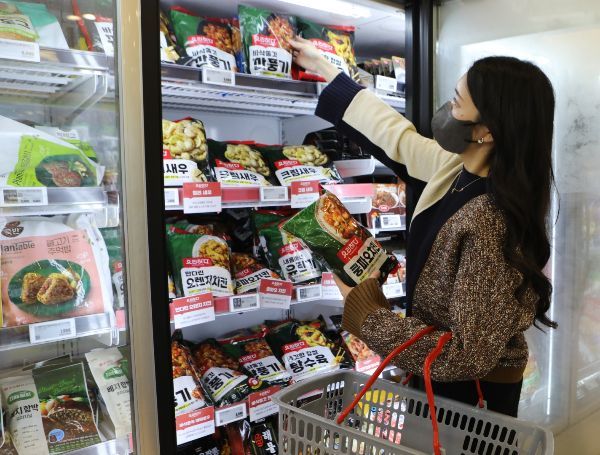
According to Statistics Korea and the Korea Agro-Fisheries & Food Trade Corporation on the 5th, the domestic frozen food production scale was 3.0449 trillion won in 2021, showing a 5.2% increase compared to the previous year (2.8951 trillion won). The growth of the domestic frozen food market is led by frozen convenience foods.
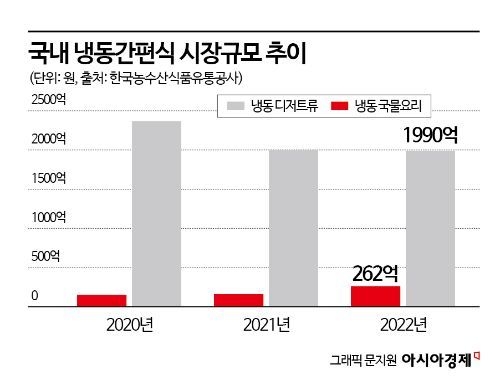
Last year, the frozen convenience food market size was 225.2 billion won, up 4.4% from a year earlier. The frozen convenience food market is classified into desserts and soup dishes, among which the frozen soup dishes segment is growing particularly rapidly. Last year, the frozen soup dishes market was 26.2 billion won, a 63.5% increase compared to the previous year. Although it is far smaller than the frozen dessert segment (199 billion won) in scale, the frozen dessert segment has been declining by an average of 8.3% annually since 2020, while frozen soup dishes have grown by 11.6% during the same period, rapidly expanding their size.
Specifically, last year, the frozen soup dishes market was composed of frozen jjigae (Korean stew) at 57.5% (15 billion won), frozen tang (Korean hot pot) at 39.5% (10.4 billion won), and frozen guk (Korean soup) at 3.0% (800 million won). By manufacturer, Daesang held 25.9%, Fresh Easy 11.8%, CJ CheilJedang 6.2%, and Pulmuone Foods 3.8% market shares.
Frozen soup dishes apply rapid freezing technology that causes less damage to ingredients, making them tastier and more flavorful than conventional retort soup dishes, which is believed to increase consumer preference. Generally, room-temperature products (retort) are convenient to store and cost-effective, but sterilization processing damages the original ingredients, which is a noted drawback. On the other hand, frozen soup dishes require a freezing system for storage and distribution, which is a disadvantage, but with the growth of dawn delivery platforms and expanded volume, cost issues have been resolved through economies of scale, sustaining growth.
In terms of scale, the frozen dessert market, which accounts for most of the frozen convenience food market, is divided into side dishes (52.6%) and snacks (40.0%). The side dish (meal) market, including items like tteokgalbi (grilled short rib patties), donkatsu (pork cutlet), and chicken nuggets, was the largest at 104.8 billion won. Snacks such as hot dogs and hotteok (sweet pancakes) accounted for 79.7 billion won, frozen cakes 4.6 billion won, and frozen desserts and cookies 2.1 billion won. By manufacturer, CJ CheilJedang led with 29.4%, followed by Ottogi with 23.7%, and Pulmuone Foods with 18.6%.
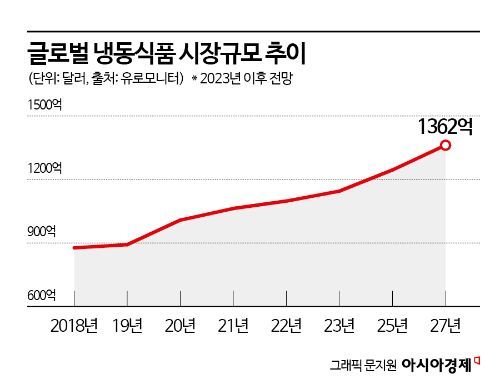
Meanwhile, according to market research firm Euromonitor, the global frozen food market size was 109.8 billion USD (approximately 143 trillion won) last year, a 25.5% increase from 87.6 billion USD in 2018. The global frozen food market is expected to continue growing, reaching 136.2 billion USD (approximately 177 trillion won) by 2027.
The improvement in frozen food quality has had the greatest impact on the global growth of the frozen food market. In the past, frozen foods were mostly perceived as simple meals that lacked quality, taste, and nutritional value. However, during the COVID-19 pandemic and beyond, the development of rapid freezing and thawing technologies has led to an increase in premium frozen foods with taste and nutrition comparable to regular meals, changing the perception to foods that are nutritious and convenient to eat.
Additionally, the popularization of air fryers has influenced the rapid growth of the frozen food market. Air fryers, which are convenient for cooking, are recognized as cooking appliances with lower power consumption than conventional cooking devices, leading to increased usage. According to market research firm Global Information, as of last year, the penetration rates of air fryers in households were 36% in the United States and 30% in the United Kingdom.
© The Asia Business Daily(www.asiae.co.kr). All rights reserved.
![Clutching a Stolen Dior Bag, Saying "I Hate Being Poor but Real"... The Grotesque Con of a "Human Knockoff" [Slate]](https://cwcontent.asiae.co.kr/asiaresize/183/2026021902243444107_1771435474.jpg)


















