Temporary Cabinet Meeting Approves Reconsideration Requests for Nobong Act and Broadcasting Three Laws
Determined to Uphold 'Principles' and Overcome Despite Expo Defeat Aftermath
Presidential Office "Regretful as It Violates Constitution... Government Will Maintain Its Stance"
Prime Minister Han "Regrettable Passage Without Discussion... Causes Massive National Economic Difficulties"
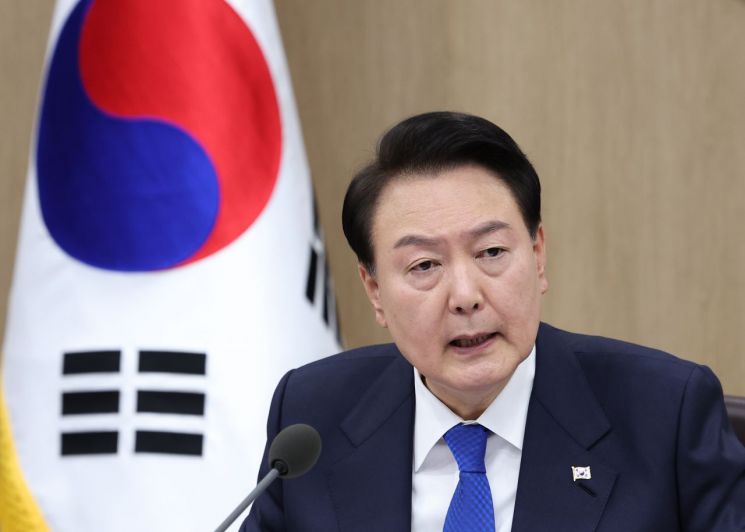
President Yoon Suk-yeol exercised his veto power on the 'Yellow Envelope Act (Amendment to the Labor Union and Labor Relations Adjustment Act)' and the 'Broadcasting Three Acts (Amendments to the Broadcasting Act, the Korea Broadcasting Culture Promotion Agency Act, and the Korea Educational Broadcasting System Act)' on the 1st. Even after canceling official internal and external schedules for two days due to the fallout from the failed bid for the Busan World Expo, he demonstrated his determination to uphold principles for the sake of public livelihood. The Presidential Office views these bills as 'job deprivation laws' and 'laws blocking fair media.'
On the same day, President Yoon gave final approval to the veto requests on the Yellow Envelope Act and the Broadcasting Three Acts, which were resolved at an extraordinary Cabinet meeting presided over by Prime Minister Han Duck-soo at the Government Complex Seoul. This marks the third use of veto power following the Grain Management Act and the Nursing Act. A senior official from the Presidential Office stated, "These are effectively job deprivation laws and laws blocking fair media, and the government will uphold its principles."
The Presidential Office had been reserved about the possibility of the president exercising veto power on these bills. This was due to concerns that repeated vetoes could reinforce an image of poor communication and that opposition backlash might affect personnel hearings related to the cabinet reshuffle starting next week.
However, the principle of upholding the judgment that "the negative social impact is considerable and the bills violate the Constitution" and that "the bills were passed in the National Assembly without bipartisan agreement" was maintained. On the same day, Prime Minister Han also expressed regret and concern over the bills, stating, "It is very regrettable and unfortunate that these bills were passed in the National Assembly without sufficient discussion. We are concerned that they will cause significant inconvenience to the public and severe difficulties for the national economy," explaining the background for recommending the president exercise veto power.
In particular, regarding the Yellow Envelope Act, he pointed out that "it forcibly expands the parties to negotiations and the targets of strikes and creates exceptions to the principle of civil damages, which not only severely undermines healthy labor-management relations but also causes conflict and confusion in industrial sites." Regarding the Broadcasting Three Acts, he expressed concern that "although the purpose of the amendments is to guarantee the independence and political neutrality of public broadcasting, the content may actually lead to the opposite result."
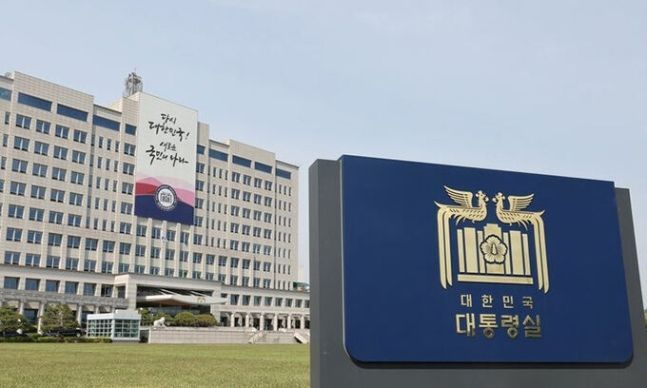
In political circles, it is seen that despite the lingering fallout from the Expo defeat, President Yoon upheld the principles of his governance philosophy. Starting with the early reorganization of the Presidential Office the day before, and with a cabinet reshuffle planned for next week, it also signifies an intention to overcome the current crisis through personnel changes and reform.
Accordingly, there are expectations that the cabinet reshuffle next week will proceed at a rapid pace. The government ministries currently mentioned as targets for ministerial replacement include the Ministry of Economy and Finance, Ministry of Land, Infrastructure and Transport, Ministry of Justice, Ministry of Patriots and Veterans Affairs, Ministry of Foreign Affairs, Ministry of Science and ICT, Ministry of SMEs and Startups, Ministry of Agriculture, Food and Rural Affairs, and Ministry of Employment and Labor. Choi Sang-mok, the senior secretary for economic affairs at the Presidential Office, has been virtually nominated as the successor to Deputy Prime Minister and Minister of Economy and Finance Choo Kyung-ho, who is a sitting member of the National Assembly. For the successor to Minister of Land, Infrastructure and Transport Won Hee-ryong, Shim Kyo-eon, president of the Korea Research Institute for Human Settlements and leader of the real estate task force during President Yoon’s transition period, is being mentioned. Lee Yong-hoon, president of Ulsan National Institute of Science and Technology, is being considered as a candidate for the successor to Minister of Science and ICT Lee Jong-ho. For the chairman of the Financial Services Commission, Son Byung-doo, chairman of the Korea Exchange, is a strong candidate instead of Kim So-young, vice chairman of the Financial Services Commission. For the successor to Minister of Foreign Affairs Park Jin, candidates include former Foreign Ministry International Security Ambassador Lee Jung-min and Foreign Ministry North Korean Human Rights and International Cooperation Ambassador Lee Shin-hwa.
However, it is clear that exercising veto power amid the suspension of National Assembly discussions on next year’s budget bill could exacerbate conflicts between the ruling and opposition parties. Kim Ki-hyun, leader of the People Power Party, has maintained the position that "the Yellow Envelope Act, which will strangle our economy, and the Broadcasting Three Acts, which turn public broadcasting into the Democratic Party’s in-house broadcast, must be stopped." Meanwhile, Lee Jae-myung, leader of the Democratic Party of Korea, has stated that "there is no justification for the president’s exercise of veto power."
© The Asia Business Daily(www.asiae.co.kr). All rights reserved.


















