Current State of Virtual Asset Crimes as Seen by the Hapsudan Prosecutor
The Vast Majority Are Nonexistent 'Scam Coins'
"Also Applies to Telecom Fraud and Insider Trading"
Judicial Cooperation Reduction System and Manpower Reinforcement Needed
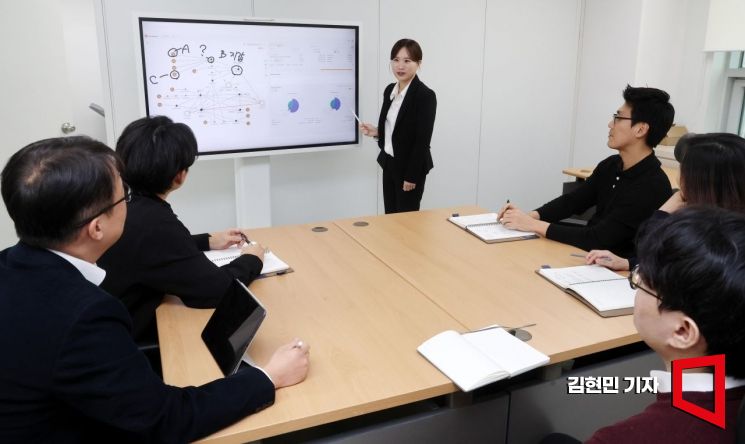
On the afternoon of the 28th of last month, at the Seoul Southern District Prosecutors' Office's Joint Investigation Unit on Virtual Asset Crimes (Joint Investigation Unit) meeting room in Yangcheon-gu, Seoul, Prosecutor Lee Eun-woo (43, Judicial Research and Training Institute class 42) was holding an investigation-related meeting with working-level staff from related organizations such as the Financial Supervisory Service, the Korea Deposit Insurance Corporation, and the Korea Exchange. With a complex flowchart of virtual asset electronic wallets displayed on the electronic whiteboard, Prosecutor Lee and his team were focused on tracking the flow of funds.
 Eunwoo Lee, Prosecutor at the Joint Investigation Unit for Virtual Asset Crimes, Seoul Southern District Prosecutors' Office. Photo by Hyunmin Kim kimhyun81@
The Southern District Prosecutors' Office Joint Investigation Unit, the only dedicated virtual asset investigation organization in Korea, was launched on July 26. Prosecutor Lee volunteered to join the unit. Recently, at a joint academic conference hosted by the Financial Law Association and the Prosecutors' Community, he introduced the U.S. case of punishing virtual asset crimes by applying the 'wire fraud' provision and advocated for its introduction in Korea. We asked Prosecutor Lee about the current state of virtual asset crimes and the legal and institutional solutions.
- What differences have you noticed between investigating virtual asset crimes and traditional securities and financial crimes?
▲The securities and financial markets have primary supervisory agencies like the Financial Supervisory Service, so cases often come after some level of investigation has already been conducted. In contrast, cases handled by the Joint Investigation Unit lack a primary agency, so evidence must be collected and analyzed from start to finish, which takes more time. There is also a manpower issue. Significant IT knowledge is required during investigations. IT-specialized investigators and agents supported by the Supreme Prosecutors' Office and related agencies have been a great help, but it is still insufficient. Even in general criminal cases, coin-related crimes are frequent. There is a growing demand for coin tracking, but manpower cannot keep up.
- What are the representative types of virtual asset crimes in Korea?
▲The so-called 'scam coin' cases, where virtual assets without substance are issued and circulated. Unlike stocks or bonds, virtual assets are difficult to objectively price, and their prices are determined by market supply and demand. Therefore, once listed on an exchange, price manipulation through false disclosures or wash trading is possible. While this is illegal under the Capital Markets Act, there are no direct punishment provisions for virtual assets, so charges such as fraud, obstruction of business, and breach of trust are applied. However, it is challenging to uncover the entire process, including insider collusion, role division, and execution from the issuance preparation stage to delisting.
- You advocated for the domestic introduction of the U.S. 'wire fraud' provision applied to virtual asset crimes. What is wire fraud?
▲Under U.S. federal criminal law, wire fraud occurs when a person attempts to obtain property by fraud and, for that purpose, transmits or causes to be transmitted any writings, signals, or sounds by means of interstate or foreign communication. It is punishable by fines or imprisonment of up to 20 years. U.S. case law holds that wire fraud is established when a person intentionally uses interstate communication networks to participate in fraud. Since virtual assets without securities characteristics cannot be punished under securities fraud provisions in the U.S., the wire fraud provision, which does not limit the scope of punishment, is actively used. In situations where new crimes have not been properly punished and are misrepresented as 'legalization of illegality,' applying wire fraud sends a clear message that if the rights and interests of others are infringed and the elements of the crime are met, punishment is possible.
- Are there types of wire fraud cases in the U.S. similar to crimes in Korea?
▲The 'Centra Tech' case, where investors were recruited under the pretense of developing an impossible virtual asset payment system, matches the typical scam coin cases in Korea. The founder of Centra Tech was sentenced to eight years in prison and three years of probation for this crime. The 'Coinbase' case, where an exchange employee used undisclosed information about the listing of a specific coin to make profits and was punished, is another example. The employee was sentenced to two years in prison.
- Why is the introduction of the wire fraud provision necessary in Korea?
▲The U.S. wire fraud provision has less stringent elements than Korea's fraud statute, allowing broader application. In frauds targeting unspecified many, even if the victim's loss or causal relationship with the disposition is not clearly recognized, punishment can be imposed if it is proven that the perpetrator used communication means with fraudulent intent. In contrast, Korea requires some degree of identification of the victim and deceptive acts, which inevitably requires a larger amount of evidence to prove the charges. Considering responses to frauds targeting unspecified many using phone, internet, and SNS, it is necessary to consider introducing wire fraud provisions.
 Eunwoo Lee, Prosecutor at the Joint Investigation Unit for Virtual Asset Crimes, Seoul Southern District Prosecutors' Office. Photo by Hyunmin Kim kimhyun81@
- Will the virtual asset law, to be implemented in July next year, address the institutional loopholes so far?
▲The virtual asset law contains provisions similar to the Capital Markets Act that prohibit the use of undisclosed important information and price manipulation, and it imposes continuous monitoring and reporting obligations on virtual asset service providers regarding abnormal transactions. However, it is limited to expect private virtual asset service providers to perform market surveillance at the level of public institutions, so ways to strengthen public monitoring and supervision must continue to be discussed. When virtual assets are delisted, white papers or disclosure materials that serve as investment decision bases are sometimes deleted, but if these are disclosed through public sites and arbitrary deletion is prevented, the listing and circulation of virtual assets without substance will be greatly reduced.
- Investigations into virtual asset crimes take a long time. Is there a way to supplement this?
▲There is a need to introduce the 'judicial cooperation reduction system,' recently introduced through amendments to the Capital Markets Act, into the virtual asset law as well. Without cooperation from internal conspirators, investigations and punishments take a lot of time. Tracking coins by requesting warrants every time is slower than tracking based on clear statements. Faster investigations will also lead to quicker recovery of victims' damages.
 Eunwoo Lee, Prosecutor at the Joint Investigation Team for Virtual Asset Crimes, Seoul Southern District Prosecutors' Office. Photo by Hyunmin Kim kimhyun81@
▶ Prosecutor Lee Eun-woo Profile= A member of the 42nd class of the Judicial Research and Training Institute, he served at Seoul Eastern District Prosecutors' Office in 2013, Changwon District Prosecutors' Office Masan Branch in 2015, Busan District Prosecutors' Office Western Branch in 2018, the special investigation team for the late Sergeant Lee Ye-ram's death case in 2022, and the Seoul Southern District Prosecutors' Office Financial Investigation Division 1. He earned a Master of Laws (LLM) degree from Duke University in 2020 and passed the Illinois State Bar Exam the same year. From July 2020 to January 2021, he worked on compliance-related tasks at the World Bank.
© The Asia Business Daily(www.asiae.co.kr). All rights reserved.



















