Next-Generation Core Technology Development Project Also Passes Preliminary Feasibility Study
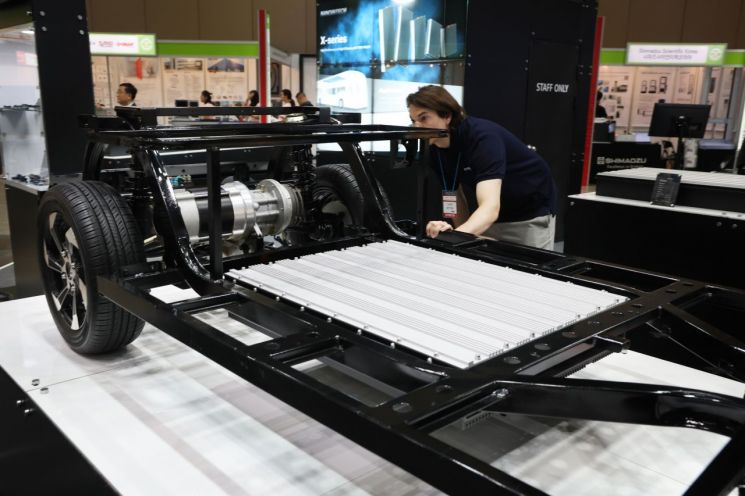 On June 27, 2023, lithium-ion batteries for electric vehicles were exhibited at the 2023 World Battery & Charging Infrastructure Expo held at KINTEX in Goyang-si, Gyeonggi-do. [Image source=Yonhap News]
Next-generation secondary battery development projects worth 110 billion KRW, including all-solid-state, lithium-sulfur, and lithium-metal batteries, have passed the preliminary feasibility study.
On the 29th, the Ministry of Trade, Industry and Energy announced that the "High-performance Next-generation Secondary Battery Technology Development Project for Eco-friendly Mobility" has passed the preliminary feasibility study with a total project cost of 117.23 billion KRW (82.06 billion KRW in national funding).
As commercial secondary batteries are approaching their performance limits and the technology gap between competing countries is gradually narrowing, next-generation secondary battery technology is attracting attention as a future game changer.
Unlike current commercial batteries, whose performance mainly depends on the types and ratios of minerals included in the cathode materials, next-generation batteries have various combinations of cathode materials, anode materials, and electrolytes (such as all-solid-state), and the types of minerals included in cathode and anode materials are also very diverse. Therefore, it is not easy for individual companies to develop all the necessary technologies and secure an appropriate technology portfolio. While individual companies, centered on the three major battery manufacturers, are developing next-generation batteries, there has been a need for technology development through large-scale national projects led by the government.
The project that passed the preliminary feasibility study this time will invest in secondary battery technology development related to next-generation electrolytes (all-solid-state), cathode materials (lithium-sulfur), and anode materials (lithium-metal) over five years from 2024 to 2028.
All-solid-state secondary batteries are called dream batteries because they use solid electrolytes to drastically reduce the possibility of fire. Lithium-sulfur secondary batteries use sulfur in the cathode material, making them lighter than existing secondary batteries, and are expected to be primarily used in urban air mobility where weight is critical. Lithium-metal secondary batteries use lithium metal in the anode material to improve energy density and lifespan, and also feature the advantage of not using graphite, which has insufficient domestic production and processing capacity.
Lee Seung-ryeol, Director of the Industrial Policy Office, said, "This is the first preliminary feasibility study project in the secondary battery field in 13 years, and due to high interest from companies in next-generation batteries, participation is expected not only from cell manufacturers but also from various companies in materials, parts, and equipment." He added, "Taking this project as an opportunity, we plan to discover companies with excellent technology such as startups and actively foster materials, parts, and equipment companies to fully establish a domestic ecosystem related to next-generation secondary batteries."
The Ministry of Trade, Industry and Energy also announced that the "Next-generation Common and Core Root Technology Development Project for New Industry Response" (totaling 113.1 billion KRW, including 84.8 billion KRW in national funding) has passed the preliminary feasibility study. The root industry refers to foundational industries that process materials such as steel into parts and equipment necessary for various industries through technologies like casting and mold making. With this preliminary feasibility study approval, the development of 15 common core root technologies applicable to multiple demand industries will proceed from 2025 to 2030.
© The Asia Business Daily(www.asiae.co.kr). All rights reserved.
![Clutching a Stolen Dior Bag, Saying "I Hate Being Poor but Real"... The Grotesque Con of a "Human Knockoff" [Slate]](https://cwcontent.asiae.co.kr/asiaresize/183/2026021902243444107_1771435474.jpg)















