U.S. investment bank (IB) Goldman Sachs has identified the Korean stock market as a promising investment destination for next year. In particular, it emphasized the need to pay attention to defense stocks, predicting that the South Korean government's short-selling ban will act as a catalyst to boost stock prices.
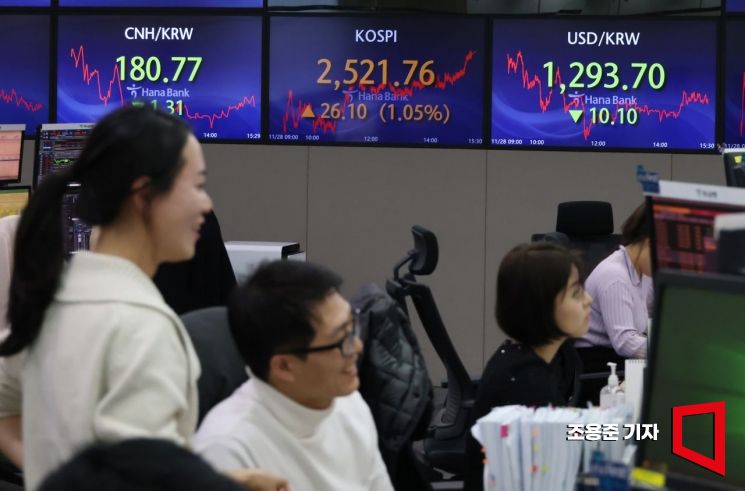 On the 28th, supported by institutional investors' 'buying' momentum, the KOSPI rose more than 1% from the previous session to reach the 2,520 level. Employees are monitoring the stock market and exchange rates in the dealing room of Hana Bank in Myeongdong, Seoul. The KOSPI closing price on this day was recorded at 2,521.76, up 26.10 points (1.05%) from the previous session. Photo by Jo Yongjun jun21@
On the 28th (local time), Goldman Sachs forecasted that although the Korean semiconductor market experienced a profit decline phase this year, it is expected to recover fully starting next year. As a result, the Korean stock market is anticipated to record the highest profit growth rate in the Asia-Pacific region. The Korean stock market had been undervalued and overlooked within the Asia-Pacific region to the extent that it was called the 'Korea discount,' but the situation is expected to reverse from next year. The investment rating was maintained as 'overweight' as before.
The earnings per share (EPS) growth rate of the Korean stock market is expected to be 54% next year and 20% in 2025. The price-to-book ratio (PBR) of the KOSPI was estimated at 0.92. The price-to-earnings ratio (PER) indicates whether a company's stock price is undervalued; a value of 1 or less means the stock price is lower than the book value per share.
In particular, Goldman Sachs named South Korea as one of the world's largest arms suppliers and identified defense stocks as the most attractive sector. Considering South Korea's strong position in the global defense market, defense stocks such as Korea Aerospace Industries (KAI), Hanwha Aerospace, Hyundai Rotem, Hanwha Systems, and LIG Nex1 were described as good investment options that can hedge geopolitical risks.
Goldman Sachs also anticipated that the South Korean financial authorities' decision earlier this month to ban short-selling until June next year could contribute to stock price increases. The KOSPI index has already risen more than 12% so far this year, the highest performance among major Asian stock markets excluding Japan.
Goldman Sachs analyzed, "Historically, after a short-selling ban, the KOSPI index has shown a bullish trend of at least 10% over the following six months."
© The Asia Business Daily(www.asiae.co.kr). All rights reserved.
![Clutching a Stolen Dior Bag, Saying "I Hate Being Poor but Real"... The Grotesque Con of a "Human Knockoff" [Slate]](https://cwcontent.asiae.co.kr/asiaresize/183/2026021902243444107_1771435474.jpg)
















