Cooperation with the Overseas Cultural Heritage Foundation... First Preservation and Restoration Support for Private Art Museums
Samsung Foundation of Culture (Chairman Kim Hwang-sik) announced on the 29th that it will start a support project for the preservation and restoration treatment of Korean cultural heritage located overseas in cooperation with the Overseas Korean Cultural Heritage Foundation. Earlier, in March, the foundation conducted a preservation treatment support project for the relics of independence activist Ahn Jung-geun.
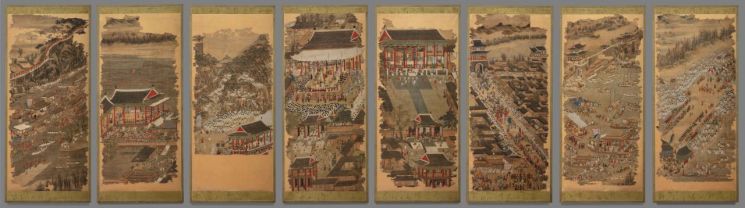
First, the Conservation Research Laboratory of the Leeum Museum of Art will carry out preservation treatment on 'Pyeongan Gamsa Hyangyeondo (平安監司饗宴圖)' owned by the Peabody Essex Museum in the United States for about 16 months starting from November. The artwork for preservation treatment was selected through a public contest held by the Overseas Korean Cultural Heritage Foundation from February to April 2023, targeting institutions worldwide that hold Korean cultural heritage, and finalized through expert review.
'Pyeongan Gamsa Hyangyeondo' is an eight-panel folding screen depicting a banquet hosted by the Pyeongan Governor for those who passed the provincial civil service examination (Dogwa) held in Pyeongan Province. Each panel features a distinct theme, including scenes of the successful candidates crossing the Taedong River and entering Pyongyang, parading along the main street into the city, the Pyeongan Governor meeting the candidates at Seonhwadang, banquets at Bupyeongnu and night banquets at Yeongwangjeong, and boating on the Taedong River.
In addition to the officials and successful candidates, the painting realistically depicts musicians and government courtesans (gwan-gi), the boating scene on the Taedong River with aristocrats and lower officials, and torches lit for nighttime events, showcasing the grandeur and splendor of the banquet held in Pyongyang for the provincial examination passers.
The artwork is an eight-panel pictorial record painted on silk (hwagyeon) with glue and pigments, depicting grand banquet scenes and processions taking place in locations such as the Taedong River, Seonhwadang, Yeongwangjeong, and Bupyeongnu in Pyongyang in a detailed and realistic manner. Each panel measures 128.1×58.0 cm. Although the artist is unknown, the composition, brushwork, and coloring techniques suggest it was painted by a professional artist in the early 19th century.
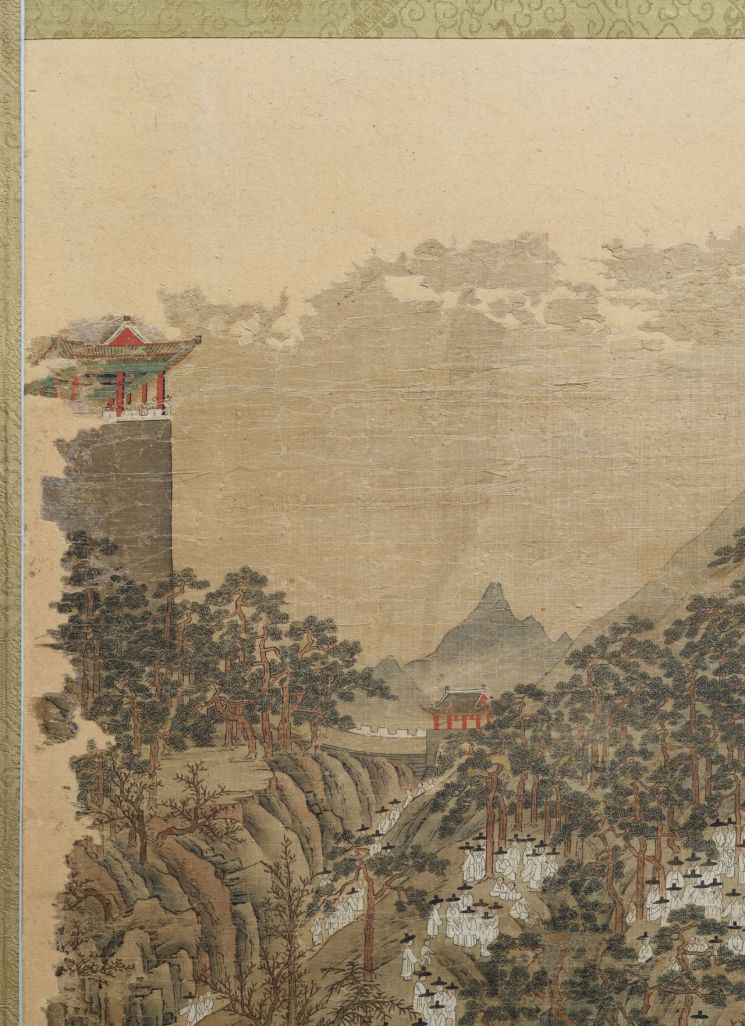
The Leeum Museum of Art explains that 'Pyeongan Gamsa Hyangyeondo' is highly regarded as an excellent work due to its intricate overall depiction and high-quality pigments. A notable feature is the use of gold leaf pigment throughout the painting, making it a masterpiece that demonstrates precise historical accuracy and stable brushwork as a 19th-century Joseon dynasty pictorial record.
'Pyeongan Gamsa Hyangyeondo' is significantly damaged on all sides due to insect damage and other factors, with about one-third of the banquet scene at Bupyeongnu missing. Aging has reduced the flexibility of the silk, causing creases and cracks across the entire painting.
The artwork is presumed to have originally been made as a folding screen. Although its form at the time of acquisition by the Peabody Essex Museum in 1927 is unknown, it is currently separated into eight individual panels.
The Conservation Research Laboratory of the Leeum Museum of Art plans to remove the old and oxidized backing paper attached to the back of the painting and fill the missing parts caused by insect damage or other factors with paper and silk of the same material as the original, applied on both front and back.
The paper and silk used for filling will be reproduced after investigating the materials of the painting, and after filling, colors will be matched to harmonize with the artwork. The Leeum Museum of Art stated that it will investigate similar contemporary works painted in the 19th century and restore the currently separated panels to their original form as a Joseon dynasty folding screen.
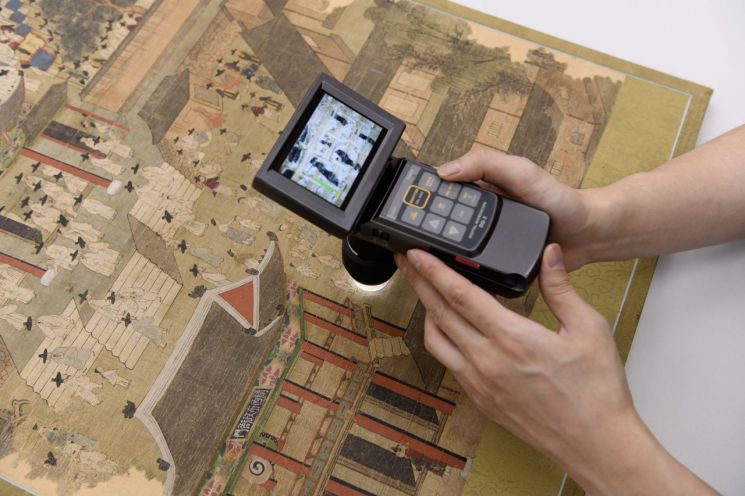 Inspecting the Pyeongyang Gamsa Hyangyeondo through a microscope to check its condition. [Photo by Leeum Museum of Art]
This preservation treatment support is the first case of supporting the preservation and restoration of overseas cultural heritage using the excellent preservation treatment technology possessed by a domestic private art museum. The preservation treatment is scheduled to be completed by March 2025.
Before 'Pyeongan Gamsa Hyangyeondo' returns to its holding institution, Samsung Foundation of Culture plans to hold various programs such as exhibitions and symposiums at the Leeum Museum of Art to provide the public with opportunities to enjoy outstanding Korean cultural heritage overseas that has been difficult to appreciate until now.
Kim Jeong-hee, Chairman of the Overseas Korean Cultural Heritage Foundation, said, “The Leeum Museum of Art is the first private art museum to support preservation technology, which will greatly help Korean cultural heritage overseas maintain its original form and promote its value to many people.”
Lynda Roscoe Hartigan, Director of the Peabody Essex Museum, said, “This project will greatly contribute to the planned opening of the Korea Gallery in 2025. We hope that this beautiful artwork, reborn in the hands of experts who can best preserve Korean cultural heritage, will be loved by many people for a long time.”
Ryu Moon-hyung, CEO of Samsung Foundation of Culture, stated, “Following the preservation treatment support for the relics of independence activist Ahn Jung-geun, we will continue to support the revival of overseas Korean cultural heritage that has not been exhibited due to poor condition through the preservation treatment technology accumulated by the Leeum Museum of Art, thereby widely promoting the excellence of our culture.”
© The Asia Business Daily(www.asiae.co.kr). All rights reserved.



















