Democratic Party's General Assembly Postponed by One Day on 29th... Heated Debate Expected
Lee Jae-myung: "What's the Use of Losing Gracefully" Bipartisan Commentary
Non-Lee Faction: "Must Gain Trust to Win General Election" Rebuttal
The Democratic Party of Korea is experiencing internal conflict between the 'parallel' and 'mixed-member proportional' systems regarding electoral reform. Party leader Lee Jae-myung mentioned reforming to a mixed-member proportional and regional proportional representation system to prevent satellite parties during the last presidential election. However, concerns have arisen that this could reduce the Democratic Party's number of seats, and recently he hinted at a return to the parallel proportional representation system, saying, "What use is it to lose gracefully?" Meanwhile, among lawmakers advocating political innovation, there is a counterargument that "winning the general election requires gaining trust," indicating a difficult path ahead before reaching a conclusion. The lawmakers' meeting scheduled for that day (29th) to hold a thorough discussion on electoral reform was also postponed by one day.
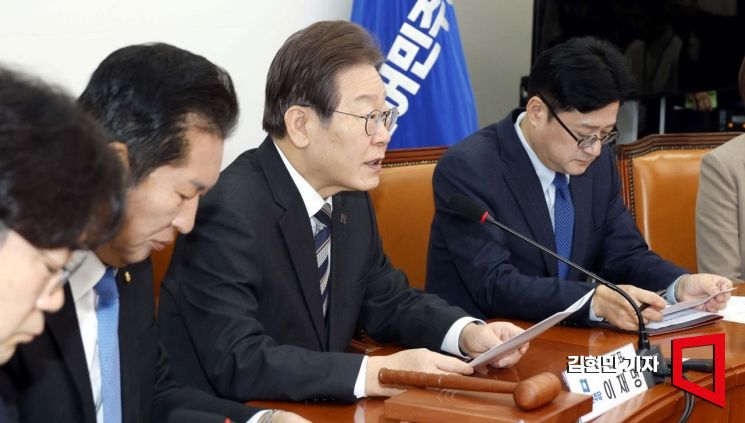 Lee Jae-myung, leader of the Democratic Party of Korea, is speaking at the Supreme Council meeting held at the National Assembly on the 29th. Photo by Hyunmin Kim kimhyun81@
On that day, the Democratic Party announced through a notice that "today's lawmakers' meeting has been postponed to tomorrow (30th)." The meeting was intended to gather lawmakers' opinions on electoral reform for next year's general election. The party stated, "To allow sufficient time for discussion on major issues such as the election law, we will hold a lawmakers' meeting tomorrow (before the plenary session), and after adjournment, reconvene to continue the discussion."
The core issue is the method of allocating proportional representation seats. Previously, the Democratic Party had discussed electoral reform by maintaining the 'mixed-member proportional' system while banning 'satellite parties,' which were criticized as a 'trick' in the last general election. Those advocating for maintaining the mixed-member proportional system argue that since Leader Lee promised political reform in this direction during the last presidential election, it must be implemented to uphold trust with the public.
Lawmaker Kim Jong-min, who has been leading electoral reform efforts, posted on Facebook that day under the title "You must gain trust to win," writing that he opposes Lee Jae-myung-style politics. Quoting Lee's remark, "What use is it to lose gracefully," he criticized, "This means abandoning promises to the people for electoral victory and regressing in electoral reform." Kim emphasized, calling it "penny wise, pound foolish," and said, "You don't win by gaining trust after winning; you win by gaining trust first."
The day before, lawmaker Lee Tan-hee declared he would give up his current constituency (Yongin Jeong) and announced his candidacy in a difficult district, stating, "I will relinquish vested interests first." Lee said, "Over the past four years, we have repeatedly promised the people 'political reform,'" adding, "Defending the mixed-member proportional system and not creating satellite parties is a great decision by the Democratic Party to relinquish vested interests." He warned, "Conversely, if we join hands with the People Power Party and pass the old parallel proportional system, the bipartisan cartel law, denying our identity, our fate in the next general election will be as precarious as a candle in the wind that could be extinguished at any moment."
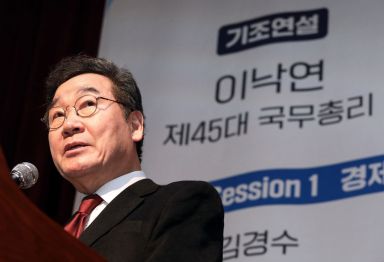
Former Democratic Party leader Lee Nak-yeon also emphasized in a keynote speech at the 'Solidarity and Coexistence' forum held at the Baekbeom Kim Koo Memorial Hall the day before, "We must overcome political polarization caused by large parties," and stressed, "What we must do immediately is to maintain a semi-mixed-member proportional system on the premise of abandoning satellite parties." He criticized the parallel system, which is known to have been agreed upon by the two major parties to monopolize seats, saying it would severely exacerbate the harms of political polarization.
However, Leader Lee Jae-myung has been making remarks suggesting a shift from his previous stance by bringing up 'realism.' In a YouTube live broadcast the previous afternoon, he said, "Elections are a contest, so what use is it to make idealistic claims stylishly?" He added, "If politics functioned normally in society, we could compromise and dialogue considering common sense and the general public sentiment, but realistically, it is almost impossible." He warned, "If we lose the first party status or fail to secure a majority in next year's general election, there will be no way to stop this reckless and regressive trend. Although the National Assembly is somewhat blocking it now, if the ruling party takes over the National Assembly, society will become one where common sense does not prevail."
Some analyses suggest that if the Democratic Party does not create satellite parties and applies the mixed-member proportional system in next year's general election, it could cede the position of the largest party in the National Assembly to the People Power Party. According to a simulation recently shared on social media by Choi Byung-chun, director of the New Growth Economy Research Institute and former deputy director of the Democratic Research Institute, even if the People Power Party and the Democratic Party receive the same number of votes, the number of seats varies significantly depending on the proportional representation method chosen and whether satellite parties are formed. For the Democratic Party, choosing the mixed-member proportional system would result in losing 16.45 seats, while the People Power Party would gain 9.55 seats, Lee Jun-seok's new party 4 seats, the Justice Party 2.3 seats, and Cho Kuk's new party 0.65 seats.
Ultimately, there is an interpretation that the Democratic Party must return to the 'parallel' system or a semi-mixed-member proportional system premised on satellite parties to secure seats. Leader Lee's remarks such as "What use is it to lose stylishly?" and "We cannot ignore the harsh realities" are understood in this context.
Lawmaker Jin Sung-jun appeared on CBS Radio that day and said, "What the leader said during the last presidential election might be the ideal image of our politics," but added, "Since the other party still insists on 'never allowing it' and 'even creating satellite parties,' we cannot avoid considering this reality." When asked by the host if many lawmakers are thinking about returning to the parallel system, he answered, "I think many do."
© The Asia Business Daily(www.asiae.co.kr). All rights reserved.
![Clutching a Stolen Dior Bag, Saying "I Hate Being Poor but Real"... The Grotesque Con of a "Human Knockoff" [Slate]](https://cwcontent.asiae.co.kr/asiaresize/183/2026021902243444107_1771435474.jpg)
















