Ministry of Employment, October Business Labor Force Survey Results
Real Wages Down 1.2% from January to September Due to Sharp Inflation Increase
Nominal wages have failed to keep pace with the consumer price inflation rate through September this year, resulting in a decrease in the real wages received by workers.
According to the October Business Labor Survey results announced by the Ministry of Employment and Labor on the 29th, the cumulative average monthly total wage per worker at businesses with one or more regular employees from January to September was 3,961,000 KRW, an increase of 2.5% (96,000 KRW) compared to the same period last year.
However, the inflation rate during the same period was steeper. The Consumer Price Index stood at 111.18, rising by 3.7%. Accordingly, the real wage, calculated by dividing the nominal wage by the Consumer Price Index and multiplying by 100, was 3,563,000 KRW cumulatively from January to September, a 1.2% decrease (-42,000 KRW) compared to the same period last year (3,605,000 KRW). Real wages represent the actual value of wages considering inflation.
As of the last business day of October, the number of employees at businesses with one or more workers was 19,969,000, an increase of 303,000 (1.5%) compared to the same month last year (19,667,000). Regular employees increased by 210,000 (1.3%), temporary and daily workers by 83,000 (4.2%), and other workers by 9,000 (+0.8%) compared to the same month last year.
The industries with increased employment were health and social welfare services (99,000; 4.5%), professional, scientific, and technical services (43,000; 3.4%), and accommodation and food services (33,000; 2.9%), in that order. Industries with decreased employment were education services (-14,000; -0.9%) and electricity, gas, steam, and air conditioning supply (-1,000; -1.1%). Among all industries, manufacturing, which accounts for the largest share of employees (about 19%), increased by 20,000.
In October, the number of new hires (922,000) exceeded the number of separations (867,000) by 55,000. New hires increased by 15,000 (1.6%) compared to the same month last year, while separations increased by 26,000 (3.1%).
Among new hires, recruitment was 885,000, up 25,000 (2.9%) from the same month last year, while other types of entry (transfers between headquarters and branches, reinstatements) were 36,000, down 11,000 (-22.4%).
Among separations, voluntary separations were 295,000, up 19,000 (6.8%) compared to the same month last year; involuntary separations (due to contract termination, restructuring, mergers, dismissals, etc.) were 527,000, up 18,000 (3.5%); and other separations (transfers between headquarters and branches, retirement, death, sick leave, parental leave, unpaid leave, etc.) were 44,000, down 11,000 (-19.3%).
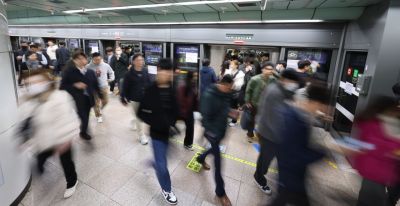 On the 9th, when the Seoul Metro Union operating lines 1 to 8 began a two-day warning strike, the platform of Seoul Subway Line 5 at Gwanghwamun Station was crowded with commuters during the morning rush hour. Photo by Jo Yongjun jun21@
© The Asia Business Daily(www.asiae.co.kr). All rights reserved.
![Clutching a Stolen Dior Bag, Saying "I Hate Being Poor but Real"... The Grotesque Con of a "Human Knockoff" [Slate]](https://cwcontent.asiae.co.kr/asiaresize/183/2026021902243444107_1771435474.jpg)
















