A recent study has shown that probiotics also help alleviate influenza virus infections.
A research team led by Professor Mina Kwon and Dr. Seung-il Kim from the Departments of Convergence Medicine and Microbiology at Ulsan University College of Medicine, Asan Medical Center in Seoul, discovered human-derived probiotics and administered them orally to mice. They confirmed that antiviral substances increased, resulting in enhanced lung immunity.
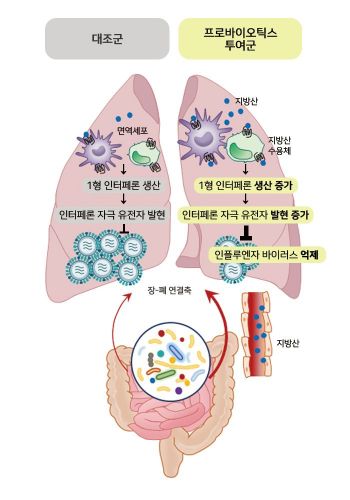
Furthermore, by proving that fatty acids derived from probiotics are effective in alleviating lung damage caused by influenza virus infection, the team also elucidated the "Gut-lung axis" theory, which posits that the gut and lungs interact through gut microbiota.
Although probiotics have been actively marketed as supplements for gut health, there has been little research clarifying the specific mechanisms related to interactions with the lungs. This study is significant in that it precisely revealed the immune regulatory action of fatty acids on the lungs as evidence supporting the efficacy of probiotics.
The research results were recognized for their excellence and published in the recent issue of the SCI-level international journal Microbiome (Impact Factor 15.5).
Respiratory virus infections, including COVID-19 and influenza, are highly contagious and cause global outbreaks, significantly increasing mortality and complication risks in people with underlying diseases and elderly patients. When infected with respiratory viruses, antiviral drugs are administered to alleviate symptoms such as headache, chills, and respiratory issues. Based on this study’s findings, regular intake of probiotics is expected to help mitigate respiratory virus infections.
The research team observed mice infected with the influenza virus, dividing them into groups that were administered probiotics and those that were not. They found that mice consuming probiotics showed alleviated lung damage caused by infection and an increase in type 1 interferon, an antiviral substance.
Type 1 interferon is a cytokine (an immune-regulating substance) produced by the host that helps activate the immune system’s defense when a virus invades the body. Once produced, type 1 interferon binds to interferon receptors and induces the production of various substances, such as interferon-stimulated genes, which have antiviral functions.
Conversely, mice that did not consume probiotics produced relatively fewer antiviral substances and appeared more vulnerable to influenza virus infection. Additionally, mice genetically engineered to lack interferon receptors did not receive the interferon signals activated by probiotics, resulting in reduced antiviral effects.
Further detailed observation of the gut and lungs of mice that consumed probiotics revealed a high production of fatty acids (palmitic acid) derived from probiotics. The team identified that these fatty acids promote the production of antiviral substances in the lungs, thereby elucidating the concept of the gut-lung axis.
Professor Mina Kwon, the principal investigator from the Departments of Convergence Medicine and Microbiology at Ulsan University College of Medicine, Asan Medical Center in Seoul, said, "This study is a foundational research proving that probiotics can contribute to antiviral action by activating the immune system. We hope these findings will aid future research on human defense immune systems using microbiomes such as probiotics and on alleviating viral infections."
This study was conducted with support from the National Research Foundation of Korea under the Mid-career Researcher and Creative Challenge Research Program.
© The Asia Business Daily(www.asiae.co.kr). All rights reserved.
![Clutching a Stolen Dior Bag, Saying "I Hate Being Poor but Real"... The Grotesque Con of a "Human Knockoff" [Slate]](https://cwcontent.asiae.co.kr/asiaresize/183/2026021902243444107_1771435474.jpg)















