Seminar on Development Plans for Used Battery Industry at the National Assembly
"Like the Automobile Management Act, a separate Battery Management Act should be established to fundamentally resolve regulatory issues concerning used batteries."
Jeon Byung-yoon, Executive Director of the Korea Electric Vehicle Industry Association, emphasized the necessity of a Battery Management Act at the seminar on the development plan for the electric vehicle battery industry titled ‘Where Will Used Batteries Go?’ held on the 28th at the National Assembly Members' Office Building, Seminar Room 3.
He stated, "Although exemptions from waste regulations have been made through amendments to the Resource Circulation Act and a safety inspection system for reused batteries has been established by revising the Electrical Appliances Safety Control Act (EASC Act), the Resource Circulation Act is still being operated similarly to subordinate regulations under the Waste Management Act," adding, "It seems there is a forced effort to keep the concept of used batteries confined to waste."
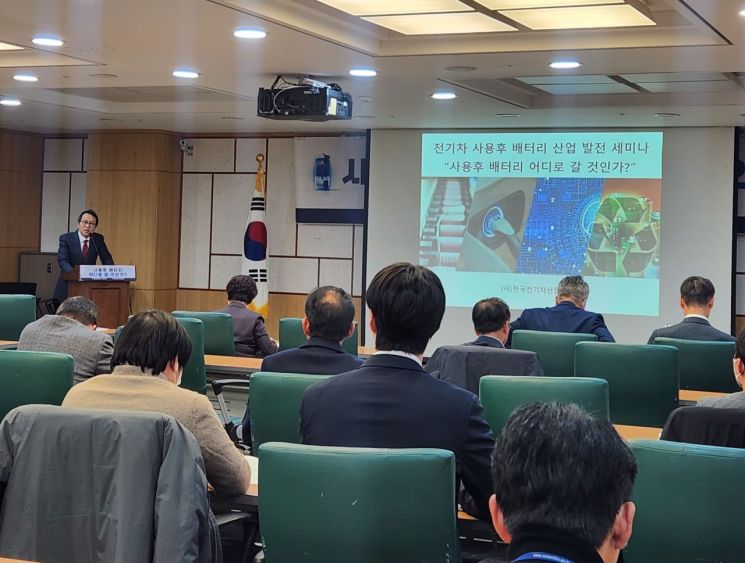 At a seminar held at the National Assembly Members' Office Building on the 28th, Jeon Byung-yoon, Executive Director of the Korea Electric Vehicle Industry Association, is giving a presentation on the topic of 'Used Battery Trading, Distribution, and Challenges.'
 [Photo by Choi Seo-yoon]
The seminar, co-hosted by Kim Jeong-jae, the People Power Party (PPP) floor leader of the National Assembly Land, Infrastructure and Transport Committee, and Kim Seong-won, the PPP floor leader of the Industry, Trade, and Small and Medium Enterprises Committee, was held to discuss how used batteries can be recycled as resources.
Representative Kim pointed out, "It is true that South Korea’s used battery industry is lagging behind competing countries," and added, "It faces difficulties in commercialization due to complex multi-ministerial regulations such as the Waste Management Act, Resource Circulation Act, and Automobile Management Act." He also noted, "Recycling domestic used batteries can secure critical minerals sufficient to produce 170,000 electric vehicles."
Kim Jeong-jae, who introduced the amendment to the Rational Use of Energy Act to promote the reuse of used batteries, said, "Batteries are a gold mine," explaining, "The lifecycle of electric vehicle batteries is 8 to 10 years, and after this period, driving range decreases and charging speed is impaired, making battery replacement essential." He added, "A system must be established to recycle and reuse the flood of used batteries emerging worldwide to recover resources."
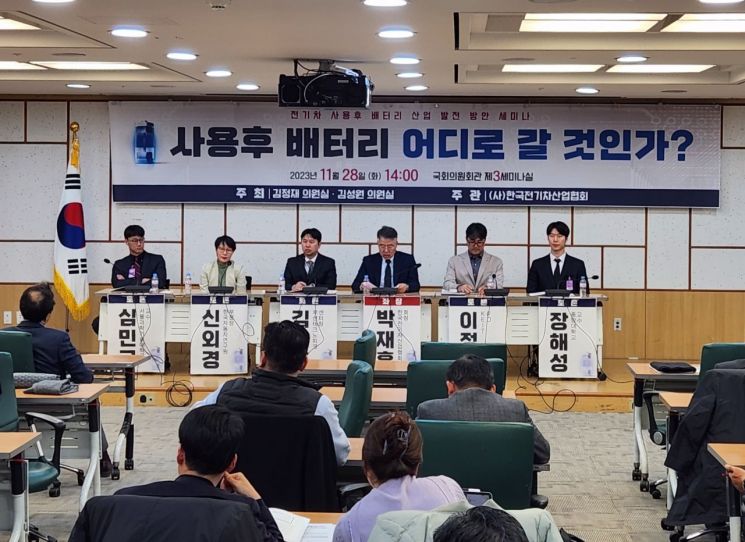 On the 28th, at the National Assembly Members' Office Building, Shin Oegyeong, Head of Division at the Korea Automotive Technology Institute, spoke at the seminar on battery industry development measures titled "Where Will Used Batteries Go?" hosted by Kim Jeongjae and Kim Seongwon, members of the People Power Party.
 [Photo by Choi Seoyoon]
Kim Yong-hyu, Director of the Smart Mobility Technology Center at Busan Technopark, stressed the importance of the Battery Management System (BMS). Director Kim said, "The BMS monitors battery status and ensures optimal operation," and explained, "Used batteries can vary more in condition than new batteries, so effectively managing and coordinating them is very important." He added, "Lithium-ion batteries offer high output and density with good performance but are unstable and pose fire risks," emphasizing, "BMS is crucial to guarantee the safety of lithium-ion batteries."
There were also suggestions to expand the fields of used battery recycling and reuse. Professor Jang Hae-sung of Chung-Ang University stated, "Raw material recovery through wet and dry processes is a traditional recycling method for electric vehicle used batteries, but due to serious drawbacks such as carbon emissions and wastewater generation, it is difficult to consider it an efficient and sustainable method." He emphasized, "Continuous interest and support are needed to shift recycling methods, which are currently limited to raw material recovery, toward energy storage system (ESS) reuse and next-generation recycling technologies."
Lee Jeong-du, Secondary Battery PD at the Korea Institute for Advancement of Technology (KIAT), said, "To respond to situations like China’s graphite export restrictions, we plan to conduct recycling R&D projects related to parts with high overseas dependency such as graphite and electrolytes," adding, "Regulations related to the smooth reuse of used batteries should be simplified, and a distribution system should be established to expand the market."
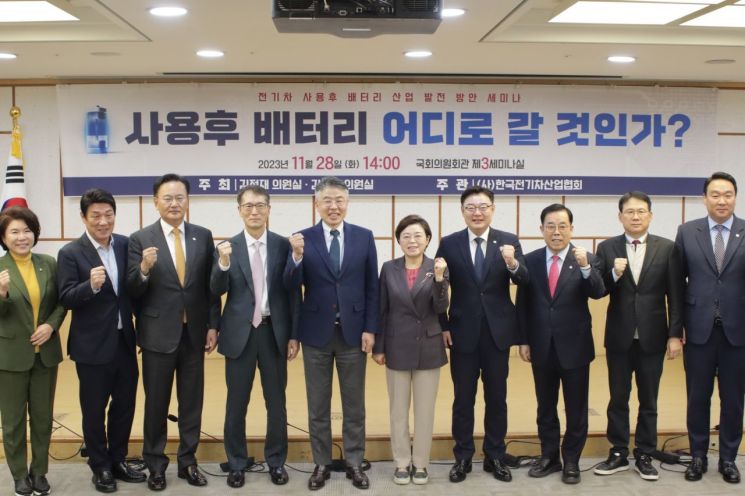 On the 28th, attendees are taking a commemorative photo at the seminar on battery industry development measures titled "Where Will Used Batteries Go?" hosted by People Power Party lawmakers Kim Jeong-jae and Kim Seong-won at the National Assembly Members' Office Building.
 [Photo by Kim Jeong-jae]
© The Asia Business Daily(www.asiae.co.kr). All rights reserved.
![Clutching a Stolen Dior Bag, Saying "I Hate Being Poor but Real"... The Grotesque Con of a "Human Knockoff" [Slate]](https://cwcontent.asiae.co.kr/asiaresize/183/2026021902243444107_1771435474.jpg)

















