Choi Byeongcheon, Head of New Growth Research Institute
Scenarios for Proportional Representative Election Methods Revealed
Ruling and Opposition Parties' Vote Shares Vary by Electoral System
The Democratic Party of Korea is facing turmoil as an analysis suggests that if it does not create a satellite party and applies the mixed-member proportional representation system in next year's general election, it could lose its position as the largest party in the National Assembly.
On the 27th, according to the Democratic Party, Choi Byung-chun, director of the New Growth Economy Research Institute and former deputy director of the Democratic Research Institute, recently released a simulation of next year's general election on social networking services (SNS). The simulation showed that even if the People Power Party and the Democratic Party receive the same number of constituency seats and the same party vote share in the next general election, a significant difference in the number of seats between the two parties could occur depending on whether they create satellite parties.
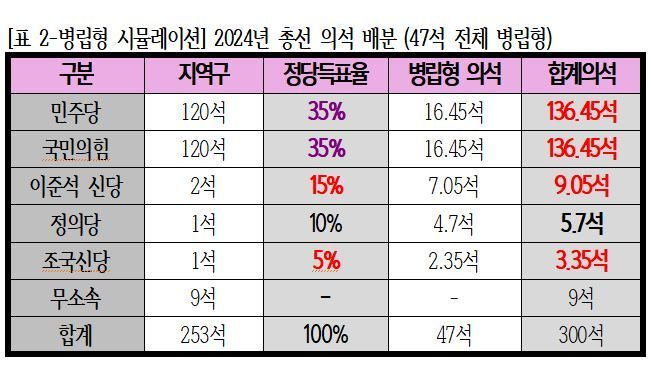
Choi conducted the simulation based on the assumption that both the People Power Party and the Democratic Party win 120 constituency seats each and receive 35% of the party vote share. The simulation also assumed that former People Power Party leader Lee Jun-seok forms a new party that wins 2 constituency seats and 15% of the party vote share, the Justice Party wins 1 constituency seat and 10% of the party vote share, and Cho Kuk's new party wins 1 constituency seat and 5% of the party vote share. Additionally, the simulation included a scenario where 9 independent candidates are elected nationwide.
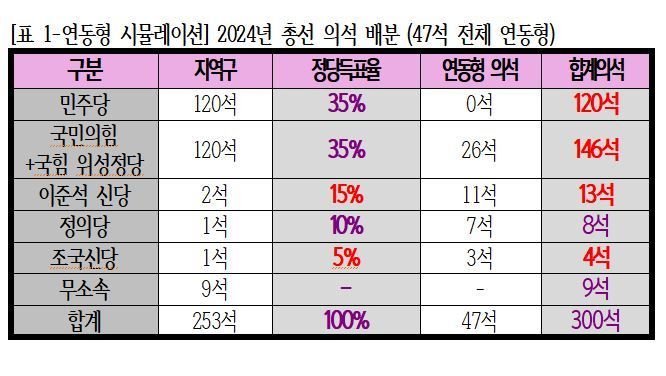
Under the mixed-member proportional representation system, which links constituency seats and proportional seats, the Democratic Party would secure only 120 seats, while the People Power Party would obtain 146 seats. Lee Jun-seok's new party would get 11 seats, the Justice Party 8 seats, Cho Kuk's new party 4 seats, and independents 9 seats. In contrast, under the parallel voting system, both the Democratic Party and the People Power Party would have 136.5 seats each, Lee Jun-seok's new party 9 seats, the Justice Party 5.7 seats, Cho Kuk's new party 3.4 seats, and independents 9 seats.
Even if the People Power Party and the Democratic Party receive the same votes, the number of seats varies drastically depending on the proportional representation system adopted and whether satellite parties are created. For the Democratic Party, adopting the mixed-member system results in a loss of 16.45 seats, while the People Power Party gains 9.55 seats, Lee Jun-seok's new party 4 seats, the Justice Party 2.3 seats, and Cho Kuk's new party 0.65 seats. Choi explained, "The structure is such that the Democratic Party loses seats, which are then divided among the other parties," adding, "If the People Power Party creates a satellite party and the Democratic Party does not, a difference of 26 seats will occur."
Along with Choi's simulation, various other simulation results have circulated, creating a restless atmosphere within the Democratic Party. Some within the party cautiously mention that adopting the parallel voting system may be inevitable.
However, those advocating for the mixed-member proportional representation system are opposing this atmosphere. Democratic Party lawmaker Kim Jong-min, who has been pushing for electoral reform, urged on SNS, "I demand a decision from leader Lee Jae-myung," and called for "legislation to ban satellite parties." Despite opposition from the ruling party, he insists that the ban on satellite parties must be passed to preserve the mixed-member proportional representation system. Kim criticized, "Even considering whether to regress on the electoral system is a deviation from the spirit and path of the Democratic Party," and said, "If our party agrees to the parallel voting system using the People Power Party as an excuse, it is political collusion." Referring to the 'National Unity Political Reform Plan,' which promised the introduction of mixed-member proportional representation during an emergency party meeting in the last presidential election, he warned, "If the Lee Jae-myung leadership breaks those many promises and engages in electoral law collusion, we will do everything possible to join forces with conscientious Democratic Party lawmakers to stop it."
Democratic Party lawmaker Lee Tan-hee, who has consistently advocated for preserving the mixed-member proportional representation system, argued that it is the path to victory in the general election. On MBC Radio that day, Lee said, "What matters is public sentiment," and added, "We must win the hearts of the people to gain public support." He stated, "(Mixed-member proportional representation) is the way to win," and questioned, "Can we fight under the framework of judging the Yoon Seok-youl administration? Can we dispel doubts about what happens if the Democratic Party holds 180 seats alone again?" Lee said, "Creating satellite parties to gain 180 seats alone was our deviation," and argued, "This declaration helps us fight under the single framework of judging the Yoon Seok-youl administration."
Regarding the simulation results, Lee also countered, "If the current system remains, the People Power Party benefits, so why do they oppose it so much?" According to the simulation results, there is no reason for the People Power Party to oppose the mixed-member proportional representation system.
© The Asia Business Daily(www.asiae.co.kr). All rights reserved.
![Clutching a Stolen Dior Bag, Saying "I Hate Being Poor but Real"... The Grotesque Con of a "Human Knockoff" [Slate]](https://cwcontent.asiae.co.kr/asiaresize/183/2026021902243444107_1771435474.jpg)

















