On the 27th, Naju City, Jeollanam-do (Mayor Yoon Byung-tae) announced that it will install and operate dedicated collection bins for "waste pesticides," a major cause of environmental pollution and hazardous household waste, at 20 eup, myeon, and dong administrative welfare centers.
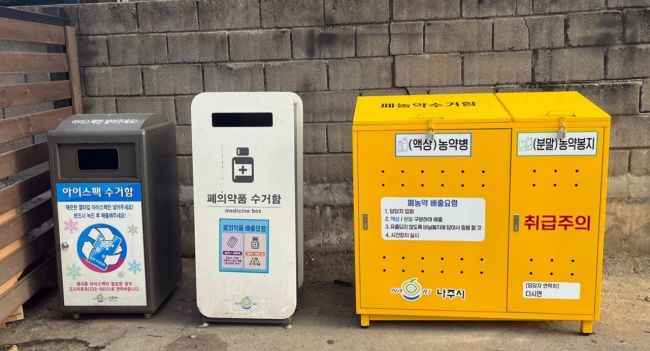 Naju City has installed dedicated collection boxes at 20 Eup, Myeon, and Dong administrative welfare centers for the safe collection and disposal of leftover pesticide waste.
 [Photo by Naju City]
Until now, used pesticide containers were classified as agricultural waste and collected by the Korea Environment Corporation for recycling. However, leftover waste pesticides have been left unattended on farms for extended periods, causing difficulties in disposal as they were discarded in fields, farmlands, and residential areas.
The installed waste pesticide collection bins have separate slots for liquid (bottles) and solid (packets) types, and are designed to allow sealed disposal to prevent leakage of residual pesticides or scattering of powder.
Due to concerns about mismanagement or misuse of waste pesticide containers, disposal must be done in the presence of the eup, myeon, or dong officials, and collection and processing occur every Wednesday.
Mayor Yoon Byung-tae of Naju said, "If leftover waste pesticides are discarded, they cause ecological disruption, environmental damage, and adverse health effects such as acute poisoning to residents. We will do our best to promote household waste policies that create a clean and healthy Naju through resource circulation."
Meanwhile, earlier in July, the city introduced a collection system for "waste pharmaceuticals," hazardous household waste, through a business agreement with Naju Post Office, the Post Office Public Foundation, and the Naju Pharmaceutical Association?the first of its kind in the Gwangju and Jeonnam regions?where delivery workers safely collect waste pharmaceuticals and local governments handle their disposal.
Since August, delivery workers have been collecting waste pharmaceuticals from dedicated bins at mailboxes, pharmacies, public health centers, administrative welfare centers, and apartment management offices, and delivering them to designated locations, processing more than twice the amount of waste pharmaceuticals compared to the previous year.
Naju = Lee Han-hyuk, Honam Reporting Headquarters, Asia Economy baekok@asiae.co.kr
© The Asia Business Daily(www.asiae.co.kr). All rights reserved.
![Clutching a Stolen Dior Bag, Saying "I Hate Being Poor but Real"... The Grotesque Con of a "Human Knockoff" [Slate]](https://cwcontent.asiae.co.kr/asiaresize/183/2026021902243444107_1771435474.jpg)















