Related securities organizations evaluated that computerized short selling to prevent naked short selling is an unprecedented proactive measure, although naked short selling is restricted worldwide but mainly subject to post-detection and sanctions rather than preventive systems.
On the 27th, Korea Exchange, Korea Securities Depository, Korea Securities Finance Corporation, and Korea Financial Investment Association distributed explanatory materials regarding the 'Direction for Short Selling System Improvement' recently discussed at the Civil-Government-Party Council and announced this.
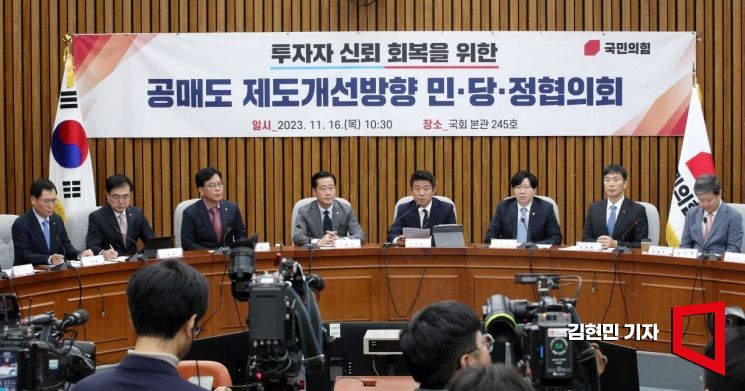 Yu Eui-dong, Chairman of the Policy Committee of the People Power Party, is speaking at the Min-Dang-Jeong Council on Directions for Improving the Short Selling System to Restore Investor Confidence held at the National Assembly on the 16th. Photo by Kim Hyun-min kimhyun81@
The related organizations explained, "This explanatory material was prepared to clarify the discussions among securities-related organizations on some claims raised during the review stage of the short selling system improvement direction and to facilitate richer opinion gathering and public discussion based on this."
Earlier, on the 16th, financial authorities and related organizations prepared a draft for improving the short selling system and discussed it at the Civil-Government-Party Council. Based on this draft, the related organizations plan to broadly collect opinions from individual and institutional investors, domestic and foreign investors, and experts, and if reasonable alternatives are proposed during this process, they will further review and present them to the National Assembly and financial authorities.
Regarding the resolution of the tilted playing field in the short selling system improvement direction, the repayment period for securities lending (daechal) will be limited to 90 days plus extensions, similar to securities borrowing (daeju), and the collateral ratio for daeju will be lowered to 105% or more, aligning with daechal.
The explanatory materials explained the reason for proposing to limit the repayment period of daechal to 90 days plus extensions, similar to daeju, stating that since extensions and reports must be made every 90 days, it is expected that securities lending will be more cautious about long-term lending compared to the current unlimited period. When the 90-day maturity arrives, lenders will evaluate the borrower's credit status, collateral situation, and the pros and cons of extension and repayment followed by selling, so the effect of introducing maturity can be expected.
The materials stated, "Unlike daeju, the obligation for early repayment (recall) is maintained, so in terms of repayment period, daeju is effectively more advantageous," and explained, "Due to the early repayment obligation, it is also difficult to maintain short selling for a long time until the price drops." In securities lending transactions, if the lender requests (recalls), the securities must be repaid immediately, and such recalls actually occur frequently. If stock prices rise, lenders are more likely to request recall to receive the stocks back and sell them. Also, since fees must be paid proportionally to the lending period, it is practically difficult to continue short selling by not repaying the borrowed stocks indefinitely until the stock price falls.
Regarding some opinions advocating banning extensions of securities lending and limiting repayment periods, the related organizations explained that they presented a cautious stance considering ▲ the impact on securities transactions other than short selling ▲ excessive deviation from global standards ▲ concerns that personal investors' securities borrowing services may become less favorable than the current system.
According to the explanatory materials, securities lending is used for various purposes, and the proportion of securities lending for short selling purposes accounts for only 20-25% of the total securities lending transactions. As of the end of October this year, the scale of stock lending was 78 trillion KRW, while the domestic short selling balance was 16 trillion KRW. Limiting the extension of securities lending repayment periods could excessively affect about 62 trillion KRW worth of securities lending unrelated to short selling. For example, if extensions for securities lending for Exchange-Traded Fund (ETF) creation are not possible, smooth ETF trading may not be guaranteed during the process of repayment and re-lending at each repayment period. Also, institutions generally do not separately manage borrowed stocks by borrowing purpose, so requiring separate management of 'stocks lent for short selling purposes' to limit repayment periods could be difficult.
Securities lending transactions are conducted under the Global Master Securities Lending Agreement (GMSLA) with internationally similar conditions. According to the standard contract, there are no restrictions on repayment periods or extensions, but there is an obligation for early repayment. This is the same in major overseas countries such as the United States, Europe, and Japan, with Taiwan being the only country that limits it to a considerably long period of about 18 months. The related organizations stated, "It is necessary to be cautious about introducing regulations that deviate excessively from global standards only in Korea."
Banning extensions of securities lending and limiting repayment periods could also make securities borrowing services for individual investors less favorable than the current system. The securities borrowing volume provided for individual investors' short selling consists of stocks borrowed by Korea Securities Finance Corporation through securities lending and other means. If extensions of securities lending are restricted, it would be difficult for Korea Securities Finance Corporation to borrow stocks to secure securities borrowing resources, making it hard to maintain the current 90 days plus extension for securities borrowing services.
The explanatory materials explained that the reason for proposing to lower the collateral ratio for securities borrowing to 105% or more, aligning with securities lending, is to improve individual investors' access to short selling and to seek a practically acceptable measure for market participants.
Regarding some opinions advocating raising the collateral ratio for securities lending to 120% or more, the current level for securities borrowing, the related organizations explained that it is necessary to consider the impact on securities transactions other than short selling and that there is a cautious stance due to the risk of reverse discrimination where domestic institutional investors could be disadvantaged compared to foreign investors.
The explanatory materials stated, "In particular, the collateral ratio affects not only stock lending but also the bond lending market worth 131 trillion KRW in relation to collateral discount evaluation, etc. Such collateral burdens could increase the cost of various financial services and act as a factor that lowers overall liquidity in securities transactions due to excessive collateral requirements beyond actual needs."
Additionally, according to the explanatory materials, securities lending is a one-to-one transaction, so the collateral ratio is not uniformly set under GMSLA and is generally known to be around 105%. In transactions where the Korea Securities Depository exercises collateral rights, it applies a 105% collateral ratio considering this market practice. The materials explained, "For foreigners, who account for more than 60% of short selling transactions, securities lending is usually conducted offshore, and they manage collateral directly, so even if domestic laws set collateral ratios, it is difficult to apply them. If only the Korea Securities Depository's collateral ratio is raised beyond global market practices, reverse discrimination would occur only against domestic institutions that mainly use the Depository's collateral management."
Regarding computerized short selling to prevent naked short selling, the related organizations proposed that institutional investors build internal systems to manage sellable balances themselves to prevent naked short selling, and all short selling institutional investors, including those exempted from computerized system application, should establish internal control standards to prevent naked short selling. Securities firms would allow short selling orders only after confirming that mandatory institutions have built internal computerized short selling systems. The explanatory materials stated, "The seller can most accurately grasp the sellable balance, so internal computerized balance management by institutional investors is a feasible measure to be prioritized and is expected to have a significant effect in preventing naked short selling." They explained, "By accurately managing trading details, securities lending and short selling status, and lending confirmation and repayment details, it is possible to prevent naked short selling orders without balances in three stages."
Separately, opinions have been continuously raised on the need to establish an external real-time naked short selling blocking system. The related organizations explained that for external real-time naked short selling blocking to be implemented, all investors' balance information must be accumulated in a central system in real time or all related systems must be connected to allow real-time inquiry of balance information, enabling securities firms or exchanges to grasp investors' balances in real time. Also, conditions such as comparing balances and sell order quantities every time a sell order occurs and deciding whether to process the sell order must be met.
The related organizations said, "Although the existing National Assembly's bill subcommittee discussed that establishing a real-time naked short selling blocking system has practical difficulties, the related organizations plan to review this again and facilitate public discussion." They added, "Regarding this, the 'Naked Short Selling Prevention Computerized System Task Force (TF)' held its first meeting on the 23rd, and the related organizations will actively participate in the TF to seek reasonable measures."
© The Asia Business Daily(www.asiae.co.kr). All rights reserved.
![Clutching a Stolen Dior Bag, Saying "I Hate Being Poor but Real"... The Grotesque Con of a "Human Knockoff" [Slate]](https://cwcontent.asiae.co.kr/asiaresize/183/2026021902243444107_1771435474.jpg)















