Naphtha 1.0%, Propane 0.78%, LNG 0.66% Price Reduction Has an Effect
Both the Ministry of Economy and Finance and experts explain that quantitatively analyzing the effect of tariff quotas on lowering inflation is not easy. This is because the variables acting during the distribution process are complex, making it difficult to precisely measure the causal relationship of price changes due to tariff reductions in numerical terms. Nevertheless, considering the scope of use of the items comprehensively, the consensus is that the price-lowering effect of tariff reductions on crude oil and liquefied natural gas (LNG) will be the most extensive. Since the effect is estimated to be large, the scale of tax reduction benefits is also significant, so in situations of fiscal shortage, it can only be chosen selectively and limitedly.
According to the Ministry of Economy and Finance on the 28th, the government reported the ‘2022 Tariff Quota Imposition Performance and Results’ to the National Assembly in May based on an analysis by the Korea Development Institute (KDI). According to the analysis, the items with the greatest producer price reduction effect among raw materials were crude oil (LPG, naphtha) and LNG. Naphtha showed a producer price drop effect of up to 1.0% in the month the tariff was exempted, and propane showed a drop of up to 0.78%. LNG was found to lower producer prices by 0.66% for city gas (household), 0.44% for general use, and 0.40% for industrial use one month after the tariff reduction.
These items are used as raw materials in the production process of other products. Therefore, the tariff reduction effect is expected to have a large ripple effect in lowering inflation. Song Young-gwan, a KDI research fellow, explained, “Especially in the case of LNG, since it is widely used as a raw material in electricity production, if the tariff reduction lowers electricity production costs, it affects the overall cost reduction in the industry.” Considering the special environment where the government has significant influence over prices in the crude oil market, it is possible to assume that the tariff reduction effect will lead to a decrease in the final consumer prices.
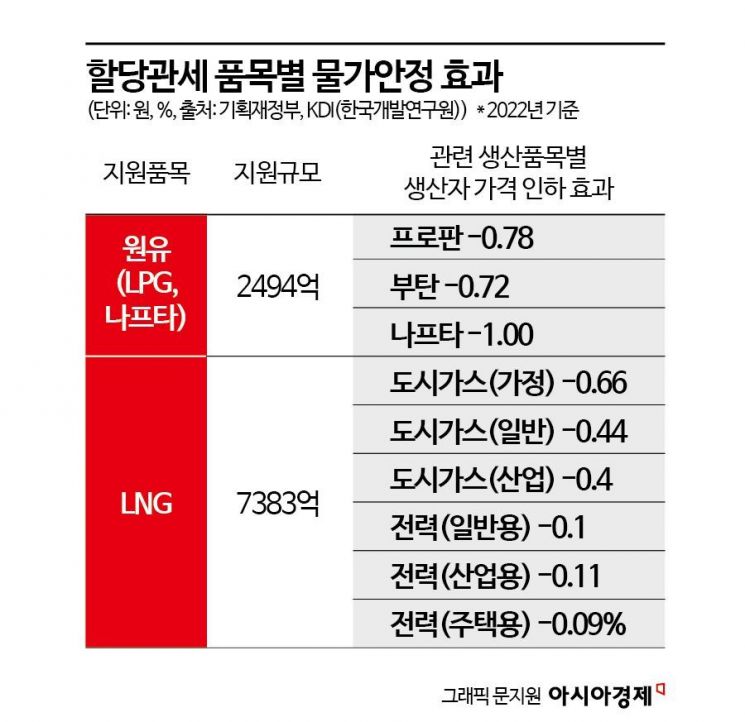
Regarding this, the Ministry of Economy and Finance stated, “The effect of tariff reductions should be judged qualitatively rather than quantitatively.” This means it is not easy to produce clear numerical values for the impact on final goods. The government explained that it only refers to the specific figures from KDI’s analysis results and does not use them as the core basis for policy decisions. However, both the government and KDI agree that considering the scope of use of crude oil, the ripple effect of price reduction on crude oil is the greatest. KDI analyzed that the application of tariff quotas on crude oil (propane, butane) last year lowered heating costs by 0.15%, and LNG lowered heating costs by 0.31%.
The problem is that it is difficult to continue applying tariff quotas to crude oil and LNG, which have large tax support scales, in a situation of fiscal shortage. The tax support amounts for last year’s tariff quota measures were 738.3 billion KRW for LNG, 229.6 billion KRW for crude oil (for naphtha production), and 69 billion KRW for LPG. Applying tariff quotas to these raw materials meant nearly 1 trillion KRW less tax revenue collected. It is a difficult choice to continue until the end of next year, when fiscal shortages and tax revenue shortfalls are expected to persist. When announcing the 2024 flexible tariff operation plan, the government stated, “For fuel-related items such as LNG, LPG, and naphtha, the support scale will be decided first in the first half of next year, and the extension of support in the second half will be reviewed again in the first half of next year.”
© The Asia Business Daily(www.asiae.co.kr). All rights reserved.
![Clutching a Stolen Dior Bag, Saying "I Hate Being Poor but Real"... The Grotesque Con of a "Human Knockoff" [Slate]](https://cwcontent.asiae.co.kr/asiaresize/183/2026021902243444107_1771435474.jpg)















