Spaceship Exceeding Physics Limits Re-detected After 2 Years
No Source Galaxy Found... Flew From Empty Space
In modern physics, an 'unidentified particle' that theoretically should not exist has been detected, drawing significant attention from the scientific community. This particle was also detected once two years ago.
According to the scientific journal Science on the 24th (local time), the particle observation was made by a joint research team led by the University of Utah in the United States and the University of Tokyo in Japan. The particle has been named the 'Amateras Particle,' after the ancient Japanese mythological deity Amateras.
This particle was first detected in May 2021. Its energy reached 244 EeV (exa-electronvolts = 10 to the power of 18 electronvolts), which is five times higher than the maximum theoretical value of cosmic rays allowed by modern physics.
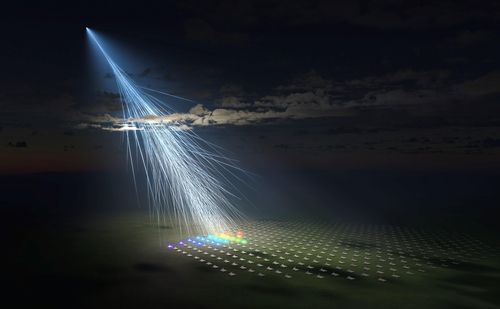 Imaginary Illustration of Ultra-High-Energy 'Amateras Particles' Colliding with Atmospheric Particles [Image Source=Yonhap News]
The joint research team arranged 507 particle detectors in a square grid over an area of 700 km² on the outskirts of Delta in the western desert of Utah, USA, conducting research to detect high-energy particles coming from space. Several Korean researchers also participated in this study, including Professor Park Il-heung from Sungkyunkwan University, Professor Cheon Byung-gu from Hanyang University, and Professor Ryu Dong-su from Ulsan National Institute of Science and Technology (UNIST).
Previously, the Amateras Particle was detected on May 27, 2021, by 23 of these detectors, and it was discovered once again recently, about two years later.
Scientists are particularly puzzled by the energy level of this particle. Even the most powerful 'ultra-high-energy cosmic rays (UHECRs)' cannot exceed an energy level of 50 EeV, but the Amateras Particle's energy is 244 EeV.
However, this is not the first time cosmic rays exceeding the 50 EeV limit have been found. In 1991, the University of Utah's 'Fly's Eye' experiment detected cosmic rays at about 320 EeV, and scientists at the time named this particle the 'Oh-My-God Particle.'
Meanwhile, the research team reported that there were no celestial bodies that could be the source in the direction from which Amateras arrived. In other words, the direction from which the cosmic ray came corresponds to a void region in the large-scale structure of the universe called the Local Void, where galaxies are almost absent.
© The Asia Business Daily(www.asiae.co.kr). All rights reserved.
![Clutching a Stolen Dior Bag, Saying "I Hate Being Poor but Real"... The Grotesque Con of a "Human Knockoff" [Slate]](https://cwcontent.asiae.co.kr/asiaresize/183/2026021902243444107_1771435474.jpg)















