NET ZERO LDN Forum in Seoul
The government and academia gathered in one place to realize carbon neutrality (net zero), where the net carbon emissions become zero. They emphasized that the amount of carbon emitted due to land degradation is greater than the air pollution caused by burning fossil fuels. They explained that carbon neutrality can be achieved only by expanding carbon reduction policies focused on air pollution prevention to policies that can reduce degraded land.
On the afternoon of the 23rd, Park Won-woo, professor of business administration at Seoul National University and chairman of GEC (Green Earth Community), said at the 'NET ZERO LDN Forum' held at the Mondrian Hotel in Seoul, "So far, carbon neutrality has mainly focused on air pollution caused by industrial activities symbolized by factory chimneys, but if carbon emissions from degraded soil become full-scale, it will be impossible to stop it with current human science." Professor Park, who chaired the forum's preparation committee, suggested, "Complementary efforts through Land Degradation Neutrality (LDN) must be pursued in parallel to achieve global carbon neutrality."
Ban Ki-moon, former UN Secretary-General, who also attended the forum, said in his congratulatory speech, "When land becomes degraded due to desertification, carbon amounting to 2,500 gigatons of carbon (GTC) is released into the atmosphere, causing tremendous impacts on climate change," adding, "Ultimately, efforts to prevent land degradation are becoming urgent for climate response."
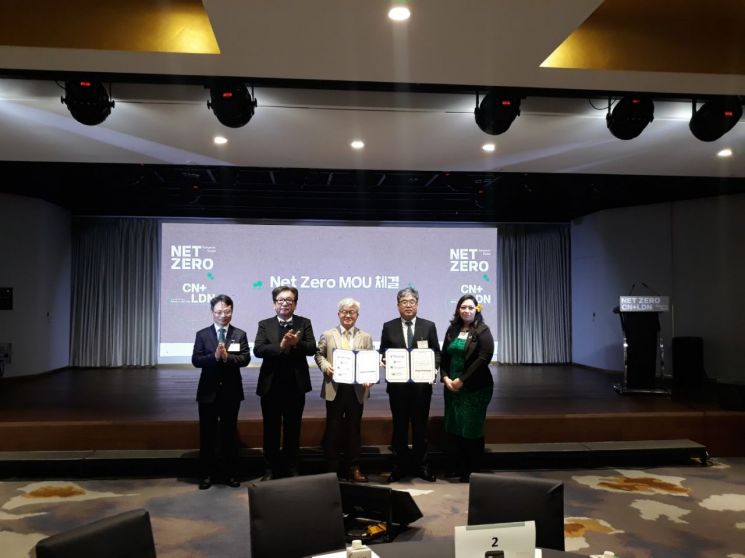 Park Won-woo, professor at Seoul National University Business School and chairman of GEC (Green Earth Community), is taking a commemorative photo with officials before the start of the 'NET ZERO LDN Forum' held at the Mondrian Hotel in Seoul on the afternoon of the 23rd.
Experts explained that global efforts are being made to reduce degraded land. LDN was proposed at the 2011 United Nations Convention to Combat Desertification Conference of the Parties (UNCCD COP) to prevent carbon emissions from desertified soil and has become a core concept of the UNCCD. Carbon sinks containing carbon on Earth include the atmosphere, vegetation, and soil, with atmospheric carbon at 830 GtC, vegetation up to 680 GtC, and soil up to 2,000 GtC. Already, 40% of the Earth's land is degraded, with an additional 2 billion hectares of soil degrading annually.
Park Eun-sik, International Forest Cooperation Officer at the Korea Forest Service, explained, "According to the UNCCD national reports submitted by 126 countries this year, the overall land degradation rate is increasing from 14.7% to 18.9%, while biodiversity is showing a decreasing trend. The government continues to provide financial support to prevent land degradation and is strengthening financial mobilization by expanding projects and official development assistance for forests in cooperation with the UNCCD, linking with Pacific island countries and southern Africa."
So Soon-jin, director at the Korea Forestry Promotion Institute, advised, "Future carbon absorption is declining due to forest aging, and carbon storage is decreasing due to low utilization of domestic timber," adding, "We need to expand thinning and timber use to establish a virtuous cycle system for forest resources." She emphasized the use of the forest carbon offset system, which is a system where companies and individuals voluntarily enhance forest carbon sinks and receive certification from the government.
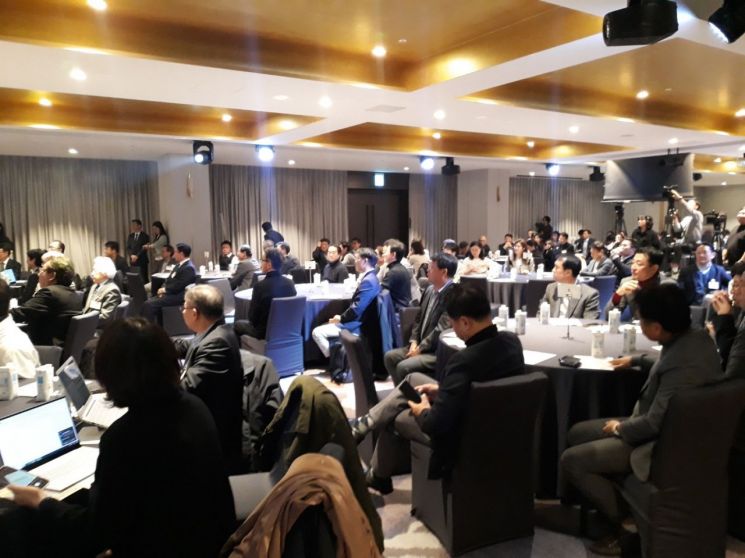 On the afternoon of the 23rd, attendees at the 'NET ZERO LDN Forum' held at the Mondrian Hotel in Seoul are listening to a lecture on net zero measures.
Lee Yo-han, professor of forest science at Seoul National University, emphasized that the REDD+ mechanism for reducing forest carbon emissions abroad will be an important means to achieve national greenhouse gas reduction targets (NDC). REDD+ refers to the mechanism under the United Nations Framework Convention on Climate Change (UNFCCC) to prevent deforestation in developing countries and reduce greenhouse gases. It is characterized by including elements of Payment for Environmental Services (PES), where developed countries provide incentives for efforts to conserve forests in developing countries. Professor Lee explained, "As of 2018, 61% of countries that submitted NDCs intended to use REDD+ as a reduction method, and 81% of Asian countries included REDD+ as a key strategy to achieve their NDCs."
At the forum, following efforts for LDN, the activation of the Compliance Carbon Market (CCM), which operates within national borders for carbon neutrality, and the Voluntary Carbon Market (VCM), where individuals and general companies can voluntarily offset their carbon footprints, were also emphasized. It was stressed that the voluntary carbon market must be further activated to increase the number of entities reducing carbon emissions.
© The Asia Business Daily(www.asiae.co.kr). All rights reserved.
![Clutching a Stolen Dior Bag, Saying "I Hate Being Poor but Real"... The Grotesque Con of a "Human Knockoff" [Slate]](https://cwcontent.asiae.co.kr/asiaresize/183/2026021902243444107_1771435474.jpg)
















