Professor Park Euncheol, Department of Preventive Medicine, Yonsei University College of Medicine
"Establish a 'Medical Workforce Review Committee' for Periodic Adjustments"
Symposium Hosted by the National Academy of Medicine and the Korean Medical Association
As the increase in medical school quotas has become a social issue, a proposal has emerged to readjust the medical workforce quota every five years through a separate organization. This is due to the anticipated difficulty in predicting medical demand caused by population aging.
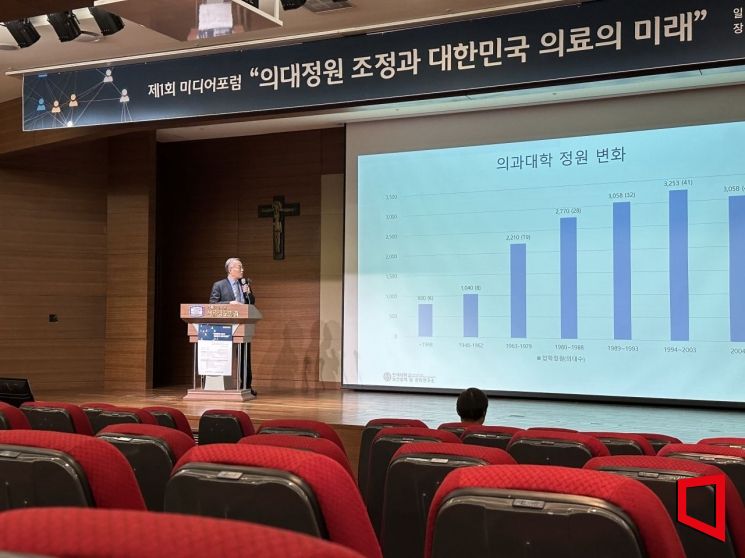 Professor Park Eun-cheol of Yonsei University College of Medicine is giving a presentation at the forum titled "Adjustment of Medical School Quotas and the Future of Healthcare in Korea," held on the afternoon of the 23rd at Seoul St. Mary's Hospital.
 [Photo by Lee Myung-hwan]
On the afternoon of the 23rd, Park Eun-cheol, a professor in the Department of Preventive Medicine at Yonsei University College of Medicine, suggested this at the '1st Korea Academy of Medical Sciences and Korea Medical & Bio Journalists Association Media Forum' held at Seoul St. Mary's Hospital in Seocho-gu, Seoul, saying, "Let's think about the future regardless of whether the number of doctors is sufficient or insufficient."
According to Professor Park, the current medical school admission quota is 3,058 students. The total number of medical school quotas in Korea, which recruited about 800 students from six universities in 1948, has remained the same since 2004 after going through the medical separation wave. In addition to the admission quota, the total quota including special admissions and military consignment students is 3,123.
Professor Park explained that there is evidence both for the shortage and sufficiency of doctors in Korea. Currently, the number of doctors per 1,000 people in Korea is 2.6, which is lower than the OECD member countries' average of 3.7. However, direct comparison is difficult because medical infrastructure and insurance systems vary by country. The number of doctors per 1,000 people in the United States and Japan is 2.7 and 2.6, respectively, showing similar figures to Korea.
He also explained that the supply and demand of doctors will show a shortage for a certain period and then an excess. According to research, assuming the current medical school quota is maintained, a shortage of doctors is expected until 2040 due to increased medical demand from aging. It was analyzed that about 10,000 doctors will be lacking compared to the expected medical expenses in 2030. However, by 2050, medical demand and the number of doctors will balance, and from 2060, an excess of doctors is expected. If the current medical school quota continues, an excess of about 74,000 doctors is expected by 2070.
Since medical demand is expected to fluctuate, flexible management of medical school quotas is necessary. Professor Park said, "Japan, which is in a similar situation to us, increased medical school quotas due to aging but then reduced them again due to the burden of medical expenses," adding, "We should consider increasing medical school quotas for the next 10 years and then gradually reducing them."
However, since it is difficult to accurately predict medical demand, he emphasized the need to establish a 'Medical Workforce Review Committee' to review this. Medical demand prediction is based on population projections such as total fertility rate, but accurate estimation is difficult. Future changes in medical workforce policies or the use of new technologies such as artificial intelligence (AI) can also affect medical demand. Professor Park suggested, "Because we do not know how medicine and population will change, a review every five years is essential," and added, "Instead of a committee, a review panel should be established with full-time staff to continuously assess the medical workforce."
On the other hand, medical organizations criticized the government's demand survey for increasing medical school quotas as 'populism' and said that no scientific evidence was presented. Woo Bong-sik, director of the Medical Policy Research Institute of the Korean Medical Association, said, "Demand surveys for doctor workforce supply and demand should be scientifically analyzed using various variables such as demand projections," and added, "Demand surveys for increasing medical school quotas without scientific projections are populism."
Meanwhile, the forum co-hosted by the Korea Academy of Medical Sciences and the Korea Medical & Bio Journalists Association was held under the theme of 'Adjustment of Medical School Quotas and the Future of Korean Healthcare.' In addition to Professor Park and Director Woo, Park Jung-shin, deputy director of Seoul National University Hospital, gave a presentation on 'Competency-Based Residency Training and Essential Medical Care.'
© The Asia Business Daily(www.asiae.co.kr). All rights reserved.
![Clutching a Stolen Dior Bag, Saying "I Hate Being Poor but Real"... The Grotesque Con of a "Human Knockoff" [Slate]](https://cwcontent.asiae.co.kr/asiaresize/183/2026021902243444107_1771435474.jpg)















