10,563 Cases Last Year, 77.8% Arrest Rate
Up to 2 Years Imprisonment, Up to 5 Million Won Fine
"Investigation Staff Reinforcement and Filtering System Enhancement Needed"
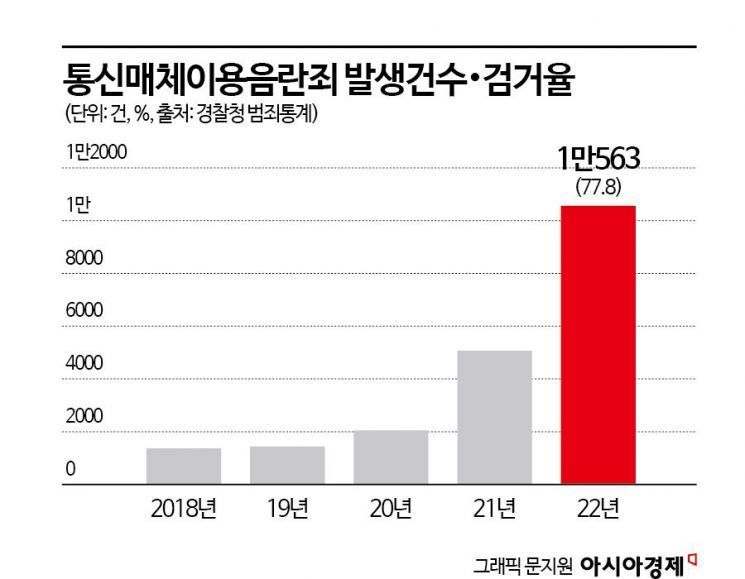
Recently, obscene materials were posted on a university community, causing social controversy, and it has been revealed that the number of crimes involving obscene acts using communication media has increased nearly eightfold in the past five years. The crime of using communication media for obscenity typically applies when sexually explicit videos, photos, or chats are transmitted via the internet, social networking services (SNS), games, or messengers. However, the rapid increase in such crimes has outpaced the capacity of investigative personnel, leading to a declining arrest rate.
 A threat message posted on the Christmas electronic billboard at a department store in Seoul.
 [Image source=Yonhap News]
According to the National Police Agency on the 24th, the number of cases of obscene acts using communication media under the Special Act on the Punishment of Sexual Crimes increased significantly from 1,365 cases in 2018, 1,437 in 2019, and 2,047 in 2020 to 5,067 in 2021 and 10,563 last year. While the number of crimes has increased, the arrest rate has decreased. The actual arrest rates were 89.2% in 2018, 85.2% in 2019, and 83.1% in 2020, maintaining the 80% range, but dropped to 78.1% in 2021 and 77.8% in 2022. A police official stated, “Crimes have increased rapidly, but the current personnel remain the same,” adding, “Although the number of arrests has increased, it cannot keep up with the rise in cases, resulting in a lower arrest rate.”
The crime of using communication media for obscenity gained attention when a fine was imposed for obscene chatting in the popular online game ‘League of Legends (LOL, LoL).’ In June 2020, A, a 24-year-old social service worker, was fined 2 million won and given a one-year probation for making sexually harassing remarks via chat in the game. The court also ordered completion of a 24-hour sexual violence treatment program and a one-year employment ban at child and youth-related institutions. At that time, among game users, a new term ‘Lolmaeum’ emerged, warning that careless obscene language could lead to becoming a sex offender.
The crime of using communication media for obscenity refers to acts of transmitting words, sounds, writings, drawings, videos, or objects that cause sexual shame or disgust to others through telephone, mail, computer, or other communication media with the intent to arouse or satisfy one’s own or another’s sexual desire. It is punishable by up to two years in prison or a fine of up to 5 million won. When a prison sentence is imposed, additional measures such as disclosure of personal information, completion of sex education, and employment restrictions may also be applied.
Related crimes continue to occur recently. On the 20th at around 8 p.m., a video of sexual intercourse between a man and a woman was posted on Korea University’s online community ‘Gopas.’ The poster claimed to have obtained the female junior’s consent before uploading the video, and the site temporarily went down. The post has since been deleted. The Seongbuk Police Station in Seoul has launched an investigation on charges of obscene acts using communication media. Additionally, on the 14th at around 10 p.m., a message saying “I will do XX to all Korean women” appeared on an electronic billboard installed with Christmas decorations on the outer wall of Lotte Department Store’s main branch in Jung-gu, Seoul. This was an abuse of an event where passersby could input messages via QR code to be displayed on the billboard. Lotte Department Store filed a complaint with Namdaemun Police Station against the poster. On the 17th, a man who sent obscene messages to a teenage girl with the intent of sexual intercourse was sentenced to one year and two months in prison and ordered a three-year employment ban at institutions related to children, youth, and persons with disabilities.
Several bills expanding the application of the crime of using communication media for obscenity have been submitted to the National Assembly. Min Hyung-bae of the Democratic Party proposed a bill specifying punishment for sexual violence occurring in virtual worlds such as the metaverse. Kim Min-gi of the Democratic Party and Lee Seong-man, an independent lawmaker, introduced bills to punish those who deliver obscene materials directly or via delivery or courier services. These acts are currently not covered by the Criminal Act, Minor Offense Punishment Act, or the crime of using communication media for obscenity, aiming to eliminate legal blind spots. Go Min-jeong of the Democratic Party suggested changing the legal term for causing shame to causing discomfort, arguing that shame implies a feeling of embarrassment or lack of dignity before others, which is a misperception since it should be an emotion felt by the victim, not the perpetrator.
Experts believe that increasing investigative personnel and strengthening filtering systems are necessary. Oh Yoon-sung, a professor of Police Administration at Soonchunhyang University, said, “Young generations tend to take the crime of using communication media for obscenity lightly,” and added, “The decline in arrest rates is due to the overwhelming number of cases, and while increasing investigative personnel is necessary, it is a challenging issue.” Im Joon-tae, a professor of Police Administration at Dongguk University, said, “It seems that the anonymity of the internet space leads to a lack of awareness that these acts are crimes,” and suggested, “If increasing police personnel is difficult, a systemic approach such as automatic deletion and filtering is needed.”
© The Asia Business Daily(www.asiae.co.kr). All rights reserved.
![Clutching a Stolen Dior Bag, Saying "I Hate Being Poor but Real"... The Grotesque Con of a "Human Knockoff" [Slate]](https://cwcontent.asiae.co.kr/asiaresize/183/2026021902243444107_1771435474.jpg)
















