Complex Cultural Space 'Jewel Changi'
A Leading Example of Airport Economic Zone Linked with Other Industries
Thanks to This, Changi Airport Reclaimed the Title of Airport of the Year
At 11 a.m. on the 23rd, Jewel Changi located at Singapore Changi Airport caught our eyes as soon as we got out of the car. On the second floor, familiar stores like the Apple Store and Shake Shack were visible. After exploring the stores, taking the escalator down to the first floor leads to an indoor waterfall, which starts operating from 11 a.m. The Forest Valley with the waterfall was designed by planting real trees to give visitors a natural experience. The trees were imported from neighboring countries such as Indonesia and Malaysia, and 20 professional arborists affiliated with the airport manage 100,000 trees. Since Singapore itself is a 'City in a Garden,' the Changi Airport officials stated that they plan to maintain this concept continuously. Ahead of Christmas on the 25th of next month, a Christmas tree was installed at the entrance of Terminal 1. From the 17th of last month until January 1st next year, the area is decorated with the theme of Japan’s popular character 'Super Mario.'
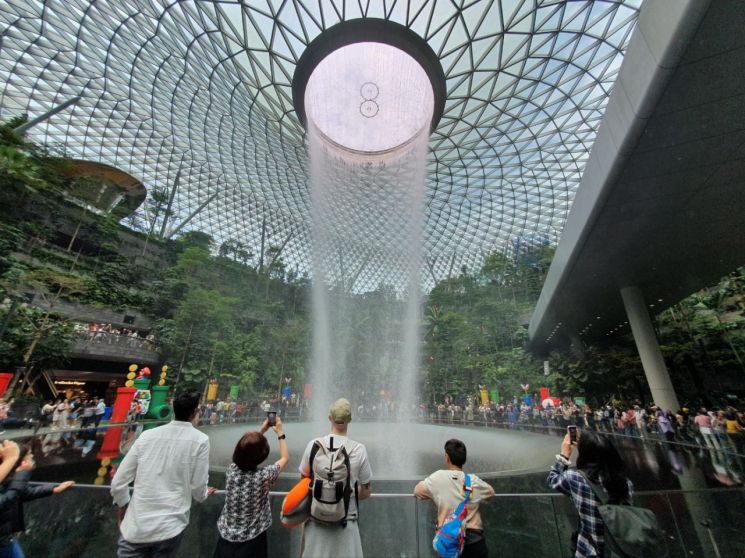
Built on what used to be a taxi stand, this place features commercial facilities arranged around the indoor waterfall. It is located between Terminal 1, Terminal 2, and Terminal 3 of Changi Airport, making it easily accessible for transit passengers. To allow travelers to enjoy the area comfortably before departure, an early check-in counter is also available on the first floor. Restaurants are concentrated on the fifth floor, and there are event facilities for weddings and meetings. Most of Jewel Changi’s revenue reportedly comes from its restaurants.
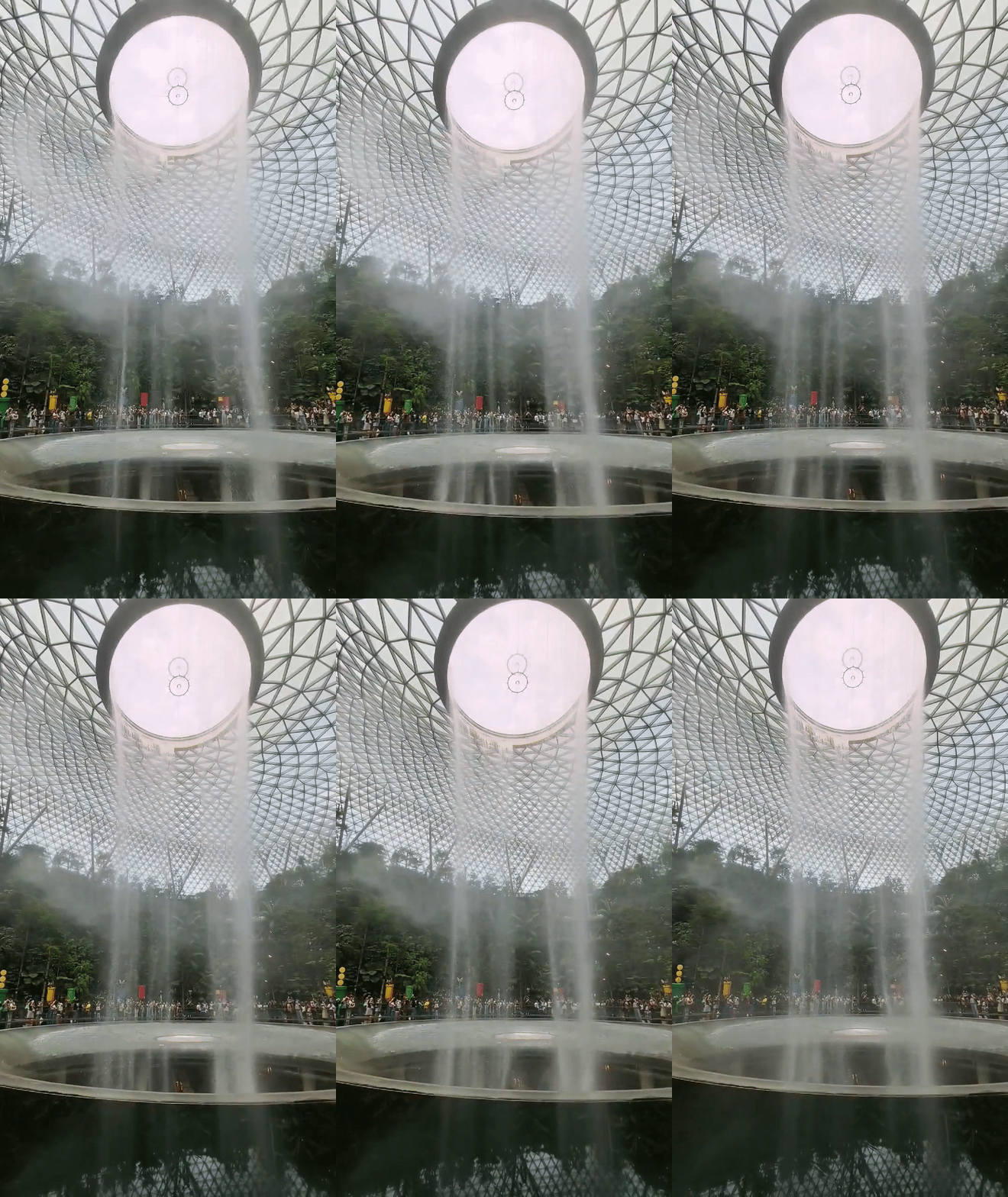
Jewel Changi, a complex cultural space visited by millions annually, is transforming Changi Airport from a mere airport facility into an 'airport where people want to stay.' Based on this, Changi Airport has been selected as the Airport of the Year by Skytrax, an aviation service consulting company.
Jewel Changi’s construction plan was set in 2007 and it opened in 2019. The project cost 1.7 billion Singapore dollars (approximately 1.5 trillion Korean won). This shopping mall is accessible after completing immigration at Singapore Changi Airport. It consists of a total of 10 floors, from five basement levels to five above ground, and the parking lot can accommodate 2,500 vehicles. This capacity is smaller compared to Incheon International Airport Terminal 1’s short-term parking lot, which holds 4,600 vehicles. Jewel Changi itself operates 24 hours, but the shops are open from 10 a.m. to 10 p.m.
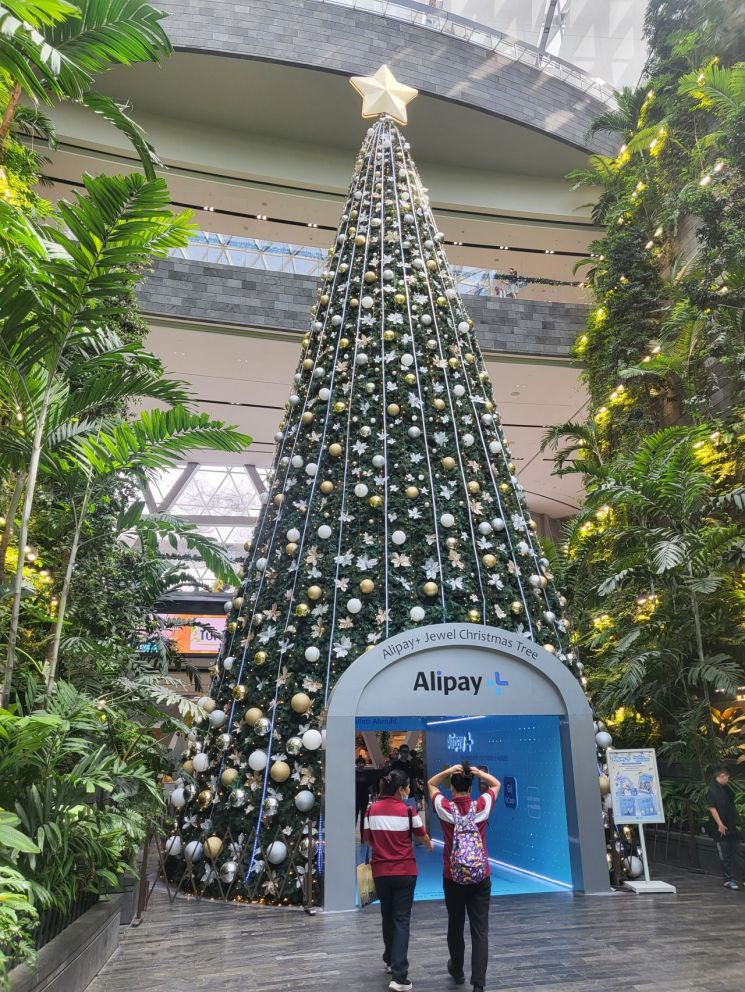 Jewel Changi, located at Singapore Changi Airport where a Christmas tree has been erected ahead of next month's Christmas season.
 Photo by Oh Gyumin moh011@
The purpose of creating Jewel Changi was to transform Changi Airport from a 'place to pass through' into a destination in itself. It is a representative example of an 'airport economic zone,' which turns an airport into an economic ecosystem linked with industries other than transportation.
After Jewel Changi was established, Changi Airport regained its position as the world’s number one airport. Skytrax, the aviation service consulting company that ranks airports, selected Changi Airport as the Airport of the Year. The high scores were attributed to the leisure facilities and shopping mall inside Jewel Changi. Changi Airport was also named the 'most beautiful airport in the world' by Le Figaro, one of France’s top three newspapers. The design was done by architect Moshe Safdie, who also designed Singapore’s Marina Bay Sands Hotel.
© The Asia Business Daily(www.asiae.co.kr). All rights reserved.
![Clutching a Stolen Dior Bag, Saying "I Hate Being Poor but Real"... The Grotesque Con of a "Human Knockoff" [Slate]](https://cwcontent.asiae.co.kr/asiaresize/183/2026021902243444107_1771435474.jpg)


















