Medical AI company Lunit announced on the 23rd that a study published in the European radiology journal 'European Radiology' (IF 7.0) showed that the cancer diagnosis ability of its mammography AI image analysis solution, 'Lunit Insight MMG,' is comparable to or better than that of first-reading breast radiologists.
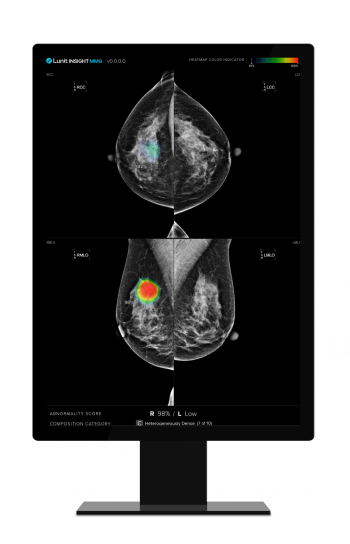
The study was led by Dr. Johanne Køhl and Dr. Mohammad Talal Elhakim from the Clinical Research Department at the University of Southern Denmark, who analyzed 249,402 mammography cases conducted in the southern region of Denmark from August 2014 to August 2018.
Currently, in Europe, it is recommended that two radiologists perform double reading during breast cancer screening. The research team evaluated the AI's cancer diagnosis ability by comparing the results of Lunit's AI solution with those of first-reading radiologists.
The Lunit AI solution interpreted cases using two AI models: the AIsens model, which applied the average sensitivity (the probability of correctly identifying cancer patients) of first-reading radiologists as the threshold, and the AIspec model, which applied the average specificity (the probability of correctly identifying non-cancer individuals) of first-reading radiologists as the threshold. Cases exceeding the threshold were classified as 'Recall' subjects, meaning patients were called back for additional cancer screening.
As a result, the AIsens model showed slightly lower specificity (97.5% vs. 97.7%) and positive predictive value (17.5% vs. 18.7%) compared to first-reading radiologists, but had a higher recall rate (3.0% vs. 2.8%). This indicates that the AI rarely missed signs of breast abnormalities and could identify more potential cancer cases. The AIspec model demonstrated accuracy results similar to those of the radiologists.
Additionally, both the AIsens and AIspec models detected fewer cancers than the radiologists (AIsens 1,166 cases, AIspec 1,156 cases, radiologists 1,252 cases), but identified approximately 3 to 4 times more interval cancers (cancers occurring between mammography screenings) (AIsens 126 cases, AIspec 117 cases, radiologists 39 cases). The company also noted that breast cancer and other types of cancers were detected.
A Lunit representative stated, "This study demonstrates the potential for AI to assist or replace first-reading radiologists in the double reading process," adding, "The application of AI may further increase cancer detection rates."
Seobum Seok, CEO of Lunit, said, "As the shortage of radiologists continues in Europe, the demand for AI adoption is steadily increasing. This study once again proves that AI can play a crucial role in cancer screening. Lunit is continuously improving AI performance to reduce the burden on medical professionals worldwide and provide more accurate diagnoses to patients."
© The Asia Business Daily(www.asiae.co.kr). All rights reserved.








![The Special Connection Between the Statue of Martyr Lee Jun in Jangchungdan Park and Mayor Oh Sehoon ③ [Current Affairs Show]](https://cwcontent.asiae.co.kr/asiaresize/319/2026012110001599450_1768957215.jpg)
