Bloomberg Predicts Global Real Estate Market Slump
US New Home Sales Virtually Frozen Due to High Interest Rates
"Korean Landlord Debt Defaults to Persist Until Next Year"
"The 'real estate jackpot' that created wealth for millions worldwide is now over."
Foreign media analysis suggests that the global real estate market downturn caused by high interest rates will continue for the next decade. In particular, South Korea, which has entered a real estate market slump, is considered risky due to having the highest household debt relative to its gross domestic product (GDP).
US Real Estate Market Freezes Due to High Interest Rates
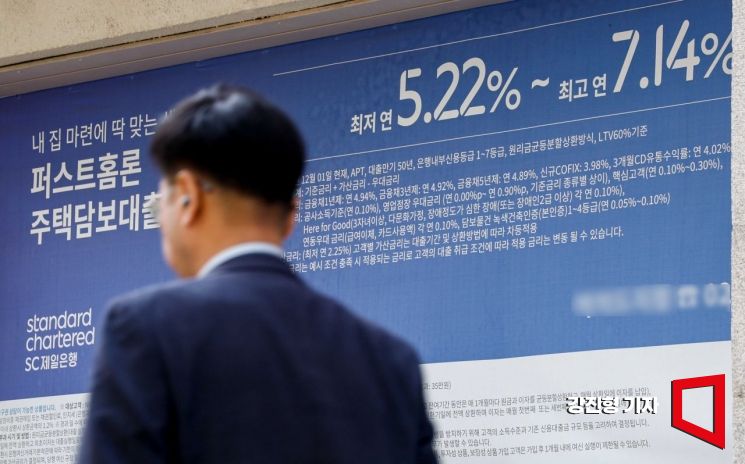 A banner displaying loan interest rates is hung on the exterior wall of a major bank in Seoul. Photo by Jinhyung Kang aymsdream@
The global real estate market is expected to suffer from prolonged high interest rates. According to Moody's Analytics, an economic analysis firm under the international credit rating agency Moody's, the fixed interest rate on 30-year mortgages in the US, which was 2.65% in 2021, is projected to average about 5.5% over the next 10 years, Bloomberg reported on the 20th (local time).
In the US, homeowners who purchased houses during low interest rates are not putting supply on the market due to high interest rates, causing a decline in new home transactions. While demand for buying and selling has decreased, the burden of loan interest rates incurred during the process of moving is also significant.
According to the National Association of Realtors, the number of home sales in the US this year has fallen to the lowest level since 2010, following the 2008 financial crisis. It is expected to decline further next year.
25% of UK Mortgage Holders "Considering Selling Homes"

As mortgage repayment burdens increase for homeowners, they reduce spending in other areas or even put their homes up for urgent sale. In the UK, about 25% of mortgage holders are reportedly considering selling their properties because they cannot afford the loan costs.
This situation is also connected to South Korea. The number of auctions, considered a leading indicator of real estate downturns, has recently increased. According to Gigi Auction, the number of apartment auctions in Seoul last month was 238, marking the highest monthly figure in 7 years and 5 months since May 2016 (291 cases).
Mark Zandi, Chief Economist at Moody's, said, "The golden age of housing is over," adding, "If you bought a house after the financial crisis, you accumulated significant assets in most parts of the world, but the next 10 years will be slow." Benjamin Keys, a professor at the Wharton School of the University of Pennsylvania, also said, "The housing market is in the early stages of an ice age," and "It does not seem likely to thaw anytime soon."
South Korea’s High Household Debt Ratio Increases Risk
There is also an assessment that South Korea's unique Jeonse system increases the risk of landlords' debt defaults. As high interest rates reduce the attractiveness of Jeonse, the amount of deposit landlords can receive from new tenants is decreasing, and landlords are finding it difficult to repay deposits to existing tenants.
Including Jeonse funds of $800 billion (approximately 1,030 trillion KRW), South Korea's household debt-to-GDP ratio is pointed out as the highest among developed countries at 157%.
Bloomberg evaluated, "South Korea is fighting the fall of landlords. The prolonged high interest rates are intensifying the pain of Korean landlords," adding, "Recent Jeonse contracts maturing were signed when house prices and Jeonse deposits were at record highs (in 2021), so the risk of landlords' debt defaults will continue until next year."
© The Asia Business Daily(www.asiae.co.kr). All rights reserved.
![Clutching a Stolen Dior Bag, Saying "I Hate Being Poor but Real"... The Grotesque Con of a "Human Knockoff" [Slate]](https://cwcontent.asiae.co.kr/asiaresize/183/2026021902243444107_1771435474.jpg)
















