Reactivation of the Political Reform Special Committee After 4 Months... Another Clash Between Ruling and Opposition Parties
Ruling Party: "Parallel System"... Opposition: "Satellite Party Prevention Law Must Be Promoted"
Democratic Party Party Resolution Possible... Hong Ik-pyo: "Efforts to Pass the Law"
The ruling and opposition parties have yet to narrow their differences on electoral system reform with five months remaining until the 22nd general election. Regarding the biggest issue, the reform of the proportional representation system, the People Power Party proposes returning from the current semi-linked system to a 'regional parallel system,' while the opposition insists on maintaining the current system but creating separate laws to prevent satellite parties, which have been identified as a side effect.
The National Assembly's Special Committee on Political Reform (Jeonggae Special Committee) held the 2nd Subcommittee on Bill Review on the 21st and began reviewing the Public Official Election Act amendment and other electoral system reform proposals to be applied in next year's general election. The Jeonggae Special Committee was reactivated after four months, and although the meeting was intended to review bills related to the proportional representation candidate nomination process, the ruling and opposition parties clashed from the start over the handling of the satellite party prevention law.
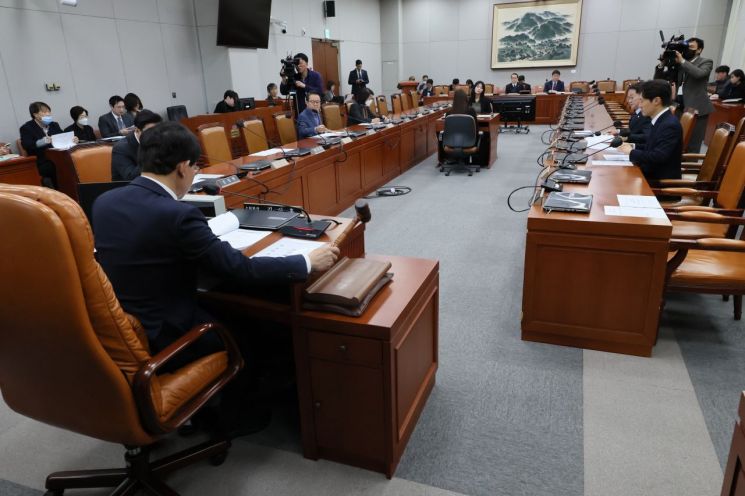 On the 21st, the Special Committee on Political Reform's 2nd Subcommittee on Bill Review is being held at the National Assembly. [Image source=Yonhap News]
Democratic Party lawmaker Itanhee said, "The Democratic Party insisted that the satellite party issue must be addressed, but I received reports that the People Power Party opposed it," emphasizing, "The satellite party prevention law must be treated as the top priority." Justice Party lawmaker Shim Sang-jung added, "The People Power Party says the semi-linked proportional representation system should be abolished because of satellite parties, but why do they oppose the satellite party prevention law?"
Kim Sang-hoon, co-chair of the 2nd Subcommittee and a People Power Party lawmaker, claimed, "After prior consultations between the leadership of both parties and agreements between the Jeonggae Special Committee secretaries, it was decided to submit the proposal of 'single-member districts for constituencies and regional parallel system for proportional representation' to each party's caucus." He added, "The People Power Party has received approval at its caucus, but the Democratic Party has not reached consensus," and said, "We have been waiting for internal coordination within the Democratic Party for over two and a half months."
Democratic Party lawmakers immediately refuted this, saying they "never agreed." While they agreed to introduce regional proportional representation during the review stage in September, they denied agreeing to the 'parallel system' that requires seat adjustments. After the subcommittee meeting, lawmaker Kim Sang-hoon told reporters, "We agreed to submit the proposal to each party's caucus to hear members' opinions and have the floor leaders negotiate," clarifying that this did not mean an agreement on the parallel system.
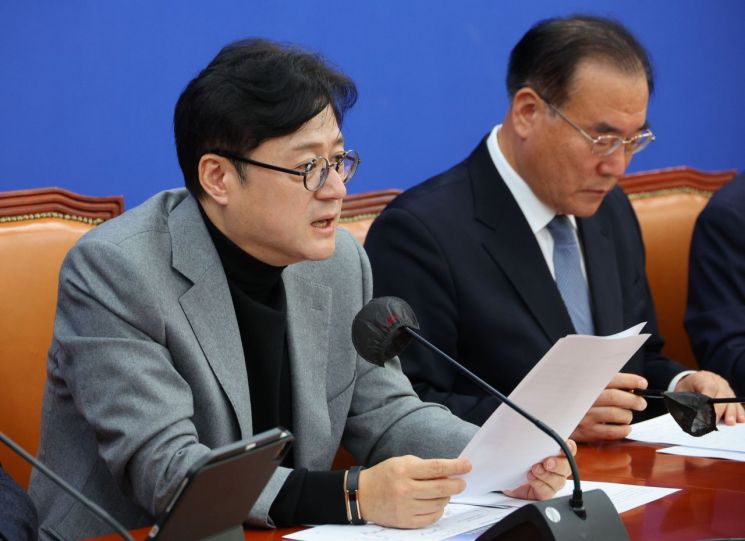 Hong Ik-pyo, the floor leader of the Democratic Party of Korea, is speaking at the party strategy meeting held at the National Assembly on the 21st.
 [Image source=Yonhap News]
With about three weeks left until the registration of preliminary candidates for the general election (December 12), there is also speculation that the Democratic Party may push the 'satellite party prevention law' as a party stance. On the morning of the same day, Democratic Party floor spokesperson Yoon Young-duk told reporters after a floor meeting at the National Assembly that when asked about the background of Floor Leader Hong Ik-pyo's statement at the Editors' Forum hosted by the Korea Newspaper and Broadcasting Editors Association that he would strive to pass the satellite party prevention law, "Since bills have been submitted, we need to classify the contentious issues and, if necessary, discuss them at the party caucus." He added, "Whether to push it as a party stance has not yet been discussed, but the Jeonggae Special Committee will discuss it first, and if necessary, inter-party consultations will be conducted."
Floor Leader Hong also stated on the 16th, after meeting Daegu Mayor Hong Joon-pyo, in response to reporters' related questions, "It is undesirable to create satellite parties in next year's general election," and "It is very important to improve the system to prevent the emergence of satellite parties as much as possible." Earlier, on the 15th, 30 Democratic Party lawmakers, including Itanhee, held a press conference urging the party to push the 'satellite party prevention law' as a party stance.
© The Asia Business Daily(www.asiae.co.kr). All rights reserved.
![Clutching a Stolen Dior Bag, Saying "I Hate Being Poor but Real"... The Grotesque Con of a "Human Knockoff" [Slate]](https://cwcontent.asiae.co.kr/asiaresize/183/2026021902243444107_1771435474.jpg)
















