Research Published in Prestigious Academic Journals in October
Domestic researchers have developed an organic material capable of converting infrared light, which is invisible to the human eye, into electrical signals. Using this material, infrared light can be detected with high sensitivity, making it promising for applications in autonomous vehicles, space and military facilities, and the bio-healthcare sector.
On the 21st, Ajou University announced that Professor Jonghyun Kim’s research team (Department of Applied Chemistry and Life Science & Graduate School of Molecular Science and Technology) collaborated with Dr. Seojin Ko and Dr. Sungcheol Yoon’s team from the Korea Research Institute of Chemical Technology to develop an organic semiconductor material that efficiently absorbs near-infrared light and an organic photodetector device using this material.
The findings were published in October in the prestigious materials science journal ACS Nano under the title “Development of High-Photoresponse Near-Infrared Organic Photodetectors Using a Novel Non-Fullerene Asymmetric Electron Acceptor Material.” Ayoung Lee (integrated master’s and doctoral program, Department of Molecular Science and Technology) and Dr. Jongwoon Ha from the Korea Research Institute of Chemical Technology participated as co-first authors, while Professor Kim and Drs. Seojin Ko and Sungcheol Yoon served as co-corresponding authors.
The Ajou University team conducted the photodetector device design and performance optimization research, while the Korea Research Institute of Chemical Technology focused on developing the near-infrared absorption material. Professors Sungjoon Park (Department of Electronic Engineering & Intelligent Semiconductor Engineering) and Junseok Heo (Intelligent Semiconductor Engineering & Electronic Engineering) also participated in device analysis research.
Unlike visible light, infrared light cannot be seen directly by the human eye but is used in various fields. This is because it can image and detect heat emitted from living organisms, engines, celestial bodies, and more. Consequently, it is applied in autonomous vehicles, space and military facilities, bio-healthcare sensors, optical communications, and other areas.
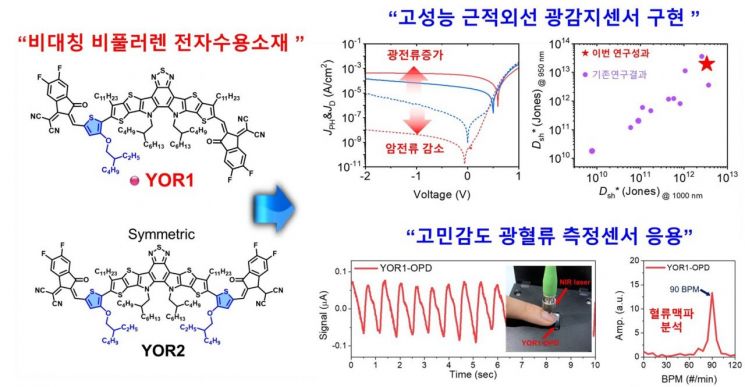
However, infrared band optical signals have low energy, making it difficult to distinguish them from various noise signals present in daily life. Due to challenges in material development, the creation of organic photodetectors that can sensitively detect long-wavelength near-infrared light has lagged behind.
In response, the joint research team developed an organic near-infrared absorption material that can easily control the light absorption wavelength while efficiently absorbing near-infrared light. They aimed to implement a highly sensitive near-infrared photodetector by controlling the nanostructure of thin films made from this material.
The team fabricated the newly developed organic semiconductor material into bulk heterojunction films together with conjugated polymers and applied them to photodetectors. They confirmed that the photodetectors could achieve high sensitivity with a photoresponse exceeding 1012 Jones for 1000 nm near-infrared light. This sensitivity level is 4 to 5 times higher than that of commercially available silicon photodetectors.
Furthermore, using the high-sensitivity photodetector based on the new material, they applied it to an optical blood flow measurement sensor and analyzed the body’s pulse wave. The research team explained that the developed photodetector can precisely detect the health condition of blood vessels.
Professor Kim stated, “There have been many challenges in achieving high-sensitivity detection of near-infrared light above 1000 nm, but this research provides a solution. We expect that the developed material and device technology will be utilized in various emerging industries such as high-sensitivity near-infrared cameras, infrared communications, and bio-healthcare sensors.”
© The Asia Business Daily(www.asiae.co.kr). All rights reserved.
![Clutching a Stolen Dior Bag, Saying "I Hate Being Poor but Real"... The Grotesque Con of a "Human Knockoff" [Slate]](https://cwcontent.asiae.co.kr/asiaresize/183/2026021902243444107_1771435474.jpg)
















