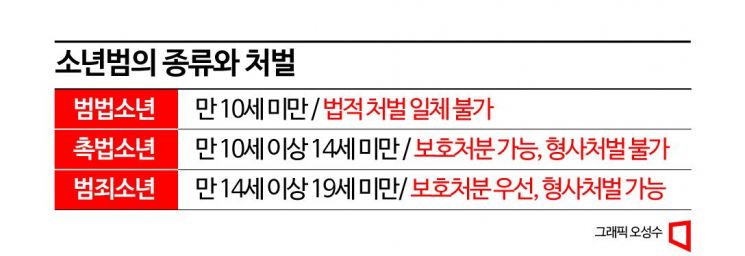
On the 17th, an incident occurred in an apartment in Nowon-gu, Seoul, where a man in his 70s walking on the street died after being hit by a stone thrown down by an 8-year-old elementary school student. This has sparked controversy surrounding ‘delinquent juveniles’ under the age of 10. Unlike “chokbeopsonyeon” (juveniles subject to protective measures, aged 10 to under 14), who may receive protective dispositions such as being sent to juvenile detention centers even if exempt from criminal punishment, delinquent juveniles under 10 receive no punishment at all. On the 21st, when this paper asked 10 experts in corrections, police, and psychology how delinquent juveniles should be handled, most experts agreed that correctional education for delinquent juveniles should be strengthened, but many opposed lowering the delinquent juvenile age below 10 or strengthening punishments.
◆ "Correction and rehabilitation should be strengthened" = Seven out of ten respondents said that correctional and rehabilitation measures, such as establishing educational programs for delinquent juveniles, should be reinforced. Professor Baek Cheol Lee of the Department of Correctional Psychology at Kyonggi University said, "It is necessary for parents and children to receive warning-type education together to prevent recurrence," and added, "The police or schools should conduct education for delinquent juveniles." Professor Kwak Geumju of the Department of Psychology at Seoul National University said, "Educational programs involving experts in psychology and psychiatry are needed."
Many expressed that correctional dispositions equivalent to protective measures for chokbeopsonyeon are inappropriate. Professor Lim Joon-tae of the Department of Police Administration at Dongguk University said, "Children under 10 are too young for criminal correction," and added, "It is appropriate to guide and admonish them to prevent dangerous behavior." Han Young-sun, former director of Seoul Juvenile Detention Center and professor of Police Administration at Kyonggi University, said, "Correctional education for delinquent juveniles is ineffective and cannot be seen as helpful to victims."
Eight out of ten experts pointed out the need to compile crime statistics related to delinquent juveniles. Currently, statistics for chokbeopsonyeon are compiled, but delinquent juveniles are not even registered as suspects, so there is no basic data for statistics. Professor Lee Su-jeong of the Department of Criminal Psychology at Kyonggi University said, "It is realistic for the Ministry of Education to conduct a survey on delinquent juveniles." Professor Lee Yun-ho, Chair Professor of Police Science at Korea Cyber University, said, "It is necessary to record all incidents involving delinquent juveniles regardless of age." Conversely, some argued that since they cannot be punished anyway, statistics are unnecessary.
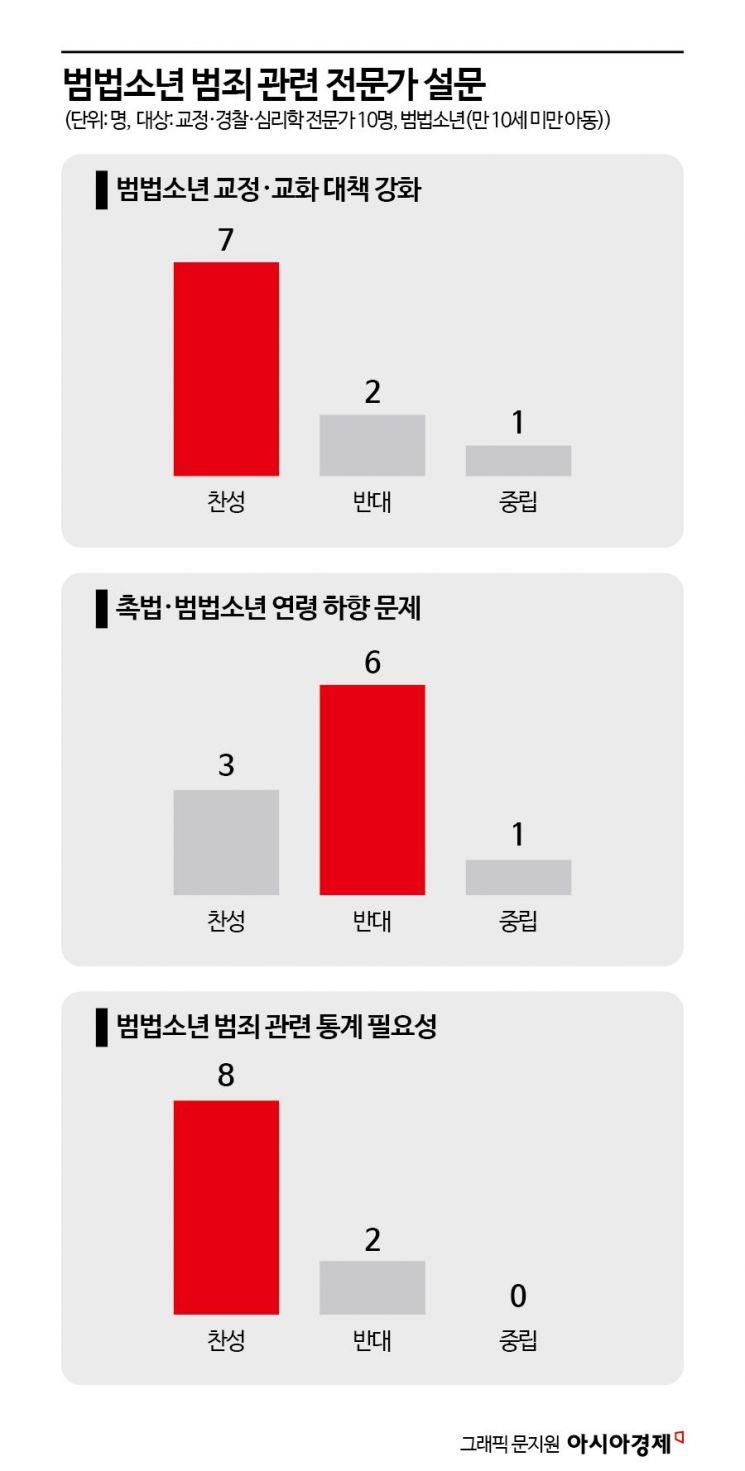
◆ Majority oppose strengthening punishment = Regarding lowering the age of delinquent juveniles, six out of ten opposed it, outnumbering supporters (3) and neutrals (1). Professor Lim Myung-ho of the Department of Psychology at Dankook University said, "The lower age limit of 10 for delinquent juveniles was set considering psychiatric aspects. Children's cognitive abilities begin to develop from age 10." Professor Lim Joon-tae opposed, saying, "Children under 10 still find it difficult to distinguish right from wrong or predict the consequences of their actions."
However, some argued that since the current Juvenile Act was enacted long ago and considering global trends, the delinquent juvenile age range should be adjusted. Professor Lee Woong-hyuk of the Department of Police Science at Konkuk University said, "The current delinquent juvenile standard was made 65 years ago, and since children's development nowadays differs from the past, there is a need to lower the age," adding, "Some U.S. states punish children aged 6 and above." Professor Lee Yun-ho also said, "It seems necessary to lower the upper age limit of delinquent juveniles to 8 or 9."
Regarding allowing protective measures for delinquent juveniles in cases equivalent to violent crimes such as murder, opposition (6) was stronger. Professor Baek Cheol Lee said, "Considering the seriousness of the case, one might think protective measures are necessary, but it is not right to criminally punish young children," adding, "To prevent children from continuing criminal behavior as they grow, they should be managed in an educational manner." Professor Lee Geon-su of the Department of Police Science at Baekseok University also said, "For children under 10, counseling and treatment for protection and crime prevention are more effective than punishment."
© The Asia Business Daily(www.asiae.co.kr). All rights reserved.
![Clutching a Stolen Dior Bag, Saying "I Hate Being Poor but Real"... The Grotesque Con of a "Human Knockoff" [Slate]](https://cwcontent.asiae.co.kr/asiaresize/183/2026021902243444107_1771435474.jpg)
















