Naju City in Jeollanam-do has prepared a 2024 main budget totaling 939.6 billion KRW and submitted it to the city council on the 20th.
According to the city on that day, Mayor Yoon Byung-tae explained the budget formulation policy for the next year, focusing on stabilizing people’s livelihoods, protecting socially vulnerable groups, and securing future growth engines, as well as major policy projects, at the city council plenary session in the morning, seeking active cooperation from the council.
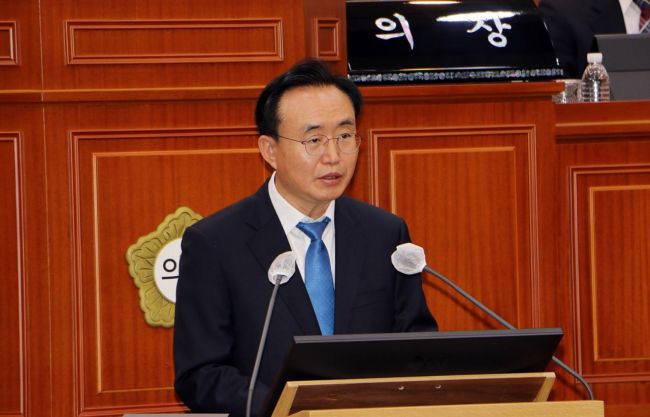 Yoon Byung-tae, Mayor of Naju City, is explaining the 2024 fiscal year budget proposal. [Photo by Naju City]
The next year’s budget proposal consists of 879.8 billion KRW in the general account and 59.8 billion KRW in the special account, which is a decrease of 63.8 billion KRW (6.4%) compared to this year’s main budget of 1.0034 trillion KRW.
The budget decrease is due to a reduction of more than 50 billion KRW in local allocation tax, which accounts for about 40% of Naju City’s revenue, caused by sluggish national tax income and prolonged economic recession, and it is also expected that local revenue collection will not be favorable.
In response to the unprecedented tax revenue decline, Naju City thoroughly reviewed all financial projects from scratch and implemented strong expenditure structure adjustments.
In particular, for facility projects, the budget was prepared focusing on projects that can be completed within the year while avoiding new projects, and improvement measures were prepared to ensure effectiveness and transparency for local subsidies that had been conventionally supported.
Administrative essential expenses were also minimized, and internal self-help efforts were strengthened by cutting business promotion expenses by more than 20% compared to this year. The resources secured through these strenuous efforts were mainly invested in budgets for stabilizing people’s livelihoods, protecting socially vulnerable groups, and securing future growth engines such as tourism, energy, and education.
Despite no national government support, the city allocated a budget of 7.5 billion KRW for issuing Naju Sarang Gift Certificates to revitalize the local commercial district. It also included 100 million KRW for card fees for tenant small business owners and 30 million KRW for insurance premiums for small and medium-sized enterprises’ sales receivables.
The welfare budget for seniors’ healthy and active old age was also carefully managed. The meal expenses per senior center, which had been fixed at 100,000 KRW per month, will be supported differentially according to realistic conditions such as the number of people, expanding from 800 million KRW this year to 1 billion KRW next year.
It allocated 1 billion KRW for the expansion facility cost of the East Senior Welfare Center (formerly Nampyeong Home Welfare Center), 1.3 billion KRW for senior bathing and beauty vouchers supported quarterly at 20,000 KRW, 150 million KRW for operating 180 “100-year safe senior centers,” and 400 million KRW for shingles vaccination support (50%) expanded from citizens aged 65 and over to all citizens aged 63 and over.
Additionally, budgets were allocated for protecting socially vulnerable groups, including 500 million KRW for emergency care projects for people with developmental disabilities, 200 million KRW for the National Physically Disabled Sports Competition, and 200 million KRW for improving mobility facilities for the disabled.
The “zero-won rental housing” support budget of 3.5 billion KRW, a youth package project of the 8th elected administration for the stable settlement of young workers and their families who moved from other regions, was prepared. Through this, the supply of rental housing is planned to expand from 30 units this year to 100 units next year.
In addition, 50 million KRW for housing costs for Naju-type youth employees (20 people), 2.6 billion KRW for childbirth encouragement money, infertility couple examination and treatment costs, and support for housekeeping care services before and after childbirth were allocated. The budget for childcare infrastructure was also fully secured, including the province’s first 24/7 year-round childcare facility, regional children’s centers, and daycare center heating and cooling costs.
A total of 34 billion KRW was allocated to the tourism industry sector aiming for the “5 million Naju tourism era.”
The city is also working to create a tourism city with attractions, food, and entertainment by allocating 5.8 billion KRW for restoring the ecological waterway of Naju Stream and developing Yeongsan River tourism resources, 800 million KRW for maintaining Naju Eupseong and Naju Mokgwana, 1.2 billion KRW for the southern region’s wide-area tourism project, 400 million KRW for creating a pet theme park, and 800 million KRW for developing the Namdo Food Street and supporting the Naju Table project.
Through this, the city plans to proclaim 2025 as the Year of Visit Naju next year and reflected a related budget of 200 million KRW.
The agricultural budget totaling 102.6 billion KRW will invest 1.5 billion KRW in fostering premium Naju pears, 1.8 billion KRW in developing representative agricultural products by region, and 700 million KRW in food upcycling and agricultural product processing industry development.
For sustainable rural foundations such as revitalizing return-to-farm and return-to-village movements, 3 billion KRW was allocated for creating pilot villages (6 locations), 150 million KRW for vacant house regeneration projects, 5.4 billion KRW for rural space maintenance and vulnerable area living condition improvement projects, and 1.9 billion KRW for improving livestock odor.
The number of foreign seasonal workers increased tenfold from 32 last year to 366 this year, and the city set a budget of 720 million KRW to support rural manpower with a goal to expand the introduction to 700 people next year.
In the energy sector for creating a future advanced science city, 17.1 billion KRW will be invested next year.
The city allocated 300 million KRW to attract large research facilities such as ultra-high-power laser research facilities and artificial sun engineering research facilities, 200 million KRW for hosting the Energy Expo, and 1.6 billion KRW for attracting related industries for the second relocation of public institutions.
In addition, 5.9 billion KRW was reflected for fostering energy-related projects, and efforts will be accelerated for designation as a power generation special zone and the creation of the Kentech energy industry-academia-research cluster.
For core projects to improve urban living conditions, 4 billion KRW was allocated for constructing the Bitgaram Innovation City Complex Innovation Center, 3 billion KRW for reorganizing public transportation routes, 4.2 billion KRW for operating the Urban Integrated Control Center and Odor Integrated Control Center, and 2.4 billion KRW for creating park golf courses in Nampyeong-eup and Anchang-dong.
A total of 670 million KRW will be invested in providing distinctive educational services through operating the Future Education Support Center, as well as in policies to create a premium education city such as elementary school enrollment support funds, middle school students’ Dream Achievement Learning Cards, and lifelong learning vouchers.
Also, 2 billion KRW was allocated for Bitgaram Children’s Theme Park, Baemesan Four Seasons Flower Garden, Nampyeong Siksan Dullegil Trail, and improvements to the Bitgaram Observatory’s viewing environment, and 6.8 billion KRW was allocated for disaster and accident safety areas such as expanding transportation facilities.
Mayor Yoon Byung-tae said, “I ask for the city council’s interest and support so that major policies and projects that can realize the vision of the 5 million Naju tourism era that enhances Naju’s value, agriculture with hope for tomorrow, and the energy-based future advanced industry mecca can be smoothly promoted.”
Naju City’s 2024 main budget proposal is scheduled to be deliberated by each standing committee of the city council and the special budget and settlement committee, and finalized through a plenary session on the 19th of next month.
Naju = Asia Economy Honam Reporting Headquarters Reporter Kim Yuk-bong baekok@asiae.co.kr
© The Asia Business Daily(www.asiae.co.kr). All rights reserved.
![Clutching a Stolen Dior Bag, Saying "I Hate Being Poor but Real"... The Grotesque Con of a "Human Knockoff" [Slate]](https://cwcontent.asiae.co.kr/asiaresize/183/2026021902243444107_1771435474.jpg)















