Fasting Video Gets More 'Likes' Than BTS
Support from Chinese Sympathizing with Fasting Purpose and 'Anti-Japan' Sentiment
Lee Jae-myung, leader of the Democratic Party of Korea, is gaining popularity among Chinese netizens. His hunger strike in protest against Japan's discharge of contaminated water from nuclear power plants in September was publicized through videos, garnering support from Chinese people with strong anti-Japanese sentiments.
According to Douyin, the Chinese version of TikTok, a video titled "Lee Jae-myung's hunger strike enters its 15th day" received 1.92 million likes as of the 17th. This number overwhelmingly surpasses the likes on videos posted around the same time, such as BLACKPINK's world tour final performance ending song "Forever Young" with 110,000 likes and BTS introduction video with 66,000 likes.
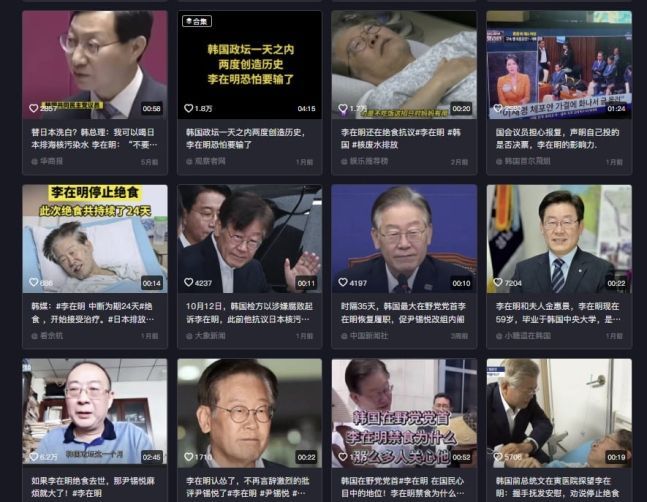 Screen showing a search for "Li Zaiming (李在明)" on Douyin, the Chinese version of TikTok.
 [Photo by Douyin]
Searching Lee's name in Chinese characters, "Li Zaiming" (李在明), on Douyin reveals dozens of videos. Most of these videos show Lee's hunger strike protest at the National Assembly in September. Comments on related videos include "For the first time, I respect a Korean," "Supporting Lee Jae-myung, the only one shouting justice in South Korea," and "Lee Jae-myung changed my perspective on Koreans."
At the end of August, Lee launched a hunger strike to resist the prosecution's investigation against him, demanding an apology for the president's destruction of people’s livelihoods and democracy, opposition to Japan's nuclear contaminated water discharge, and comprehensive government reform and cabinet reshuffle.
Chinese media reported on Lee's hunger strike, describing him as "the leader of South Korea's main opposition party who went on a hunger strike to stop Japan's contaminated water discharge," thereby informing the Chinese public. Local media covered Lee's hunger strike and his hospitalization.
Sichuan Broadcasting Station in China created and uploaded 24 videos related to Lee on its official social media accounts, documenting his hunger strike until he stopped and appeared in court for the warrant review.
At that time, anti-Japanese sentiment in China was at its peak due to Japan's Fukushima contaminated water discharge issue, and Lee's videos received great response from Chinese viewers. Recently, as Sino-Japanese relations have improved, the popularity of videos related to Lee has somewhat cooled down.
© The Asia Business Daily(www.asiae.co.kr). All rights reserved.
![Clutching a Stolen Dior Bag, Saying "I Hate Being Poor but Real"... The Grotesque Con of a "Human Knockoff" [Slate]](https://cwcontent.asiae.co.kr/asiaresize/183/2026021902243444107_1771435474.jpg)















