Candidates Yang Kyung-soo and Park Hee-eun
Emphasize the Need for Yoon Seok-yeol Administration's Resignation
Korean Confederation of Trade Unions Returns to Tripartite Commission
Contrasts with MZ Union's Opposition to Political Struggles
As the election for the new leadership of the Korean Confederation of Trade Unions (KCTU) approaches, both candidates for chairman, Yang Kyung-soo and Park Hee-eun, are raising their voices for the "resignation of the Yoon Seok-yeol administration," indicating that a hardline struggle against the government is likely to continue under the next leadership. This contrasts with the labor sector's emerging atmosphere of dialogue, as the Federation of Korean Trade Unions (FKTU) recently returned to the Economic, Social and Labor Council (ESLC) after five months, and so-called "MZ unions" oppose political and illegal struggles.
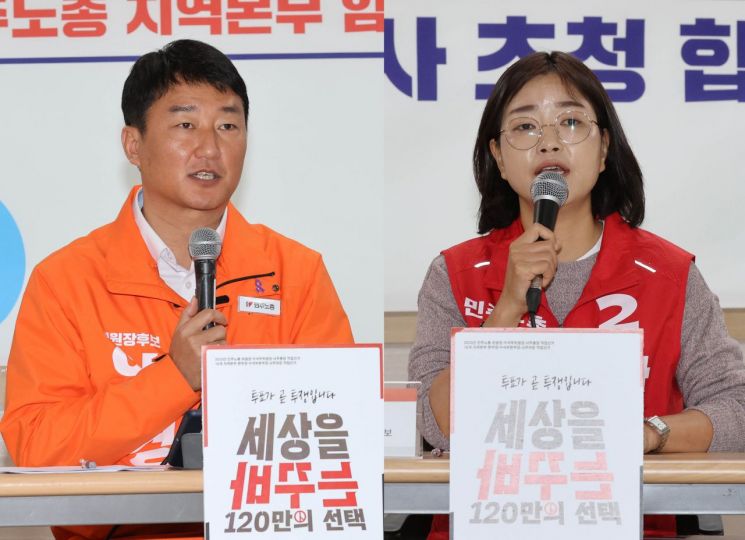 On the morning of the 7th, candidates number 1 Yang Kyung-soo (left) and number 2 Park Hee-eun, who attended the first joint debate invited by media outlets for the '2023 Korean Confederation of Trade Unions (KCTU) and KCTU Regional Headquarters Executive Simultaneous Election' held at the KCTU in Jung-gu, Seoul.
 [Image source=Yonhap News]
◆KCTU Leadership Election Candidates, "Struggle Against the Government"= Voting for the KCTU chairman election will be held over a week from the 21st to the 27th. The new leadership's term will begin in January next year and last for three years. As of June 30, the KCTU has 1.2 million members, comprising 16 affiliated organizations including the Public Transport Workers' Union, Metal Workers' Union, and the Korean Teachers and Education Workers' Union. The chairman represents this large organization and oversees its operations. The chairman also holds the authority to appoint and dismiss heads of affiliated institutions, chairpersons of standing and special committees, the secretariat, and members of affiliated bodies.
Candidate No. 1, Yang, is challenging to become the first KCTU chairman to serve consecutive terms. Yang is running with Lee Tae-hwan, former head of the Public Transport Workers' Union Airport and Port Transport Headquarters, as the senior vice chairman candidate, and Ko Mi-kyung, former KCTU planning director, as the secretary-general candidate. Candidate No. 2, Park, who has served as KCTU vice chairman for the past three years, is vying to become the first female KCTU chairman. Her senior vice chairman candidate is Kim Geum-cheol, secretary-general of the Construction Industry Federation, and her secretary-general candidate is Lee Young-joo, former KCTU secretary-general.
Both candidates declared their intention to struggle against the Yoon Seok-yeol administration immediately upon announcing their candidacies. The candidate debate held on the 17th focused primarily on political struggle. Yang said, "We must expand our scope (including social issues) in line with labor agendas and nurture people who oppose Yoon Seok-yeol. We need to respond aggressively and offensively." Lee Young-joo, Park's secretary-general candidate, also said, "There will be no union members opposing the political empowerment of workers. The KCTU should lead in strengthening progressive parties and fight together. In that process, our (KCTU's) political empowerment line will also be established."
This political collectivization and social struggle line of the KCTU has continued since its founding in 1995. The KCTU's founding declaration includes phrases such as "fierce struggle to advance the nation's independence, democracy, and unification" and "realization of political empowerment." A KCTU official said, "It is as important to struggle across society as it is within the labor domain. The selection of the nuclear wastewater discharge issue as a key agenda is in the same context."
◆Other Unions Favor Dialogue Atmosphere= On the 13th, the Federation of Korean Trade Unions (FKTU) declared its return to the Economic, Social and Labor Council (ESLC), which includes the government, labor, and business sectors. This came five months after it announced in June that it would completely suspend dialogue with the current government through the ESLC. The FKTU stated, "Our society is facing complex and difficult situations such as rapid industrial transformation, climate crisis, low birthrate and aging society issues, and prolonged uncertainty and low-growth shocks caused by the Middle East war. In this crisis, we will do our best to protect workers' survival rights and labor rights by returning to social dialogue to prevent the burden of economic crises from being passed on to workers." This decision reflects the FKTU's pragmatic tendency, unlike the ideologically strong KCTU.
A new form of labor movement is also emerging, centered on the MZ unions, mainly composed of workers in their 20s and 30s. The MZ union, Olbareun Union, did not participate in the warning strike of the Seoul Metro Workers' Union, affiliated with the KCTU, held on the 9th and 10th. Song Si-young, chairperson of Olbareun Union, said, "Collective actions that harm citizens only increase negative perceptions of the labor movement. The same goes for illegal and violent rallies. It only causes the union to be seen as a kind of political group without gaining public sympathy."
This change is driven by a pragmatic judgment that fundamental labor rights expansion and desired outcomes cannot be achieved through hardline struggle alone. In fact, within the FKTU, there were many opinions that "we should not confront the government only" regarding the return to the ESLC. The MZ unions also argue that to strengthen labor rights effectively, the focus should be on the essentials. Kim Han-yeop, chairperson of the Kumho Tire Office Workers' Union, said, "Shouting political messages like regime resignation dilutes the essence. The union should emphasize workers' rights and interests."
Even as other unions shift toward pragmatic tendencies, the reason the KCTU continues to focus on struggle against the government is analyzed to be the preservation of vested interests. Professor Kim Sung-hee of Korea University Labor Issues Research Institute said, "The 'two-track' strategy of strikes and dialogue has brought changes across the labor sector as it is judged to be more effective in securing union benefits. However, the KCTU's main forces grew alongside democratization, so to maintain support from members, it cannot help but maintain a hardline stance. It has long been the case that the KCTU has started to distance itself from other labor forces." Professor Kim Dae-jong of Sejong University Business School predicted, "Political struggles such as regime resignation do not bring real benefits to workers. Hardline unions focused on political struggle will be marginalized in the labor sector."
© The Asia Business Daily(www.asiae.co.kr). All rights reserved.
![Clutching a Stolen Dior Bag, Saying "I Hate Being Poor but Real"... The Grotesque Con of a "Human Knockoff" [Slate]](https://cwcontent.asiae.co.kr/asiaresize/183/2026021902243444107_1771435474.jpg)















