Conflict over Contaminated Water and Maritime Sovereignty Issues
'Strategic Mutual Benefit Relationship' Promotion Reconfirmed
Japanese Prime Minister Fumio Kishida met with Chinese President Xi Jinping at the Asia-Pacific Economic Cooperation (APEC) summit held in San Francisco, USA, and demanded the immediate lifting of China's import restrictions on Japanese seafood. The two leaders also discussed contentious issues such as the Fukushima nuclear plant contaminated water issue and maritime territorial disputes, reaffirming their commitment to pursuing the diplomatic principle of a "strategic and mutually beneficial relationship" between the two countries.
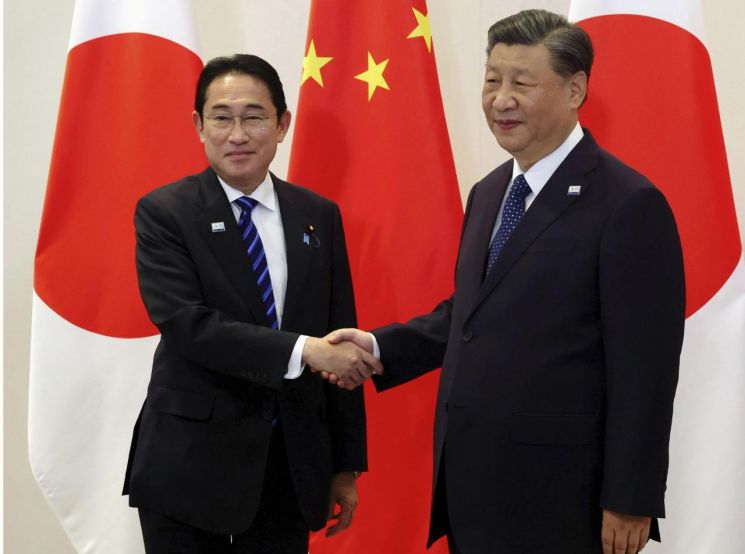
According to Kyodo News on the 17th, Prime Minister Kishida stated at a press conference following the summit that he requested President Xi to lift the import restrictions on seafood related to the discharge of contaminated water from the Fukushima Daiichi Nuclear Power Plant. Kishida said, "We agreed that China and Japan should find a solution to the seafood import restrictions through consultation and dialogue," adding, "We are considering having experts discuss the contaminated water issue (referred to by the Japanese government as 'treated water')."
Earlier, the Japanese government began discharging contaminated water from the Fukushima nuclear plant into the ocean for the first time on August 24, and China strongly opposed this unilateral action, responding by completely suspending imports of Japanese seafood. The suspension of exports to China and Hong Kong, which accounted for more than half of Japanese seafood sales, dealt a significant blow to Japanese fishermen and the seafood industry.
Additionally, Prime Minister Kishida revealed that he discussed maritime territorial disputes with President Xi. He said, "I requested the immediate removal of buoys installed by China within Japan's exclusive economic zone (EEZ) in the Senkaku Islands (known as Diaoyu Islands in China), with which China has territorial disputes with Japan." He added, "I expressed serious concerns about China strengthening military activities around Japan in cooperation with Russia and conveyed that peace and stability in the Taiwan Strait are extremely important to the international community." He also emphasized, "I urged the early release of Japanese nationals detained in China on espionage charges."
However, the two leaders reaffirmed their commitment to continue pursuing the strategic and mutually beneficial relationship, which is a common goal of bilateral relations. Prime Minister Kishida explained, "We shared the recognition that communication at various levels, including between leaders, must continue," and "We reaffirmed that Japan and China will comprehensively promote a strategic and mutually beneficial relationship."
Here, the strategic and mutually beneficial relationship refers to the diplomatic goal agreed upon by former Japanese Prime Minister Shinzo Abe and former Chinese President Hu Jintao during Abe's visit to China in 2006. The strategic and mutually beneficial relationship, as stated in the joint statement issued by the two countries in 2008, reflects the shared recognition that both countries have significant influence and responsibility for peace, stability, and development not only in the Asia-Pacific region but also globally, and that long-term cooperation for peace and friendship is the only option for both sides.
© The Asia Business Daily(www.asiae.co.kr). All rights reserved.
![Clutching a Stolen Dior Bag, Saying "I Hate Being Poor but Real"... The Grotesque Con of a "Human Knockoff" [Slate]](https://cwcontent.asiae.co.kr/asiaresize/183/2026021902243444107_1771435474.jpg)















