266 Stores in Large Mart
One in Five Stores Overall
Aiming for Increased Sales by Riding Customer Attraction Effect
Daily goods store Daiso is strengthening its position by entering large supermarkets with high foot traffic. This business strategy is interpreted as an effort to increase sales by leveraging the customer attraction effect that large supermarkets inherently possess.
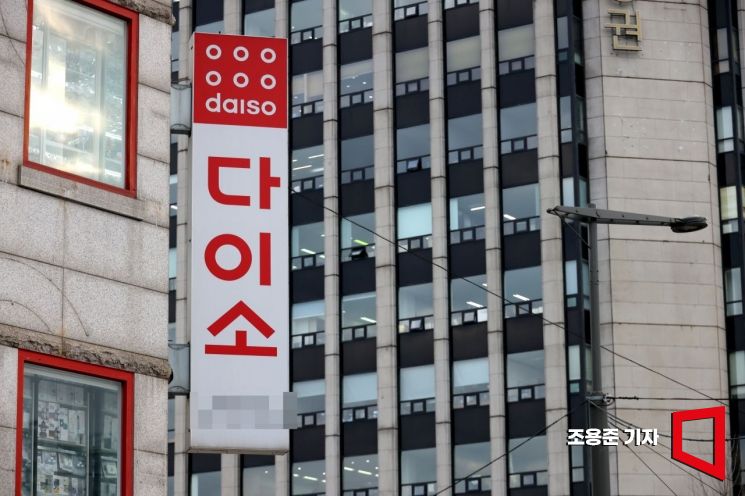 The household goods store 'Asung Daiso' has purchased all shares of the Japanese Daiso Sangyo, in which it was the second-largest shareholder. This move is expected to remove the label of being a 'Japanese company' and transform it into a native Korean company. The photo shows a Daiso store located in Jongno-gu. Photo by Yongjun Cho jun21@
According to industry sources on the 20th, the number of Daiso stores operating inside large supermarkets was 266 as of the end of last year. Considering that there are about 1,450 Daiso stores nationwide, one out of every five stores is located in a large supermarket.
Daiso has been increasing the proportion of stores inside large supermarkets every year. The number rose from 253 in 2020 to 258 the following year, an increase of 5 stores, and expanded by 8 more last year. This year, new stores have opened in large supermarkets located in Jung-gu, Seoul, and Deogyang-gu, Goyang, Gyeonggi Province.
The reason behind Daiso's expansion of store presence inside large supermarkets is the customer attraction effect. A Daiso representative said, "Since most sales come from offline, it is natural to open stores in good locations. Large supermarkets are basically located in good commercial areas and have well-equipped convenience facilities such as parking lots, which makes their customer attraction effect excellent."
Opening small-scale stores inside large supermarkets can also save on operational costs such as labor. For example, in the case of A Mart, if the store size is less than 250 pyeong (approximately 826 square meters), payment is required to be processed through the supermarket's checkout counters. From Daiso's perspective, this means there is no need to install separate checkout counters or employ staff to assist with payments inside the store.
The fact that rent is not significantly different compared to surrounding commercial areas is also a positive factor. Rent is an important consideration for Daiso, which gains margin through a high-volume, low-margin strategy, when expanding stores, but in the case of large supermarkets, it is not an operational burden. A Daiso representative said, "If the rent in large supermarkets were particularly expensive, it would have been difficult to enter from a profitability standpoint."
However, renewals conducted by large supermarkets are considered variables in store expansion and operation. This is because forced closures can occur unintentionally during renewals. In fact, a large supermarket located in Gwonseon-gu, Suwon-si, Gyeonggi Province recently downsized its store through a renewal, resulting in the disappearance of the Daiso store. Some Daiso stores also closed due to store replacements in nearby complex shopping malls.
© The Asia Business Daily(www.asiae.co.kr). All rights reserved.
![Clutching a Stolen Dior Bag, Saying "I Hate Being Poor but Real"... The Grotesque Con of a "Human Knockoff" [Slate]](https://cwcontent.asiae.co.kr/asiaresize/183/2026021902243444107_1771435474.jpg)















