2023 Korea Annual Consultation Report
The International Monetary Fund (IMF) has forecast South Korea's gross domestic product (GDP) growth rate for this year to remain unchanged at 1.4%. It expects the growth rate to reach the 2% range next year, supported by improvements in semiconductor exports starting in the second half of this year. To stabilize prices, the IMF recommended maintaining the current high interest rate stance for a considerable period and advised against premature monetary policy easing, given the persistent potential risks such as high household and corporate debt.

On the 17th, the IMF predicted in its '2023 Korea Article IV Consultation Report' that South Korea's economic growth rate will be 1.4% this year and 2.2% next year. This forecast is consistent with the outlook presented in last month's World Economic Outlook. Previously, the IMF had revised South Korea's growth rate downward throughout the year: from 1.7% in January to 1.5% in April, then 1.4% in July and October. However, it expects the Korean economy to gradually rebound from the second half of this year, supported by improvements in semiconductor exports and recovery in the tourism industry.
Regarding the South Korean government's policy direction, the IMF largely assessed it as aligned with its policy recommendations. The IMF positively evaluated the government's efforts to tighten the belt in next year's budget and to normalize fiscal policy through the introduction of fiscal rules. In particular, it analyzed that the fiscal rules, with appropriately set management indicators and limits, will help address South Korea's long-term challenges such as rapid population aging.
The IMF forecast that South Korea's inflation rate will continue to decline, reaching 3.6% this year and 2.4% next year. This matches the inflation forecast (3.6%) announced by the Korea Development Institute (KDI) on the 9th and is 0.2 percentage points lower than KDI's forecast for next year (2.6%). The IMF advised that "it is important to maintain the current high interest rate stance for a considerable period to stabilize prices." Fortunately, it evaluated that South Korea's current monetary policy is being pursued in an appropriate direction. Although the current account surplus is at about 1.3% of GDP this year due to weak demand from major trading partners, it is expected to gradually improve and recover to around 4.0% in the medium to long term.
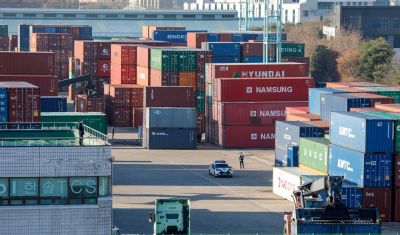
South Korea's High Household and Corporate Debt Pose Risks
The IMF warned that South Korea's financial sector faces potential risks due to high household and corporate debt, as well as project financing (PF) loans from non-bank financial institutions. However, considering the manageable level of these risks, the sufficient financial assets held by households and corporations, and strict macroprudential regulations, the IMF assessed that the likelihood of systemic financial market risks is low. It advised that financial support should be provided temporarily and selectively to vulnerable households and businesses. Furthermore, it emphasized the need to strengthen soundness regulations and establish monitoring systems for non-bank financial institutions.
The IMF urged continuous structural reforms to enhance South Korea's potential growth rate and respond to demographic changes. It explained that labor-related systems such as employment types, working hours, and wage structures need to be more flexible to improve productivity. Efforts to reduce gender disparities in the labor market were also called for. The IMF suggested that "pension reform should be pursued by balancing medium- to long-term fiscal soundness and the high elderly poverty rate, and more aggressive climate change policies by the South Korean government are necessary to achieve the 2030 greenhouse gas reduction targets."
Meanwhile, the IMF announced that starting this year, it will evaluate the adequacy of South Korea's foreign exchange reserves solely through qualitative assessments, excluding the previous quantitative evaluations, aligning with other advanced economies. Based on qualitative assessments including stress tests, the IMF explained that South Korea's foreign exchange reserves are sufficient to respond to external shocks. This report was prepared based on interviews conducted by a six-member IMF mission team, led by Mission Chief Herald Finger, with government ministries and related agencies such as the Ministry of Economy and Finance and the Bank of Korea from August 24 to September 6.
© The Asia Business Daily(www.asiae.co.kr). All rights reserved.
![Clutching a Stolen Dior Bag, Saying "I Hate Being Poor but Real"... The Grotesque Con of a "Human Knockoff" [Slate]](https://cwcontent.asiae.co.kr/asiaresize/183/2026021902243444107_1771435474.jpg)
















