The three major indices of the U.S. New York stock market showed slight declines in early trading on the 16th (local time) as investors monitored corporate earnings and economic indicators. It appears that the market is taking a brief pause and catching its breath after a rally driven by easing inflation.
At around 10:52 a.m. at the New York Stock Exchange (NYSE), the Dow Jones Industrial Average, which focuses on blue-chip stocks, was trading around the 34,900 level, down 0.26% from the previous close. The large-cap S&P 500 index was down 0.15% at 4,496, while the tech-heavy Nasdaq index was down 0.31% at 14,059.
Currently, energy, consumer staples, and consumer discretionary sectors within the S&P 500 are declining. In contrast, utilities, communication, and technology sectors are on the rise. Cisco Systems fell nearly 12% after lowering its future revenue guidance. Palo Alto dropped more than 5% following a weak earnings outlook. Walmart fell over 7% despite better-than-expected earnings, as it lowered its future net income forecast. On the other hand, department store chain Macy's jumped about 7% on quarterly results that exceeded expectations. Among other major tech stocks, Alphabet (Google), Microsoft, and Apple all rose more than 1%. Tesla declined by over 2%.
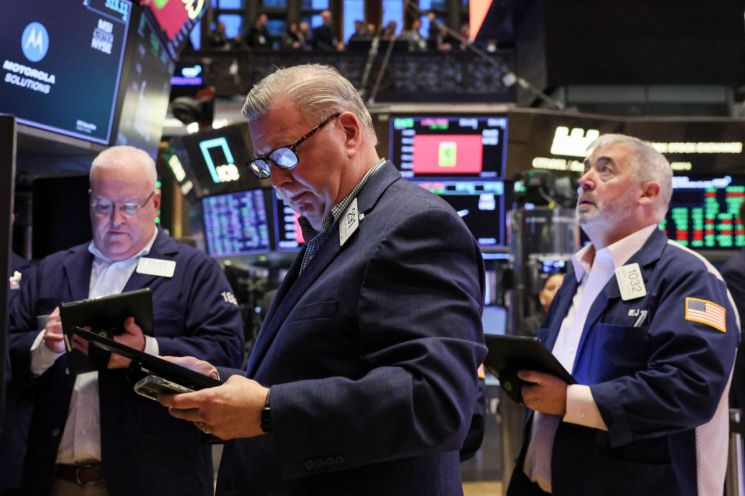
Investors are taking a wait-and-see approach as they review corporate earnings, particularly from retailers, and economic data. The market, which had rallied following the release of consumer price index (CPI) and producer price index (PPI) figures that showed slower inflation than expected, now appears to be pausing. Since November, the S&P 500 has risen more than 7%, the Dow nearly 6%, and the Nasdaq jumped 9.8%.
The weekly initial jobless claims in the U.S. for the period of November 5-11 were 231,000, an increase of 13,000 from the previous week. This figure exceeded the Dow Jones consensus forecast of 222,000. The number of unemployed receiving benefits for more than two weeks reached the highest level in about two years. Continuing claims, which represent those filing for unemployment benefits for at least two weeks, rose by 32,000 to 1,865,000. This suggests that existing unemployed individuals are facing increasing difficulties in finding new jobs.
These employment figures can be interpreted as additional signals that the cumulative effects of the Federal Reserve's interest rate hikes are gradually impacting the labor market. The Fed has been closely monitoring employment indicators, believing that labor market cooling is necessary to curb inflation. However, some argue that these changes may be due to seasonal fluctuations.
On the same day, U.S. import prices for October fell 0.8% month-over-month, a larger drop than experts had forecast according to Dow Jones data. This, like the previously released CPI and PPI, is seen as a signal reinforcing the trend of easing inflation. Industrial production in October decreased by 0.6% compared to the previous month, missing both forecasts and the prior month's figures. This decline is attributed to a sharp drop in automobile and parts production due to the United Auto Workers (UAW) strike.
Chris Larkin of Morgan Stanley stated, "It is too early for the Fed to declare victory over inflation, and rate cuts are still far off," but added, "These indicators will ease concerns about further rate hikes. The key question is whether these 'Fed-friendly indicators' will continue to provide bullish momentum to the stock market."
According to the Chicago Mercantile Exchange (CME) FedWatch tool, as of the morning of the same day, the federal funds futures market reflects a 99.5% probability that the Fed will keep rates steady at 5.25-5.5% at the next meeting in December. The probability that rates will remain unchanged through January is 93.3%.
The shutdown crisis that had the financial markets on edge has eased. The U.S. Senate passed an additional temporary budget bill on the previous day, allowing government operations to continue through January and February of next year, thus avoiding a shutdown at least until then. However, opposition led by hardline Republicans continues, raising concerns that shutdown risks may reemerge after this temporary budget expires. The budget bill, led by House Speaker Mike Johnson, a Republican, staggers the exhaustion of budgets across government departments and notably excludes large budget cuts opposed by Democrats as well as contentious aid packages for Ukraine and Israel.
In the New York bond market, Treasury yields declined. The benchmark 10-year U.S. Treasury yield fell to around 4.44%. The 2-year yield, which is sensitive to monetary policy, stood at 4.83%. The dollar index, which measures the value of the U.S. dollar against six major currencies, dropped 0.2% to 104.1.
European stock markets showed mixed performance. Germany's DAX index rose 0.45%, while France's CAC index fell 0.33%, and the UK's FTSE index declined 0.79%.
© The Asia Business Daily(www.asiae.co.kr). All rights reserved.
![Clutching a Stolen Dior Bag, Saying "I Hate Being Poor but Real"... The Grotesque Con of a "Human Knockoff" [Slate]](https://cwcontent.asiae.co.kr/asiaresize/183/2026021902243444107_1771435474.jpg)















