With the introduction of the cell therapy drug 'Kymriah,' which can cure leukemia with just a single administration, interest in advanced regenerative medicine led by cell and gene therapy (CGT) is growing in South Korea.
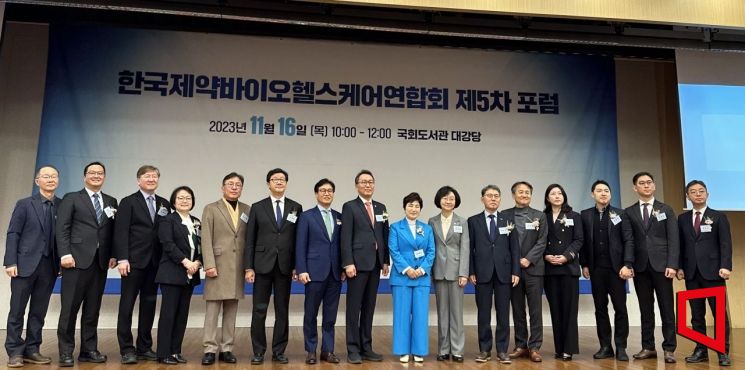 On the 16th, participants are taking a commemorative photo at the Korea Pharmaceutical Bio Healthcare Association-hosted forum titled "Future Food of Korea - Fostering Advanced Regenerative Medicine and Advanced Biopharmaceutical Industry and Globalization," held at the National Assembly Library Auditorium in Yeongdeungpo-gu, Seoul.
 [Photo by Lee Chunhee]
On the 16th, at the National Assembly Library Auditorium in Yeongdeungpo-gu, Seoul, a forum titled "Future Food of Korea: Promotion and Globalization of Advanced Regenerative Medicine and Advanced Biopharmaceutical Industry" was held to assess the current status of the advanced regenerative medicine industry and discuss future directions on the third anniversary of the enforcement of the "Act on the Safety and Management of Advanced Regenerative Medicine and Advanced Biopharmaceuticals (Advanced Regenerative Bio Act)."
The event was hosted by the Korea Pharmaceutical Bio Healthcare Federation and organized by the Advanced Regenerative Medicine Industry Association. The Korea Pharmaceutical Bio Healthcare Federation, launched in January, is a coalition formed by major domestic associations in the pharmaceutical, bio, and digital healthcare industries, including the Korea Pharmaceutical and Bio Association, Korea Smart Healthcare Association, Korea Biopharmaceutical Association, Korea Pharmaceutical Importers and Exporters Association, Korea New Drug Development Research Association, and the Advanced Regenerative Medicine Industry Association. To raise awareness of industry issues and share proactive agendas, these organizations take turns hosting forums every two months.
Advanced regenerative medicine refers to technologies that treat diseases by replacing human body structures or functions using human cells, among other methods. Examples include treating macular degeneration, an ophthalmic disease, with stem cells, gene therapy using chimeric antigen receptor (CAR)-T cells, tissue engineering therapies, and hybrid therapies combining these approaches.
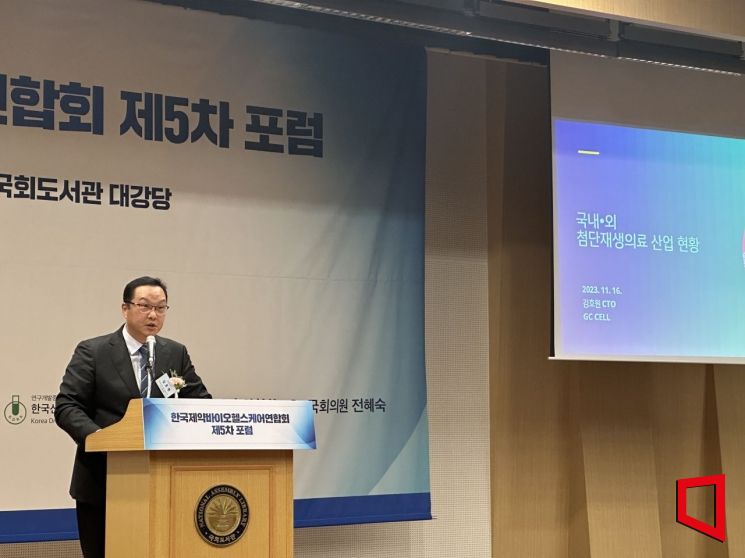 On the 16th, Kim Ho-won, CTO of GC Cell, is presenting at the seminar titled "Future Food of Korea - Fostering and Globalizing the Advanced Regenerative Medicine and Advanced Biopharmaceutical Industry," hosted by the Korea Pharmaceutical Bio Healthcare Association, held at the National Assembly Library Auditorium in Yeongdeungpo-gu, Seoul.
 [Photo by Lee Chun-hee]
Kim Ho-won, CTO of GC Cell, explained, "It is expected to provide a new alternative for an aging society and patients with rare and intractable diseases for which there are no treatments. Since major global countries such as the U.S., Europe, Japan, and Korea enacted related laws and since the approval of 'Kymriah' in 2017, the advanced regenerative medicine industry has been growing rapidly."
The market size of the advanced regenerative medicine industry is expected to grow at an average annual rate of 22.8%, reaching $174.7 billion (approximately 225 trillion KRW) by 2032. Leading this market is the CAR-T cell therapy market. Currently, Kymriah, Yescarta, Tecartus, Breyanzi, Abecma, and Carvykti have been approved. Kim CTO noted, "This is likely because the future market outlook is the most promising," adding, "Global pharmaceutical companies are focusing on developing fourth-generation CAR-T platforms targeting solid tumors through independent or joint research."
To capitalize on the growth of the advanced regenerative medicine industry, Kim CTO appealed, "A national-level strategy is required." He emphasized, "For the continuous development of the industry, it is necessary to train a large number of professionals with advanced technology and provide R&D funding support to promising pharmaceutical and biotech companies."
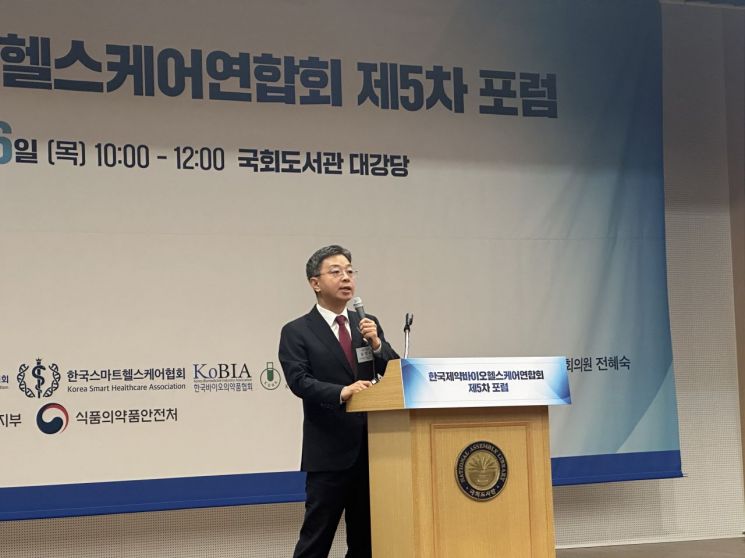 On the 16th, Kim Geon-su, CEO of Curecell, is presenting at the forum titled "Future Food of Korea - Fostering Advanced Regenerative Medicine and Advanced Biopharmaceutical Industry and Globalization," hosted by the Korea Pharmaceutical Bio Healthcare Association, held at the National Assembly Library Auditorium in Yeongdeungpo-gu, Seoul.
 [Photo by Lee Chun-hee]
Following this, Kim Geon-su, CEO of Curecell, which is conducting Phase 2 clinical trials of 'Anbalcel' aiming to develop the first domestic CAR-T therapy, stated, "In the past, anticancer drugs could not distinguish well between healthy and cancer cells, leading to side effects and the saying 'patients died from the anticancer drugs themselves.' Immuno-oncology drugs have almost no side effects, allowing patients to maintain their quality of life, and CAR-T is the most advanced and the only field where actual products have been developed," emphasizing high expectations for the future.
Curecell recently completed the last patient dosing in the Phase 2 clinical trial of Anbalcel for diffuse large B-cell lymphoma (DLBCL), involving 80 patients in Korea. They plan to analyze the results next year and submit a new drug application to the Ministry of Food and Drug Safety around September.
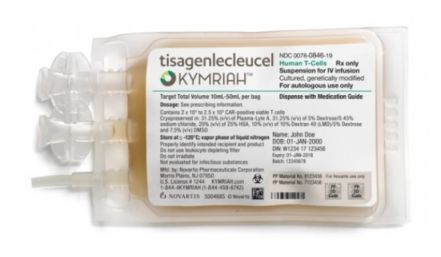
Kim CEO emphasized, "CAR-T can treat terminal cancer with a single administration," adding, "When Kymriah was approved, some doctors said, 'I've never seen anything like this in my lifetime,' highlighting its revolutionary nature." He also noted, "Currently, six products are available for hematologic cancers, but there are no CAR-T therapies for solid tumors such as lung and colorectal cancers, which rank 1st to 9th in global cancer mortality statistics. This means there is still an opportunity for us, and with proper preparation, we can seize opportunities in solid tumors," offering a hopeful analysis.
He called for efforts to activate clinical trials, stating, "Because CAR-T therapies utilize the complex human immune system, their value cannot be confirmed through animal testing. To realize their value, it is necessary to enter clinical trials quickly and test the drug on even a small number of patients," highlighting the need for infrastructure and regulatory improvements.
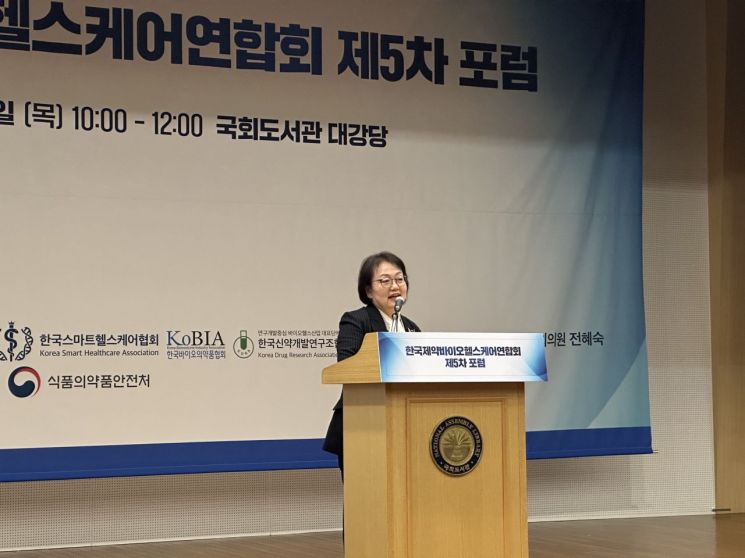 On the 16th, Park Sora, Director of the Regenerative Medicine Promotion Foundation, is presenting at the forum titled "Future Food of Korea - Fostering and Globalizing the Advanced Regenerative Medicine and Advanced Biopharmaceutical Industry," hosted by the Korea Pharmaceutical Bio Healthcare Association, held at the National Assembly Library Auditorium in Yeongdeungpo-gu, Seoul.
 [Photo by Lee Chunhee]
Park So-ra, Director of the Regenerative Medicine Promotion Foundation, stressed that improving patient accessibility to CGT, which is currently low to the extent that the term 'stem cell tourism' has emerged, is an urgent task. As a solution, Park pointed out, "In many countries, patients can pay for treatments that are not approved, whereas in Korea, only clinical research is allowed."
She further noted the need to revise the Advanced Regenerative Bio Act, which has been in effect for three years, to improve the system. Currently, amendment bills have been proposed in the National Assembly by Assemblyman Kang Ki-yoon of the People Power Party and Assemblywoman Jeon Hye-sook of the Democratic Party. These bills include provisions to expand research subjects to clinical research participants to promote clinical research. Additionally, various system improvements are necessary, such as ongoing projects to allow clinical research results to be used as evidence linked to clinical trials.
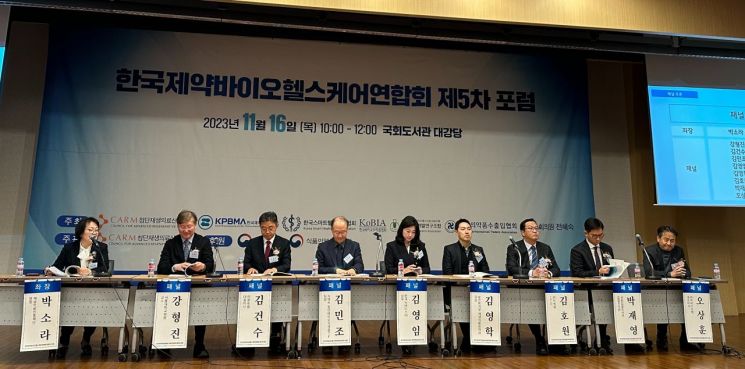
During the subsequent discussion, various detailed suggestions for revitalizing the advanced regenerative medicine industry were presented. Kang Hyung-jin, Professor of Pediatrics at Seoul National University Hospital, advised, "Globally, investigator-initiated clinical trials account for 80% of all clinical trials, but in Korea, it is only about 20%. Since Kymriah and Yescarta were all developed by universities or research institutes, regulatory relaxation to activate investigator-initiated trials is necessary."
Kim Young-im, Executive Director of Korea Novartis, which introduced Kymriah to Korea for treatment, urged regulatory easing for facilities required for cell collection, as Kymriah is a 'patient-tailored therapy.' Kim said, "I understand that Korea is the only country requiring a permit for managing human cells and tissues to use Kymriah. Medical institutions must invest in facilities, and patients cannot receive treatment at hospitals without such permits," calling for regulatory improvements that enable coexistence. Kim Ho-won CTO also noted, "Since the installation cost is about 1 billion KRW, only about five top hospitals have the facilities," suggesting that regulations forcing patients in provinces to visit these hospitals should be relaxed.
Kim CTO added that due to the nature of CGT, where follow-up research is important, "data standards are very important," emphasizing, "Standards must be well established to protect personal information while maintaining anonymity and obtaining extensive information." Park Jae-young, Legislative Research Officer at the National Assembly Legislative Research Office, also explained, "We need to find ways to resolve personal information infringement issues," and stressed the necessity for academia and industry to propose related data standards.
Kim Young-hak, Director of Regenerative Medicine Policy at the Ministry of Health and Welfare, stated, "We are conducting research with awareness of data-related issues," adding, "We are studying cases from other countries and planning necessary legislative and judicial measures." He also mentioned considering various supports for workforce training and technology development projects, expressing expectations for the 'Korean-style Advanced Research Projects Agency for Health (ARPA-H)' and the 'Boston-Korea Project,' which will start next year and focus on advanced regenerative medicine.
© The Asia Business Daily(www.asiae.co.kr). All rights reserved.
![Clutching a Stolen Dior Bag, Saying "I Hate Being Poor but Real"... The Grotesque Con of a "Human Knockoff" [Slate]](https://cwcontent.asiae.co.kr/asiaresize/183/2026021902243444107_1771435474.jpg)

















