"Serving all dishes together on one table, known as hansangcharim, can be considered the most distinctive feature of Korean cuisine."
The Korea Craft & Design Foundation (KCDF) is actively promoting hansangcharim, which can be regarded as the foundation of Korean food culture.
With the global popularity of K-pop increasing interest in Korean culture, Korean cuisine is also gaining worldwide attention. On social networking services (SNS), it is easy to find videos of foreigners making Korean dishes. They prepare not only relatively simple dishes like tteokbokki but also various foods such as japchae and galbijjim, which are difficult even for Koreans to make.
However, to truly understand Korean food culture, one must know about hansangcharim, which consists of rice and side dishes. Our bansang (飯床) culture involves serving hansangcharim on a soban, with rice as the staple and side dishes as accompaniments. A soban is a single-person table used to hold dishes or for dining, closely related to Korea’s traditional floor-sitting lifestyle and culture. Korean cuisine based on hansangcharim is not just about the food itself but represents the entirety of our food, clothing, and shelter lifestyle culture.
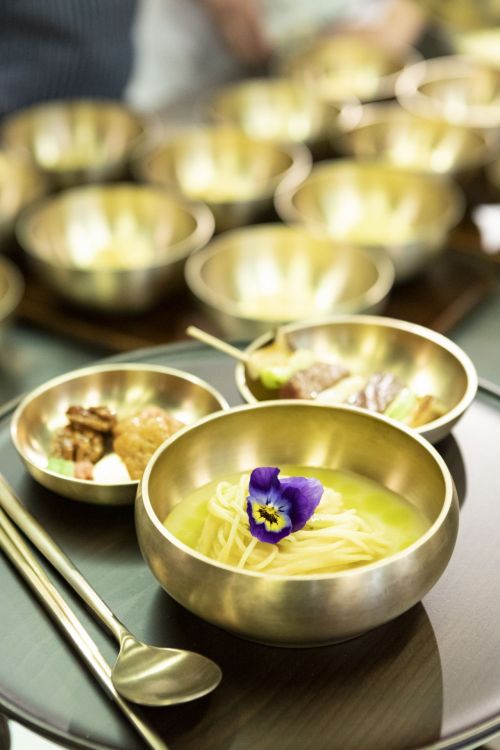 A Korean traditional meal set presented at the Korean Food Culture Class held in Milan, Italy, last April by the Korea Craft & Design Foundation.
 [Photo by Korea Craft & Design Foundation]
Accordingly, KCDF launched the 'Korean Food Culture Promotion Campaign' in 2020. This campaign goes beyond the previous limits of promoting Korean food culture, which was confined to single menu recipes and traditional uniqueness, to promote the true meaning of Korean food culture based on hansangcharim.
KCDF successfully completed campaigns to promote Korean cuisine in Paris, France, and New York, USA, in 2021 and 2022. This year, they conducted a promotional campaign titled 'HANSIK: That's SOBAN,' focusing on soban filled with sincerity and elegance. They held Korean food culture classes for about 90 locals in Milan, Italy, and Jakarta, Indonesia, introducing various cultures related to Korean cuisine, including soban, bojagi (traditional wrapping cloth), yugi (brassware), and onggi (earthenware).
At the Korean food culture class held last April at Eataly, a food culture center in downtown Milan, Italy, they attracted local interest by making kongguksu (cold soybean noodle soup) using locally sourced chickpeas and presenting a hansangcharim consisting of sanjeok skewers and yakgwa (traditional honey cookies). In September, at the Korean food culture class held at Almond Zucchini in South Jakarta, Indonesia, they showcased dakgangjeong (sweet crispy fried chicken) made with sambal sauce, a traditional Indonesian sauce, as the main dish, along with royal court-style tteokbokki and geotjeori (fresh kimchi).
Kim Tae-wan, head of the Traditional Living Culture Division at KCDF, said, "As the saying goes, understanding a country’s food culture reveals its culture. I wanted to convey that hansik (Korean food) is a culture accumulated over a long time by Koreans, including the procedures and methods of enjoying food and the spatiotemporal environment." He added, "We will continue meaningful work to share the values and beauty embedded in Korean food culture with people around the world."
© The Asia Business Daily(www.asiae.co.kr). All rights reserved.
![Clutching a Stolen Dior Bag, Saying "I Hate Being Poor but Real"... The Grotesque Con of a "Human Knockoff" [Slate]](https://cwcontent.asiae.co.kr/asiaresize/183/2026021902243444107_1771435474.jpg)















