Bank of Korea Analyzes 'AI and Labor Market Changes'
As the utilization of artificial intelligence (AI) in work increases, an analysis has revealed that 3.41 million jobs in South Korea, accounting for 12% of all jobs, are highly likely to be replaced by AI. Jobs with a high AI exposure index include chemical engineering technicians, power plant operators, and metallurgical engineering technicians. Notably, doctors, one of the country's representative high-income professions, also show a high possibility of AI replacement.
On the 16th, the Bank of Korea stated in its report "BOK Issue Note: AI and Labor Market Changes" that "while AI can bring productivity increases, it also contains concerns about a future without employment."
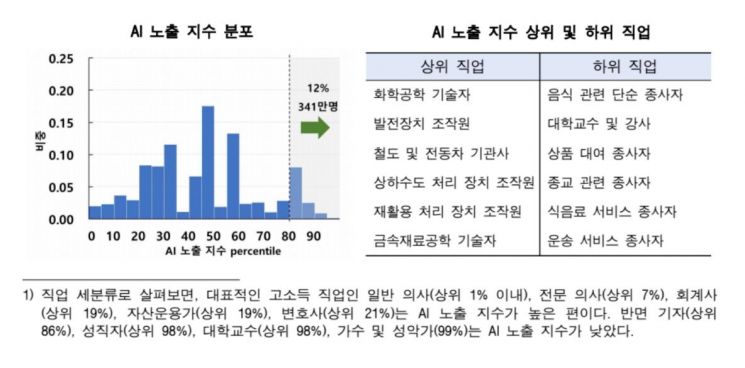
According to the report, using AI patent information to calculate the AI exposure index by occupation, about 3.41 million workers in South Korea (12% of total employed persons) are highly likely to be replaced by AI technology. Unlike existing technologies such as industrial robots and software, high-income and highly educated workers are more exposed to AI, as AI tends to replace non-repetitive and cognitive (analytical) tasks.
In particular, jobs with the highest AI exposure index include chemical engineering technicians, power plant operators, and metallurgical engineering technicians. These jobs are characterized by their suitability for streamlining tasks using large-scale data. Conversely, jobs with the lowest AI exposure index are simple service workers and religious workers, fields where face-to-face contact and relationship building are essential.
High AI Exposure Index for Doctors, Accountants, and Lawyers
Looking at detailed occupational classifications, typical high-income professions such as general practitioners, specialist doctors, accountants, asset managers, and lawyers have a high AI exposure index. On the other hand, journalists, clergy, university professors, and singers/vocalists have a low AI exposure index. Oh Sam-il, head of the Employment Analysis Team at the Bank of Korea's Research Department, explained, "Contrary to expectations, journalists have a low AI exposure index because investigative reporting, unlike simple news reporting, is conducted through face-to-face interviews and requires building relationships with sources to write articles. This characteristic likely influenced the results. The AI exposure index is calculated by investigating how many AI patents are related to the tasks, which may have affected the outcome."
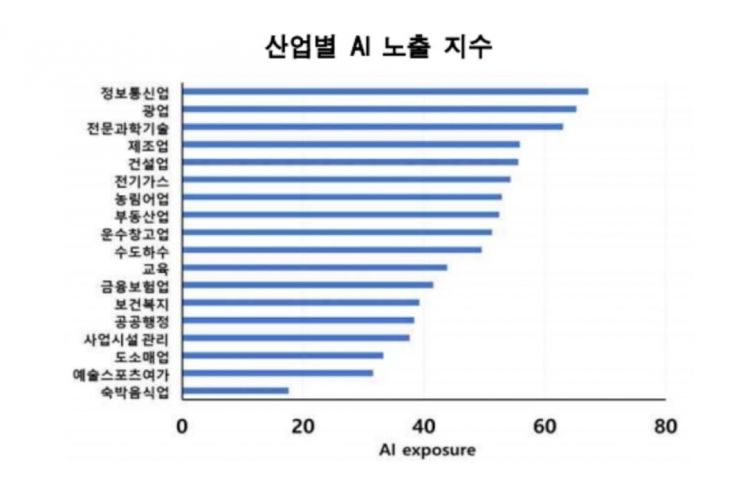
By industry, the AI exposure index is high in high-productivity sectors such as information and communication, professional scientific and technical services, and manufacturing. This is attributed to the widespread use of AI technology in recent years in wireless networks in the information and communication sector and equipment and monitoring solutions in manufacturing. Conversely, face-to-face service industries such as accommodation and food services, arts, sports, and leisure have predictably low AI exposure indices.
Furthermore, considering the decline in related jobs and lower wage growth after the introduction of industrial robots and software over the past 20 years (2000?2021), AI is also analyzed to potentially have a negative impact on jobs with high replacement potential. Han Ji-woo, a researcher in the Employment Analysis Team at the Bank of Korea's Research Department, explained, "Assuming the impact is similar to software, which showed a high correlation with AI, if the AI exposure index increases by 10 percentiles, the employment share of related jobs is expected to decrease by 7 percentage points, and wage growth is expected to be 2 percentage points lower."
The Bank of Korea views that while productivity gains from AI can lead to overall increases in labor demand and wages, the substitution effect is concentrated in specific groups, making changes in education and vocational training policies inevitable. Ultimately, the extent of benefits our society can gain from AI will depend on workers' adaptability and policy design.
Team leader Oh emphasized, "With the introduction of AI, demand for STEM (science, technology, engineering, and mathematics) skills is expected to remain strong, but at the same time, soft skills such as social skills, teamwork ability, and communication skills are likely to be increasingly rewarded. Although AI technology brings convenience to work and life, it can also cause negative social outcomes such as reduced consumer welfare and intensified profit monopolization. Therefore, proactive consideration is necessary to ensure AI develops under appropriate regulation."
© The Asia Business Daily(www.asiae.co.kr). All rights reserved.
![Clutching a Stolen Dior Bag, Saying "I Hate Being Poor but Real"... The Grotesque Con of a "Human Knockoff" [Slate]](https://cwcontent.asiae.co.kr/asiaresize/183/2026021902243444107_1771435474.jpg)

















