The inconvenience of the absence of a subway in Yangcheon-gu, the most densely populated district in Seoul, is not only causing discomfort in mobility but also slowing down regional urban development. Active promotion is needed... To timely respond to the rapidly increasing population and transportation demand due to future redevelopment of Mokdong apartments, redevelopment of Sinwol-dong area, and development of Seobu Truck Terminal, proactive expansion of transportation infrastructure reflecting future demand is essential.
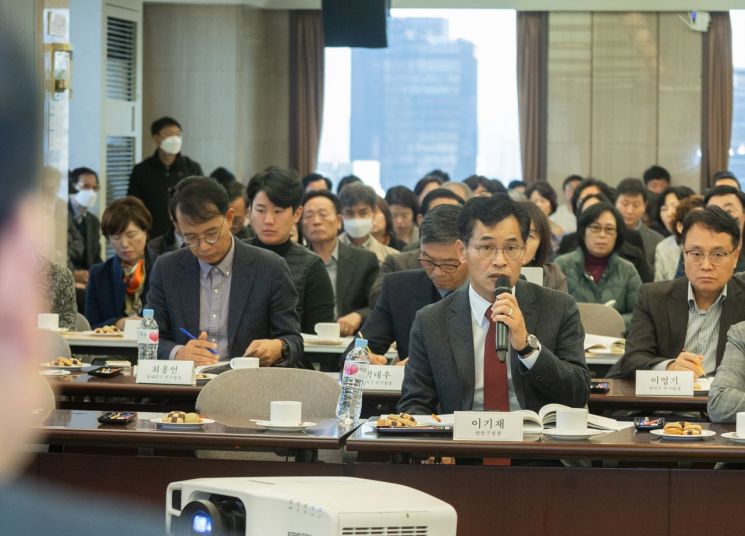 Lee Gijae, Yangcheon District Mayor, emphasized the necessity of opening the Mokdong Line at the preliminary feasibility study system improvement forum held on the 7th.
“Transportation projects are not profit-driven businesses... Urban rail projects should be approached as transportation welfare initiatives,” said a local government head at a recent Seoul city-hosted forum, drawing attention. This is Lee Gijae, the mayor of Yangcheon-gu, Seoul, an area with the highest population density but struggling due to insufficient transportation infrastructure.
As of the end of October 2023, Yangcheon-gu, home to approximately 437,000 residents, has a population density of 25,112 people per square kilometer, ranking first in Seoul for population density. However, its urban rail infrastructure, including subways, is severely lacking compared to other districts.
For example, when comparing the number of subway stations, Gangseo-gu in the southwestern region, which is geographically similar, has a population density of 13,599 people/km²?1.8 times lower than Yangcheon-gu?but has a total of 23 subway stations, 3.8 times more. Yeongdeungpo-gu, with a population density of 15,286 people/km², 1.6 times lower than Yangcheon-gu, has 19 subway stations, whereas Yangcheon-gu only has six subway stations: Mokdong Station, Omokgyo Station, Sinjeong Station, Sinjeongnegeori Station, Yangcheon-gu Office Station, and Sinmokdong Station.
Among these, the section of Nambusunhwan-ro in Sinwol-dong is the only area in Seoul without any rail transportation. Residents there endure daily commutes by overcrowded buses, often transferring two to three times to reach their workplaces.
The absence of transportation modes like subways not only causes inconvenience in mobility but also slows down regional urban development. For this reason, Lee Gijae, mayor of Yangcheon-gu, has continuously worked to expand public transportation infrastructure, including the prompt approval of the preliminary feasibility study for the Mokdong Line light rail and the establishment of Sinwol Sageori Station to extend the Line 2 branch.
In Yangcheon-gu, preliminary feasibility studies are underway for the long-awaited Mokdong Line and the Gangbuk Transversal Line, which crosses east to west. The Mokdong Line is a crucial route running 10.87 km through Yangcheon-gu, connecting Sinwol-dong, Sinjeong-dong, Mokdong, and Dangsan Station in Yeongdeungpo-gu. However, its approval has been delayed due to a lack of economic feasibility.
At a major forum held by Seoul city on the 7th to improve the preliminary feasibility study system, Mayor Lee stated, “The light rail project has been delayed due to deficit issues, but transportation projects are not profit-driven businesses. Trying to make a profit from public transportation is fundamentally wrong,” emphasizing that urban rail projects should be approached as transportation welfare initiatives aimed at balanced regional development and citizen convenience.
He continued, “Light rail is meant to connect areas where subways are difficult to build, acting as capillaries to create a subway network. However, in Seoul and the metropolitan area, if the comprehensive evaluation (AHP) focuses only on economic feasibility and uniformly applies standards based on areas like Gangnam Daechi-dong or Sinwol-dong, it will be difficult to establish urban transportation networks in Seoul’s outskirts.” He criticized the current preliminary feasibility study system for evaluating Seoul as a single region, failing to properly reflect the characteristics of urban rail underserved areas within the city.
He also pointed out the need to expand the scope of reflecting development plans in the preliminary feasibility study as an important improvement. In other words, the current criteria, which only consider approved project permits, should be broadened to include future demand such as population growth.
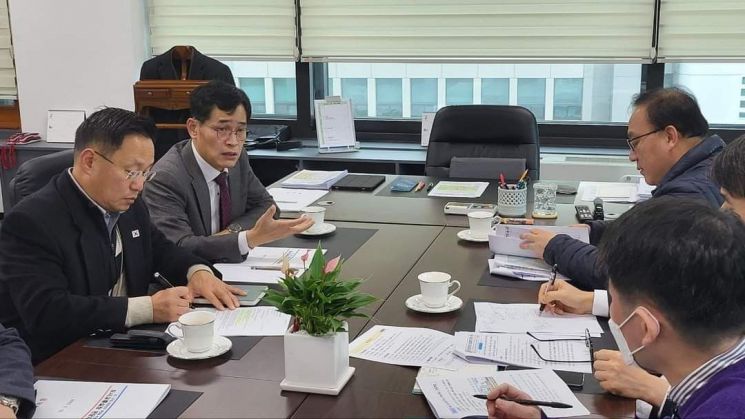 Lee Gijae, Mayor of Yangcheon District, is explaining the traffic issues of Yangcheon District during his visit to the Seoul Metropolitan Government's Urban Transportation Office last February.
Mayor Lee emphasized, “To respond timely to the rapidly increasing population and transportation demand due to projects like the reconstruction of Mokdong Apartments, redevelopment in Sinwol-dong, and the development of the Western Truck Terminal, proactive expansion of transportation infrastructure reflecting future demand is essential.”
Despite railways offering benefits beyond transportation convenience?such as lower carbon emissions compared to other modes, reduced traffic accidents, regional development effects, and environmental improvements?the projects have stagnated for over a decade, increasing local residents’ dissatisfaction and social conflicts.
Lee Gijae, mayor of Yangcheon-gu, stated, “If urban rail construction like the Mokdong Line is delayed solely because it is in Seoul, the project is still in the pre-implementation stage, and excessive economic feasibility logic is applied, the resulting damage will be borne entirely by the residents.” He urged, “Welfare is a fundamental premise for a happy life, so we must no longer hesitate and promptly proceed with the light rail Mokdong Line project.”
© The Asia Business Daily(www.asiae.co.kr). All rights reserved.
![Clutching a Stolen Dior Bag, Saying "I Hate Being Poor but Real"... The Grotesque Con of a "Human Knockoff" [Slate]](https://cwcontent.asiae.co.kr/asiaresize/183/2026021902243444107_1771435474.jpg)
















