3-Night, 4-Day Overseas Business Trip to Singapore from 14th to 17th for Benchmarking Advanced Cases in Urban Planning, Parks, and Green Spaces... Visits to Key Policy Sites Including Large-Scale High-Density Mixed-Use Development, Unique Design, and Sustainable Buildings... Gaining Insights and Exploring Application Plans for Gwangwoon University Station Area Development and Nowon-gu Facing Reconstruction
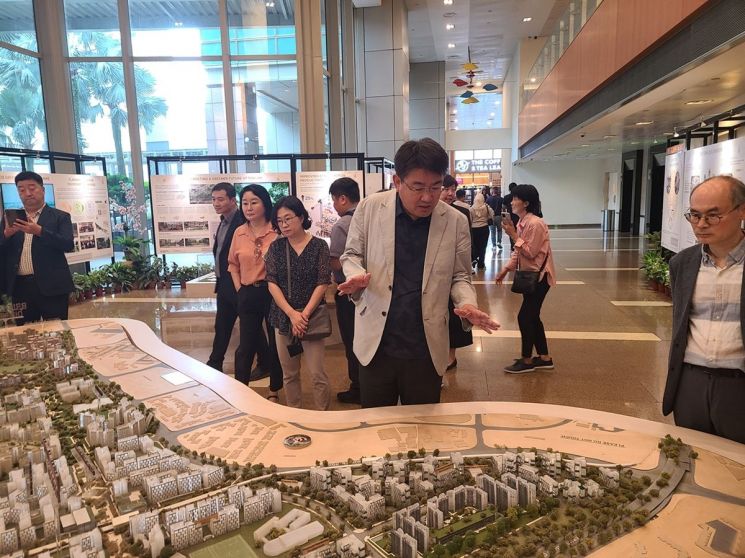
Oh Seung-rok, the mayor of Nowon District Office in Seoul, has embarked on benchmarking advanced overseas cases to devise guidelines for the redevelopment of the region's urban infrastructure.
Although the demand for apartment reconstruction and redevelopment is the highest in Seoul, this effort aims to break away from the monotonous matchbox-shaped skyline.
To this end, on the 14th, Mayor Oh departed for a 3-night, 4-day business trip to Singapore. The purpose is to learn from Singapore’s urban spatial planning, which considers diverse skyline shapes, to promote future residential and mixed-use development complexes and garden city policies.
Singapore is known as an attractive country with high residential stability due to its uniquely designed buildings, large-scale high-density mixed-use developments, and garden city policies.
On the first day of the visit, the 14th, a briefing was held with local experts including Professor Lee Kwan-ok from the Department of Real Estate at the National University of Singapore and urban planner Lee Ji-hye, where they exchanged views on Singapore’s public housing policies and urban planning.
Questions were raised about the success factors behind Singapore’s high residential stability, the impact of housing policies on economic growth, marriage, and childbirth, as well as eco-friendly housing policies aimed at carbon reduction. Suggestions were also received regarding methodological elements for reconstruction in Nowon, a densely populated residential area.
They also inspected Singapore’s first carbon-zero building, the “Faculty of Design and Environment Building” at the National University of Singapore. They received explanations on sustainable design features such as natural ventilation systems, solar power generation, and rainwater recycling facilities, as well as the participatory building management system where users provide feedback, leading to in-depth discussions.
On the 15th, they toured “SkyVille,” one of Singapore’s first public housing estates, which was redeveloped in 2015 into a new space combining community-centered design and greenery. This case, where public housing evolved from basic accommodation to a well-designed, community-focused, more comfortable, and environmentally friendly living space, provided many insights for Nowon District, which is preparing for urban regeneration and reconstruction.
Next, they visited the Urban Redevelopment Authority (URA), which oversees land use and urban planning, receiving detailed explanations about URA’s roles and authority, as well as long-term plans, mid-term plans, and area-specific development plans. They also visited the Housing & Development Board (HDB), responsible for public apartment construction, sales, and purchases, gaining insights into the success factors of Singapore’s housing policies and many exemplary cases.
They toured “Kampung Admiralty,” a senior housing complex specialized for residents aged 55 and older, and “Leiden Heights,” a public housing project designed by world-renowned architect Zaha Hadid, shaped like flower petals.
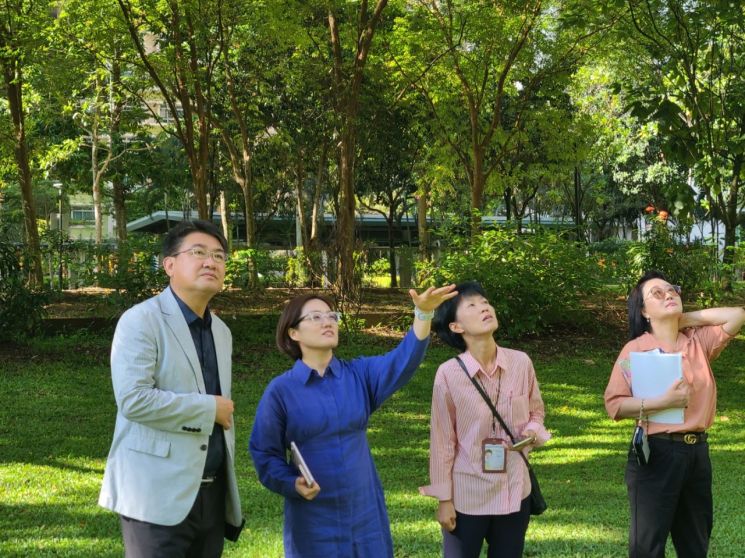
On the 16th, they visited the National Parks Board (NParks), the department responsible for Singapore’s parks and green space policies that realize the concept of a garden city, and toured Ang Mo Kio Park and the Park Connector, a network of parks connected along waterways.
They also plan to visit key policy sites such as “Gardens by the Bay,” the world’s largest column-free greenhouse garden, and “Marina One,” a super high-density mixed-use development complex.
“Marina One” was developed under the White Site zoning (introduced by Singapore’s Urban Redevelopment Authority in 1995 and designated for strategically important areas in the city center), where land use regulations such as floor area ratio and zoning restrictions are completely lifted to enable efficient mixed-use development in limited urban spaces. It features a floor area ratio of 1300%, employs eco-friendly construction techniques, and is realized as a vertical structure with excellent aesthetics and natural ventilation, with a well-designed central plaza and internal green spaces.
Oh Seung-rok, mayor of Nowon District, said, “Nowon District has the highest number of apartments over 30 years old in Seoul, so future reconstruction and redevelopment must be pursued with a vision that embraces the entire city and considers nature. We will do our best to learn from Singapore’s successful urban development cases and draw a big picture that looks beyond 100 years into Nowon’s future.”
© The Asia Business Daily(www.asiae.co.kr). All rights reserved.
![Clutching a Stolen Dior Bag, Saying "I Hate Being Poor but Real"... The Grotesque Con of a "Human Knockoff" [Slate]](https://cwcontent.asiae.co.kr/asiaresize/183/2026021902243444107_1771435474.jpg)
















