Government Unable to Set Schedule for Public Release of University Demand Survey
As the government is in full swing with preliminary plans to expand medical school quotas starting from the 2025 university entrance exams, a tense atmosphere is spreading within the medical community. The tension is heightened as some medical associations have initiated their first collective actions, such as regular work stoppages. Although the government completed a survey on the desired increase in quotas from medical schools nationwide a week ago, it has yet to set a specific announcement schedule. Critics argue that the government is losing momentum in policy implementation due to being overly cautious of the medical community.
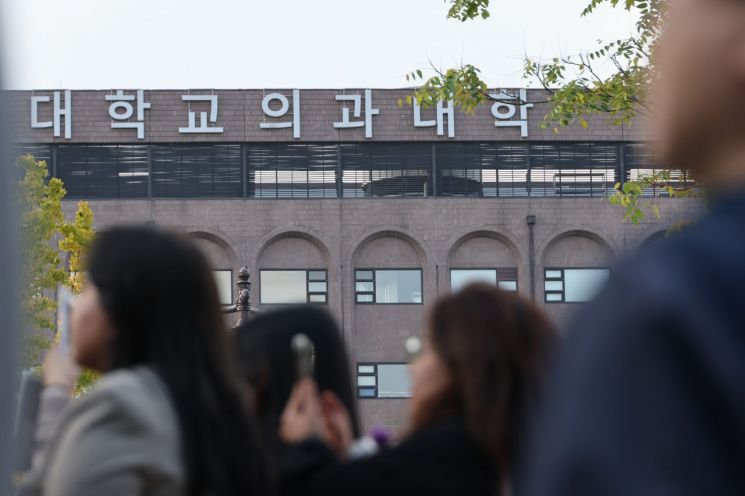
On the 17th, the Ministry of Health and Welfare reportedly has not yet scheduled the announcement of the survey results on quota increase demands from 40 medical schools nationwide. The ministry conducted a two-week survey until the 9th, asking each medical school about their desired quota size from 2025 to 2030. The results were originally planned to be announced on the 13th but were postponed to "within this week." The survey on the demand for medical school quota increases by 2030 is known to reach the high 3,000s. Although the survey only reflects desired numbers, the medical community has expressed discomfort, stating that “the total medical school quota should not be decided solely based on the survey results” (Korean Medical Education Council).
At the medical issues council meeting held on the 15th to discuss the expansion of medical school quotas, the differing positions of the government and the Korean Medical Association (KMA) were reaffirmed. Even at the 17th meeting, the government insists on ‘expanding medical school quotas starting in 2025,’ while the KMA maintains that ‘increasing medical school quotas equals populism,’ remaining at an impasse. This meeting was the first since Lee Kwang-rae, the head of the KMA negotiation team and president of the Incheon Medical Association, resigned, and Yang Dong-ho, chairman of the Gwangju Medical Association delegates, was appointed as the new negotiation team leader. The stance is considered to have become more hardline.
The KMA has stated that if the ‘September 4 Medical Agreement’ reached after the 2020 general strike is violated, it will escalate to more severe struggles. In response, Jung Kyung-sil, Director of Health and Medical Policy at the Ministry of Health and Welfare, criticized, “If the KMA ignores public demands and blocks the expansion of medical personnel, it will inevitably face public criticism for ‘professional self-interest.’”
For the first time, a medical association announced plans for regular work stoppages. The Gyeonggi-do Medical Association, a group of doctors in the Gyeonggi region, declared that they will take half-days off every Wednesday afternoon and hold protest rallies in front of the Presidential Office in Yongsan-gu, Seoul. It is reported that 50 to 100 members will participate. A medical industry insider said, “If the issue of expanding medical school quotas is pushed forward without discussions within the medical community, more medical associations may engage in collective actions.”
Some speculate that due to ongoing opposition from the medical community, the Ministry of Health and Welfare may not disclose the survey results on quota demands by medical school. If this happens, the government, which must finalize the 2025 medical school quotas by early next year at the latest, will face criticism for losing momentum in policy implementation due to being overly cautious of the medical community.
The medical community repeatedly emphasizes the stance of ‘first (先) establishing essential medical measures, then (後) discussing medical school quota expansion.’ The government has proposed a policy package alongside the quota increase, including measures to reduce legal burdens on medical personnel and increase fees for high-risk and complex surgeries. Improvements to pediatric and obstetric fees will also be implemented. This is in response to the medical community’s suggestion that a system must be established to deploy medical personnel to regional and essential medical fields.
However, it remains uncertain whether the gap between the government and the medical community regarding how many more essential medical measures need to be prepared before expanding medical school quotas will narrow. A Ministry of Health and Welfare official emphasized, “Given the reality, shown by various statistics, that there will be a shortage of medical personnel in the future, we urge the medical community to adopt a more progressive stance.”
© The Asia Business Daily(www.asiae.co.kr). All rights reserved.
![Clutching a Stolen Dior Bag, Saying "I Hate Being Poor but Real"... The Grotesque Con of a "Human Knockoff" [Slate]](https://cwcontent.asiae.co.kr/asiaresize/183/2026021902243444107_1771435474.jpg)















