Korea-Saudi Hydrogen Economy Cooperation, Domestic Clean Hydrogen Certification System Improvement and Other Positive Factors
Doosan Fuel Cell, Hyosung Advanced Materials, JNK Heater, Iljin High Solus, etc. in Focus
President Yoon Suk-yeol promised cooperation on the hydrogen economy between South Korea and Saudi Arabia during his state visit to Saudi Arabia, and with the government improving the domestic clean hydrogen certification system, the previously subdued ‘hydrogen-related stocks’ are receiving renewed attention.
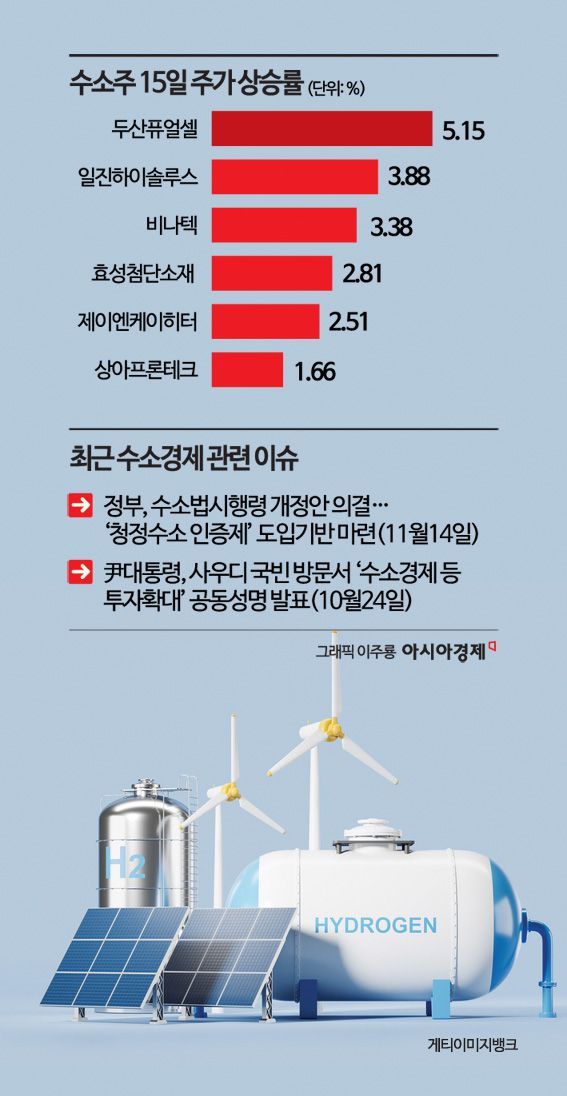
According to the Korea Exchange on the 16th, the stock price of Doosan Fuel Cell, considered a representative company in the hydrogen economy, closed at 19,400 KRW, up 5.15% from the previous day. The stock price of this company, which develops fuel cells for hydrogen power generation, had fallen to 16,050 KRW on the 1st but has recently been on the rise.
Hyosung Advanced Materials, which produces carbon fiber used in hydrogen storage tanks, closed at 384,500 KRW, up 2.81% from the previous day. JNK Heater, a company that builds hydrogen charging stations and develops hydrogen extractors, ended trading at 5,300 KRW, up 2.51%. Hydrogen tank company Iljin Hysolus recorded a 3.88% increase to 22,750 KRW. Similarly, other hydrogen-related stocks such as Vinatek (3.38%) and Sanga Front Tech (1.66%) also closed higher the previous day.
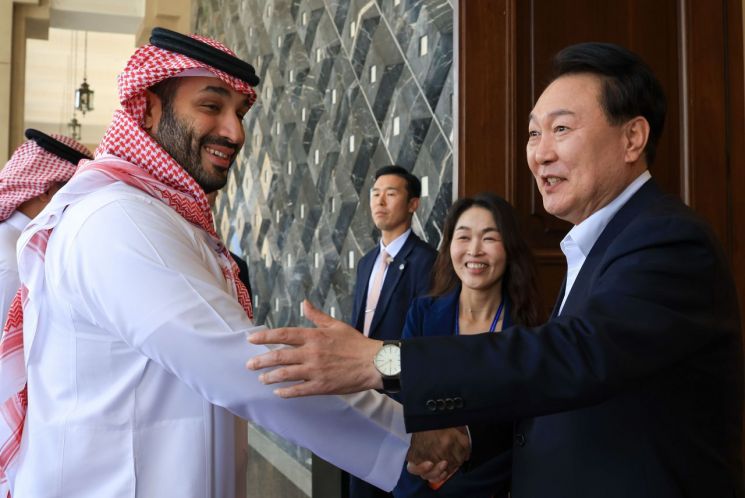 President Yoon Suk-yeol is shaking hands with Crown Prince Bin Salman of Saudi Arabia, who visited the Riyadh Guest Palace on the 24th of last month (local time). [Image source=Yonhap News]
Recently, hydrogen-related stocks have been indirectly and directly influenced by a series of positive developments. On the 14th, the government announced the approval of a partial amendment to the Enforcement Decree of the ‘Act on the Promotion of the Hydrogen Economy and Hydrogen Safety Management,’ which implements the ‘Clean Hydrogen Certification System’ as part of the hydrogen economy promotion policy, dividing it into five grades or less. This amendment includes foundational regulations for the implementation of the certification system, such as clean hydrogen certification standards and procedures, post-certification management, and designation of certification bodies. ▶Support for technology development, facility investment, distribution and supply systems, and job creation to promote the production and use of clean hydrogen ▶Production volume of clean hydrogen ▶Incentives based on usage and other support recognized as necessary by the Minister of Trade, Industry and Energy were also clearly defined as support targets.
The government currently plans to actively promote the creation of a clean hydrogen ecosystem. Park Chan-gi, Director of Hydrogen Economy Policy at the Ministry of Trade, Industry and Energy, said, “The amendment to the enforcement decree establishes a certification foundation for clean hydrogen, a key means of achieving carbon neutrality, which is expected to greatly help resolve investment uncertainties for companies. We will also ensure the smooth implementation of related systems such as the Clean Hydrogen Power Generation Bidding Market (CHPS), which will open next year.”
Earlier, on the 24th of last month, during his state visit to Saudi Arabia, President Yoon announced a joint statement with Saudi Crown Prince Mohammed bin Salman to “expand investments in future-oriented industries including the hydrogen economy.” He added, “We have agreed to strengthen cooperation in the clean hydrogen sector for export to Korea and hope that hydrogen cooperation will continue to expand.”
Compared to the Moon Jae-in administration, which directly presented the ‘Hydrogen Economy Activation Roadmap,’ the Yoon Suk-yeol administration, which emphasizes the importance of nuclear power, has given relatively less attention to the hydrogen economy. However, unlike solar power and others criticized for ‘interest cartels,’ the Yoon administration has consistently announced support plans for hydrogen energy. At the Hydrogen Economy Committee meeting chaired by Prime Minister Han Duck-soo in November last year, the government explained that it would focus support on seven strategic areas: ▶water electrolysis (technology that splits water into oxygen and hydrogen using electricity) ▶liquefied hydrogen transport ships ▶trailers ▶charging stations ▶fuel cells ▶hydrogen turbines, aiming to nurture 600 hydrogen-specialized companies by 2030.
Accordingly, interest in hydrogen-related funds and exchange-traded funds (ETFs) has also increased. According to Fund Guide on the previous day, among related ETFs, the KBSTAR Fn Hydrogen Economy Theme ETF, the largest with 224.1 billion KRW in assets, recorded a one-year return of -13.55%, but its one-month return recently improved to -3.75%. The Hanwha ARIRANG Global Hydrogen & Next-Generation Fuel Cell MV ETF, launched on February 11 last year with assets of about 4.9 billion KRW, had a one-year return of -47.72%, but its return over the past one year and one month was -12.32%. The NH-Amundi Global Hydrogen Value Chain Fund, with assets of about 2.15 billion KRW, posted a one-year return of 3.85%.
© The Asia Business Daily(www.asiae.co.kr). All rights reserved.
![Clutching a Stolen Dior Bag, Saying "I Hate Being Poor but Real"... The Grotesque Con of a "Human Knockoff" [Slate]](https://cwcontent.asiae.co.kr/asiaresize/183/2026021902243444107_1771435474.jpg)

















