Criticism of 69-Hour Workweek as 'Work to Death'
Opposition Ahead of General Election, "We Will Move Toward a 4.5-Day Workweek"
The Democratic Party of Korea has once again brought out the '4.5-day workweek' card, where workers work 4.5 days a week. This move is a counterattack targeting the ruling party, which has recently taken the lead in the political arena with initiatives such as the incorporation of Gimpo City in Gyeonggi Province into Seoul and the ban on short selling.
The 4.5-day workweek was one of the pledges made by Representative Lee Jae-myung during the last presidential election campaign. Representative Lee proposed reducing working hours, starting with the introduction of the 4.5-day workweek and eventually transitioning to a 4-day workweek society. With the upcoming general election next year, it is expected that official discussions will begin as Representative Lee has publicly mentioned the introduction of the 4.5-day workweek.
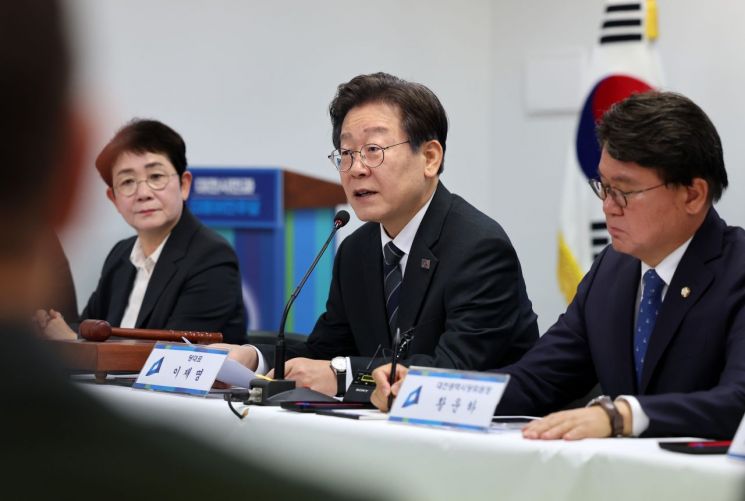
On the 15th, at an on-site Supreme Council meeting held at the Daejeon Jung-gu Daejeon City Party Office, Representative Lee said, "The Democratic Party will move toward the 4.5-day workweek. We will lead South Korea in a direction that increases labor productivity through quality rather than quantity by reducing working hours."
Since taking office as party leader, Representative Lee has emphasized the introduction of the 4.5-day workweek, which was a campaign promise during the presidential election. In March, the Democratic Party held an "Emergency Forum on the Introduction of the 4.5-day Workweek" and criticized the Yoon Seok-yeol administration's policy to extend and flexibilize working hours. At the forum, Representative Lee stated, "While the world is moving forward, it seems that South Korea is moving backward," and pointed out, "Proposing to work 60 or 69 hours a week is like saying 'let's work ourselves to death,' and it is no different from advocating a return to an overwork society that has been condemned worldwide." He added, "We must correct the grim reality that our annual working hours exceed the OECD average by a staggering 300 hours. If we regress the system from its current state, the dishonor of having the longest working hours will deepen and worsen. I hope we set the 4.5-day workweek as an achievable goal and create a future where labor and industrial environments are replaced with highly efficient work."
At that time, the government had announced a legislative plan to revise the working hours system to allow up to 69 hours per week, up from the current limit of 52 hours, but withdrew the plan after strong public backlash and began reconsideration. Recently, the government took a step back and announced a policy direction to expand the management units for extended working hours only for "certain industries and occupations." However, controversy continues as some industries and occupations can still work up to 69 hours per week.
Representative Lee's reintroduction of the 4.5-day workweek is also an extension of the government's working hours reform controversy. On the day, he questioned, "While other countries are moving toward a 4-day workweek, is it really right from a national policy or economic strategy perspective to increase working hours again?" He emphasized, "This is an era where quality, not quantity, matters. The strategy of overcoming crises and sustaining growth by increasing working hours and total labor volume is no longer viable."
With the general election five months away, Representative Lee's reintroduction of the 4.5-day workweek is expected to be followed by party-level follow-up discussions. Among the related bills currently proposed is the "Partial Amendment to the Labor Standards Act," introduced by Democratic Party lawmaker Kang Hoon-sik in July last year. The bill aims to reduce the statutory working hours from 40 to 36 hours per week and revise regulations such as the flexible working hours system accordingly to introduce the 4.5-day workweek. Another Democratic Party lawmaker, Park Sung-jun, reflecting the opinion that 'telecommuting and remote work' should be established before introducing the 4-day workweek, proposed a bill to define remote work in the current law and introduce a system of '4-day workweek at the workplace and 1-day remote work per week.'
© The Asia Business Daily(www.asiae.co.kr). All rights reserved.

















