Sejong City will introduce a flat-rate pass system that allows the use of public transportation within a 50,000 KRW limit by paying 20,000 KRW per month. This system is set to be implemented as an alternative to the previously planned free bus fare policy.
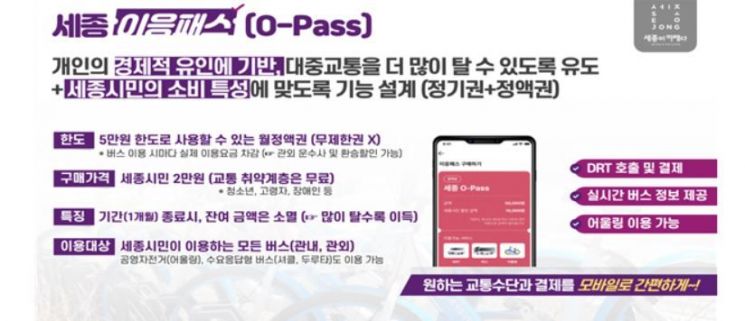
On the 15th, Sejong City announced that it will introduce and implement the ‘Sejong Ieung Pass’ starting from September next year. The Ieung Pass is a new concept monthly flat-rate pass that combines the features of a season ticket and a flat-rate pass into one card.
General citizens can purchase and use the Ieung Pass for 20,000 KRW, while vulnerable groups such as youth, the elderly, and people with disabilities can obtain it for free.
The monthly usage limit is 50,000 KRW, and any unused amount within the limit will expire, creating a structure where the more public transportation is used, the more beneficial it is for the user.
In particular, the Ieung Pass can also be used for city buses within the jurisdiction as well as intercity buses traveling to places like Daejeon, Cheongju, and Gongju.
Additionally, Sejong City explained that demand-responsive buses (Shuttle, Duruta) and Eoulling (public bicycles) will also be accessible with the Ieung Pass.
Earlier, in April, Sejong City announced the basic direction for free bus fares. The structure was to fully refund bus fares paid by citizens through Yeominjeon, with a pilot project starting in September next year and full implementation planned from 2025.
However, after gathering opinions from the Sejong City Council, experts, and citizens following the announcement, there were significant concerns and worries about the enormous budget required. There were also many opinions emphasizing the need for a cautious approach, as once free bus fares are implemented, it would be difficult to reverse the decision.
This led Sejong City to design and introduce the Ieung Pass as a substitute for free bus fares.
Along with the introduction and implementation of the Ieung Pass, a comprehensive overhaul of local public transportation policies has been announced. Rather than simply promoting public transportation through free fares, the plan aims to increase citizens’ voluntary use of public transportation.
In Sejong’s current public transportation status, the bus usage rate is 7.9%, the lowest nationwide, while private car usage is close to 50%, one of the highest levels in the country.
The main reasons for low public transportation use are the lack of a public transportation infrastructure and inefficiencies in bus route operations due to sequential urban development by residential areas. Because many citizens use private cars instead of public transportation, roads experience traffic jams akin to parking lots during rush hours, a problem that is neither new nor recent.
Therefore, Sejong City plans to completely reform its transportation policy after 12 years since its establishment to maximize the effect of the Ieung Pass and promote a transition to a public transportation-centered system.
To this end, Sejong City intends to increase the number of bus routes from the current 58 to 70 and reduce bus intervals during rush hours to within 10 minutes. It also plans to establish an integrated transfer discount system for the Happy City area, including Daejeon, Cheongju, and Gongju, to alleviate traffic congestion in metropolitan commuting sections during peak hours.
Furthermore, the city is considering improving the service quality and expanding the coverage area of demand-responsive buses, and to enhance convenience for Eoulling users, it plans to secure 6,000 bicycles and expand rental stations to 800 locations by 2030.
Sejong Mayor Choi Min-ho said, “I apologize to the citizens for not being able to implement the originally pledged ‘free bus fares,’” but added, “However, I want to emphasize the significance of being able to offer a better alternative with a smaller budget (annual free fare budget of 25.3 billion KRW versus Ieung Pass budget of 6 billion KRW) through the introduction of the Ieung Pass.”
He also added, “I ask citizens to support the successful establishment of the Ieung Pass in the region.”
© The Asia Business Daily(www.asiae.co.kr). All rights reserved.
![Clutching a Stolen Dior Bag, Saying "I Hate Being Poor but Real"... The Grotesque Con of a "Human Knockoff" [Slate]](https://cwcontent.asiae.co.kr/asiaresize/183/2026021902243444107_1771435474.jpg)















