Yoon "Requesting National Assembly Discussion for Passage Within This Year"
In September Bill Subcommittee, Both Ruling and Opposition Parties Expressed 'Opposition' Opinions
With President Yoon Suk-yeol and the leadership of both ruling and opposition parties reaching a consensus on the special law for the redevelopment of aging new towns, legislative discussions have gained momentum. Both sides appear focused on passing the special law within this year. However, in the National Assembly's standing committee subcommittee where the bill is currently pending, disagreements have erupted across party lines, making it uncertain whether the special law will clear the parliamentary hurdle.
According to the National Assembly on the 15th, the Land, Infrastructure and Transport Committee plans to hold a subcommittee meeting on the 22nd to discuss the 'Special Act on Support for Redevelopment of Aging Planned Cities.' The special law targets areas where land development was completed over 20 years ago and the area is 1 million square meters or more. Most of these correspond to new towns in the Gyeonggi region. The core of the law is to raise the current floor area ratio, which is in the 200% range, up to a maximum of 500%, and to relax or exempt safety inspections.
Since it was a campaign pledge of President Yoon Suk-yeol, the ruling party had been vocal about passing the special law, but recently the opposition party has also shown agreement, signaling a green light. On the 13th, Hong Ik-pyo, the floor leader of the Democratic Party, said at the Housing Environment Improvement Special Committee meeting, "It is time to redevelop to improve the convenience and safety of life in the first-generation new towns and to enhance the residential environment," adding, "The Democratic Party will take the lead to pass the special law on aging planned cities within this year." President Yoon said at the Cabinet meeting held at the Yongsan Government Complex the previous day, "Since the opposition party agreed to enact the special law yesterday (the 13th), I ask the National Assembly to actively discuss so that this bill, which is directly related to the lives of the people, can be passed within this year."
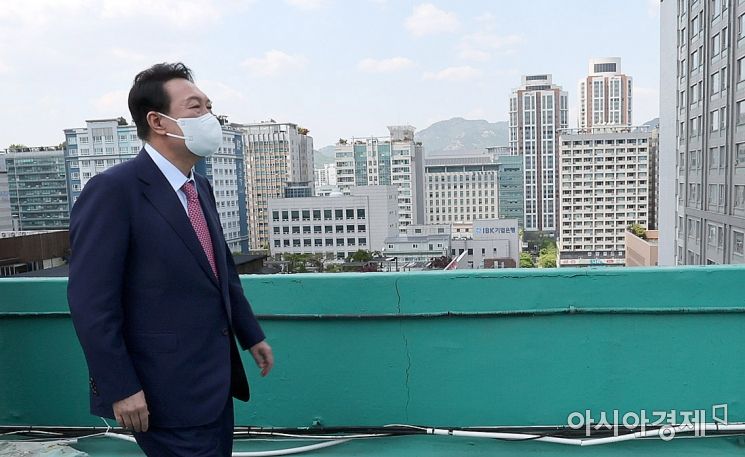 President-elect Yoon Suk-yeol is attending the first-generation new town aged apartment issues inspection held at Chowoen 7 Complex Booyoung Apartments in Dongan-gu, Anyang-si, Gyeonggi Province on the afternoon of the 2nd. Photo by Transition Committee Press Corps
However, a variable is that disagreements have surfaced across party lines in the Land, Infrastructure and Transport Committee subcommittee where the bill is being discussed. There are currently 13 related bills submitted to the National Assembly, and although three subcommittee meetings have been held so far, the differences have not been easily narrowed. At the most recent subcommittee meeting on September 13, most lawmakers from both parties expressed opposition to the bill. Yoo Kyung-jun, a member of the People Power Party, raised the issue of limiting the special law's target areas to 1 million square meters. He said at the subcommittee meeting, "Currently, the special law targets 51 areas, and looking at them by province, Gyeonggi-do has the most with 13. Ultimately, this can be said to be the old downtown and the first-generation new town law. I don't understand why it is limited like this." In a phone interview with this paper, Yoo explained, "I have opposed the bill so far, but I asked the Ministry of Land, Infrastructure and Transport to supplement unclear parts. If I think that has merit, I believe the law could pass."
Maeng Sung-kyu, a member of the Democratic Party, pointed out, "If this law passes, residents in the target areas will be greatly inflated regardless of the procedures that follow," adding, "It makes people think as if a new city will be created immediately under this law. In my view, to put it strongly, it is highly likely to be excessive promotion and excessive hope torture." Jang Cheol-min, also from the same party, suggested, "Since it is already difficult, it might be better to hold a public hearing to hear various opinions."
The lawmaker who actively supported the bill was Kim Byung-wook of the Democratic Party (Seongnam Bundang-eul, Gyeonggi-do). Kim argued, "It is somewhat problematic that the new town aging planned city law is misunderstood and distorted as a law with special privileges," adding, "There is no regional special zone law without floor area ratio benefits."
Kim Hee-guk of the People Power Party, who has opposed the special law’s floor area ratio increase and safety inspection exemption as 'special privileges' and legally inappropriate, maintains his opposition stance to the end. In a phone interview with this paper, Kim said, "Many apartments have failed safety inspections and could not proceed with redevelopment. So what is the logic of now granting this to first-generation new towns?" He added, "The ruling and opposition parties may agree and want to vote in the subcommittee, but I have no choice but to oppose it alone."
By convention, the subcommittee does not vote before deciding on an agenda item but confirms whether there are any dissenting opinions among its members and then approves it by 'unanimous consent.' However, in situations with sharp confrontations between the ruling and opposition parties, the agenda may be put to a vote and approved by a majority.
© The Asia Business Daily(www.asiae.co.kr). All rights reserved.

















