Rising Procurement Costs and Worsening Profitability
Denmark's Orsted Shares Plunge 50% This Year
The stock prices of global wind power companies have plummeted due to the headwinds of high interest rates and high inflation. Although the United States and Europe are accelerating their carbon neutrality efforts, the difficulty in raising investment funds amid high interest rates and deteriorating profitability had a significant impact. Meanwhile, hedge funds that anticipated the decline in wind power stocks made substantial profits through short selling.
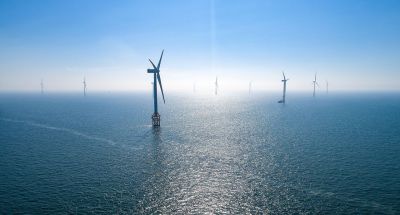
According to major foreign media on the 14th (local time), the S&P Global Clean Energy Index, composed of 100 renewable energy stocks, has fallen more than 30% since the beginning of this year. After peaking in 2021, the index dropped 6% last year and has widened its decline this year.
High interest rates and inflation increased costs for offshore wind companies, dragging down stock prices. The U.S. raised its benchmark interest rate from 0-0.25% last year to 5.25-5.5% in a year and a half, causing financing costs for wind power companies, which require significant initial investment, to soar. Renewable energy power producers typically enter into long-term contracts for electricity sales, but existing contracts have not reflected the recent surge in raw material and labor costs due to inflation, severely hurting profitability.
James Smith, manager at UK investment firm PMGR Trust, analyzed, "There is a very high correlation between interest rates and index returns," adding, "Problems with individual companies are also putting pressure on this (wind power) sector." He further explained, "It is perceived that interest rates account for 75% of the (stock price decline), with bad news making up the rest."
In fact, Ørsted, the world's largest offshore wind developer based in Denmark, recently announced it would abandon two projects off the coast of New Jersey, USA, due to rising financing and raw material costs. S&P, one of the three major global credit rating agencies, downgraded the company’s long-term credit rating to 'negative.' As a result, the company's stock price has plunged 50.7% so far this year.
Siemens Energy, engaged in wind power business, saw its stock price fall 56% since June after it was revealed that its subsidiary’s wind turbine technology had defects. On the 26th of last month, when reports surfaced that the German government was discussing financial support, its market capitalization dropped 35% in a single day.
Hedge funds made significant profits by short selling offshore wind stocks. Europe's largest hedge fund, Marshall Wace, and trading firm Cube Research & Technology, among others, shorted the sharply declining stocks of Ørsted and Siemens Energy, earning substantial capital gains. These hedge funds also shorted Vestas Wind Systems, a Danish wind turbine manufacturer whose stock price has fallen 17% this year, generating profits.
The market believes the decline in wind power companies’ stock prices is not over. Currently, the short interest ratio of Siemens Energy shares is about 14%, a significant increase from 8% at the beginning of the year.
© The Asia Business Daily(www.asiae.co.kr). All rights reserved.
![Clutching a Stolen Dior Bag, Saying "I Hate Being Poor but Real"... The Grotesque Con of a "Human Knockoff" [Slate]](https://cwcontent.asiae.co.kr/asiaresize/183/2026021902243444107_1771435474.jpg)















