The Only 'Killer Regulation' in the Medical Field
Criticism of 'Overlapping Regulations' Requiring Multiple Approvals After Initial Authorization
Pointing Out Causes of Hindrance to DTx and AI Industries
Concerns Raised About Committee Opacity
Counterarguments on 'Still Unverified Technologies'
Digital therapeutic devices (DTx), artificial intelligence (AI) medical devices, and other digital healthcare industries are facing changes in the new medical technology assessment, which is considered a representative 'killer regulation' hindering industry development. At the annual academic conference hosted by the Korea Health Industry Development Institute (NECA), the main agency, the industry's stance of "killer regulation that stifles the industry" sharply clashed with the opposing position of "verification comes first."
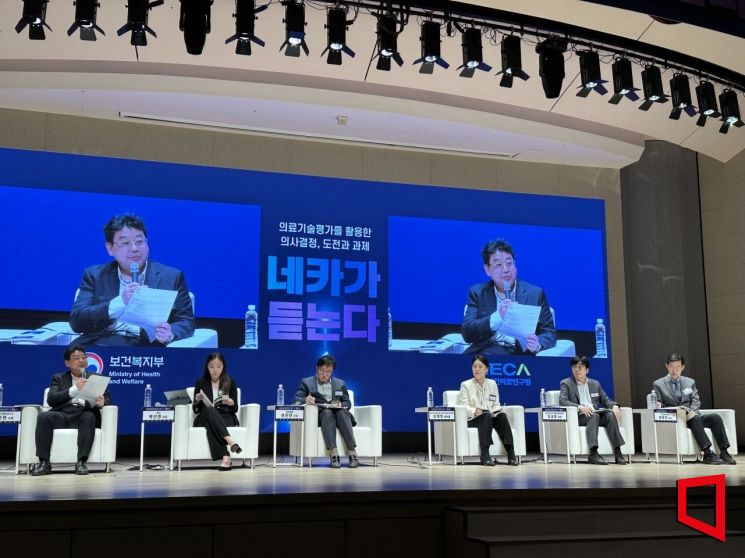 On the 14th, at the Construction Hall in Gangnam-gu, Seoul, during the 2023 NECA Annual Academic Conference 'NECA Listens,' Kim Junhyun, Director of the Health Policy Participation Research Institute, Park Seonyoung, Director of Lunit, Lee Jinhan, Dong-A Ilbo reporter, Shin Chaemin, Head of NECA New Medical Technology Evaluation Division, Oh Sangyoon, Director of Medical Resource Policy at the Ministry of Health and Welfare, and Moon Changjin, Professor at CHA University (from left), are conducting a discussion.
 [Photo by Lee Chunhee]
New medical technology assessment was even named one of the government's 'Top 15 Killer Regulations' announced last July, uniquely in the medical field. The industry consensus is that it is a 'redundant regulation' that re-examines products already approved by the Ministry of Food and Drug Safety for safety and efficacy. In response, the government is hastening preparations to create an 'early entry medical technology system' that allows faster market access for low-risk digital therapeutic devices (DTx) and AI medical devices.
Accordingly, at the 2023 NECA Annual Academic Conference 'NECA Listens' held on the 14th at the Construction Hall in Gangnam-gu, Seoul, a heated debate ensued over the necessity of the early entry system, following the 'Public Hearing on the Improvement of the Early Entry-Late Evaluation System for New Medical Technologies' held in August.
Medical Community Criticizes 'Unverified Technologies'... "Real-World Verification Needed"
Most physician speakers took a conservative view of the new medical technology assessment. Professor Junheum Yeon from Inje University College of Medicine emphasized, "Safety must be considered in addition to efficacy," and raised concerns, saying, "Even if the test is not harmful, what about errors in test results?" He strongly criticized innovative medical technologies, stating they should still be called "unverified innovative medical technologies." He suggested, "Since the potential harm is unknown, there should be barriers, and NECA should maintain the essence of medical technology evaluation while providing guidelines from the early stages of development."
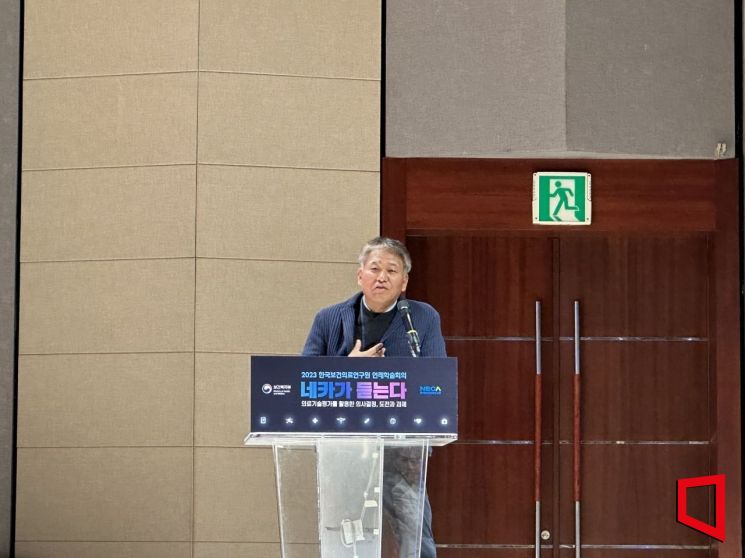 On the 14th, Professor Yeon Jun-heum of Inje University College of Medicine is presenting at the 2023 NECA Annual Academic Conference 'NECA Listens' held at the Construction Hall in Gangnam-gu, Seoul.
 [Photo by Lee Chun-hee]
Professor Youngseok Lim from Ulsan University College of Medicine (Chairman of NECA Evidence Generation Committee) also supported this view, stating, "Innovative medical technologies are technologies whose efficacy has not been fully proven," and added, "If technologies used for a certain period fail to pass the new medical technology assessment, it inevitably means that the public has used technologies lacking sufficient evidence." He pointed out that as the system's hurdles are gradually lowered?from limited medical technologies to innovative medical technologies to deferred evaluation new medical technologies?applications tend to concentrate on the lower hurdle categories.
To overcome this, Professor Lim emphasized the importance of 'Real-World Evidence (RWE)' and 'Real-World Data (RWD).' He stressed that, besides placebo effects, clinical settings also show the 'Hawthorne effect,' where symptoms improve due to good management, making randomized controlled trials (RCTs) essential. He advised, "Companies should conduct self-monitoring while considering ways to ensure reliability and strengthen accountability," and added, "A system should be in place to immediately conduct monitoring if safety issues arise."
Industry Calls It a 'Matter of Survival'... Points Out Lack of Transparency in Evaluation
On the other hand, the industry raised their voices, calling the current evaluation system a severe regulation that could kill the industry. CEO Jinhwan Im of AimMed appealed, "It's a matter of survival," explaining, "During the period when companies undergo new medical technology assessment after approval, they face financial recovery pressure and find it difficult to endure." In fact, AimMed's 'Soms,' the first domestically produced DTx approved by the Ministry of Food and Drug Safety in February after RCT clinical trials, has yet to receive its first prescription even nine months after approval.
CEO Im emphasized, "Since the medical system guarantees patient safety and life, repeated reviews are necessary," but added, "Re-examining the safety of non-invasive digital medical products is not appropriate for the times." He advocated for establishing a separate 'D-tech Track' (tentative name) system for digital medical products and insisted that industry representatives should be included in the evaluation process to have their voices heard.
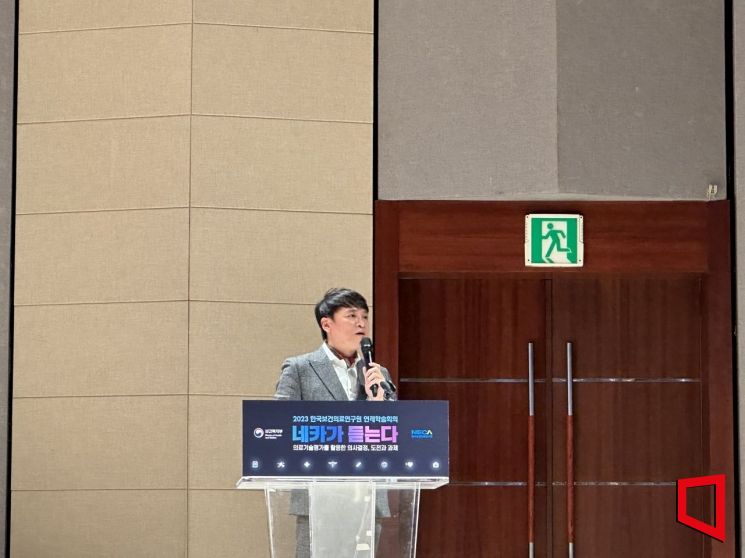 On the 14th, Lim Jin-hwan, CEO of AimMed, is presenting at the 2023 NECA Annual Academic Conference "NECA Listens" held at the Construction Hall in Gangnam-gu, Seoul.
 [Photo by Lee Chun-hee]
Jaejun Im, Head of Legal Policy at VUNO, also evaluated that, given the characteristics of the domestic medical system with separate lists for reimbursed and non-reimbursed items, "the new medical technology assessment system is effectively operating as an approval system." He pointed out that, as a de facto national administrative action, the names of committee members involved in the new medical technology assessment and detailed meeting minutes should be transparently disclosed. The industry strongly criticizes the current system as unreasonable because companies that fail the assessment are not necessarily informed of the reasons for rejection. Mr. Im said, "Already, the Health Insurance Review & Assessment Service and overseas medical technology evaluation agencies disclose committee member lists," adding, "If meeting minutes are disclosed, it would be possible to understand concerns and suggestions, enabling developers to create better products."
Civil Groups Demand Refunds if Ineffective... Government Promises to Prepare Improvements
The government and civic groups partially accepted and partially reserved judgment on these criticisms. Junhyun Kim, Director of the Health Policy Participation Research Institute, said, "Patients bear the full cost of non-reimbursed items, so who bears the risk if efficacy results are not achieved?" He called for institutional measures such as refunds when evidence is insufficient. Regarding committee composition and disclosure scope, he agreed, "I agree with disclosing committee member lists and meeting results," but opposed, "Including industry representatives in the decision-making system is inappropriate since they are subjects of evaluation."
Chaemin Shin, Head of the New Medical Technology Assessment Division at NECA, emphasized, "We will create preventive measures so patients do not spend money unnecessarily on innovative or early entry medical technologies," and said, "There are concerns that the system has been improved too much in favor of the industry, so mechanisms such as patient consent are being developed." He added, "In the past, companies that failed would visit committee members to protest, but as the culture matures, disclosure of member lists and meeting minutes will be possible someday."
Sangyun Oh, Director of Medical Resource Policy at the Ministry of Health and Welfare, explained the improvement of the early entry-late evaluation system, saying, "The core is to allow technologies with guaranteed safety to enter the market a little earlier, accumulate evidence, verify efficacy, and then undergo proper evaluation and insurance listing so patients can use them." He emphasized, "Ultimately, this does not mean lowering the evaluation hurdle or changing the listing system itself." Regarding various suggestions from the industry, he said, "We will improve the system to ensure sufficient information is disclosed," and added, "We will strictly manage and improve measures for patient safety, refunds, and related issues."
© The Asia Business Daily(www.asiae.co.kr). All rights reserved.
![Clutching a Stolen Dior Bag, Saying "I Hate Being Poor but Real"... The Grotesque Con of a "Human Knockoff" [Slate]](https://cwcontent.asiae.co.kr/asiaresize/183/2026021902243444107_1771435474.jpg)


















